


Compare Lunio vs TrafficGuard against 10 key criteria to discover which click fraud protection solution is right for you. See why Lunio comes out on top for lead gen and high spend advertisers, while TrafficGuard works better for mobile user acquisition and affiliate campaigns.
Introduction
Lunio, CHEQ and TrafficGuard often make the shortlist when you’re looking for click fraud protection. But when it’s time to whittle it down to one, our Lunio vs TrafficGuard (and Lunio vs CHEQ) comparison guides will help you decide which solution is the right fit for you.
The TL;DR is that Lunio is best suited for performance marketing teams running lead gen and ecommerce campaigns across multiple ad platforms, not just Google and Meta. TrafficGuard, meanwhile, works well for mobile user acquisition, affiliate, and sports betting campaigns, as well as offering a low-cost option for Google Search-only advertisers.
But there’s a bit more to it than that. Here, we compare Lunio vs TrafficGuard against checkable criteria, giving our verdict on each. You’ll also learn more about what exactly Lunio (formerly PPC Protect) covers and the data you’ll get from your free Lunio traffic audit.
Lunio vs TrafficGuard at a glance
Compare Lunio vs TrafficGuard on many key criteria in this head-to-head comparison table, factchecked as of October 2026.
|
Criteria |
Lunio |
TrafficGuard |
|
Positioning |
In-house performance marketers spending $1M+ annually on lead gen or high CPC campaigns. |
Cross-channel click fraud protection for enterprises. Also offers a spend-limited SME product for Google Search advertisers. |
|
Detection methodology |
Real-time machine learning behavioral analysis plus rules-based filters. Trained on conversion data. Suspicious traffic is automatically rechecked to limit false positives |
Detection using behavioural, device, and IP signals |
|
Platform scope |
Automated protection for 10 platforms: Google Ads, Microsoft Ads, Meta, TikTok, LinkedIn, X, Pinterest, Reddit, Outbrain and AdRoll. Detection-only monitoring for 6 more networks, including OpenAI, Taboola and Criteo. |
Automated protection for 6 channels: Google Search, Performance Max, Meta, affiliate, mobile user acquisition, and programmatic. |
|
Data and reporting |
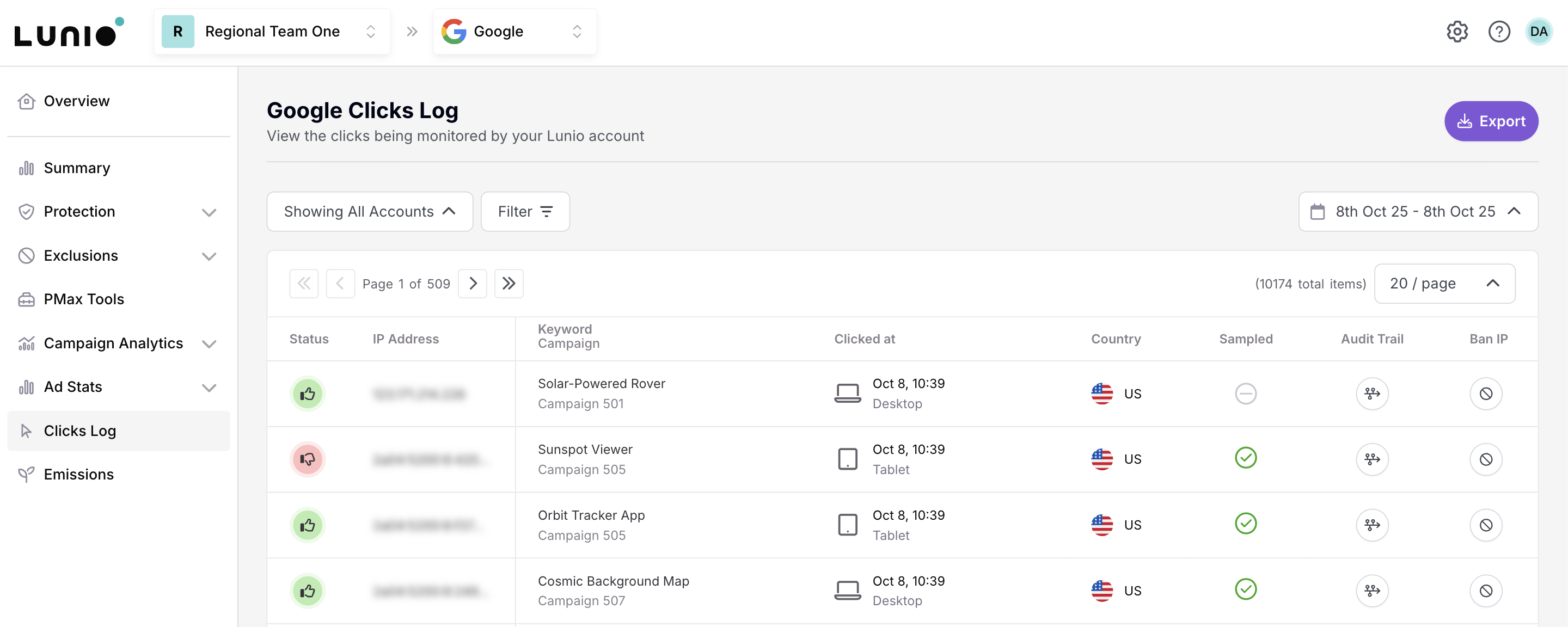
Exportable click log in the dashboard, with data for each click including campaign, click ID, IP, ISP, device, user agent, country, keyword, match type, ad network, placement, landing page URL, timestamp and validity status |
Dashboards, raw data exports, and granular insights |
|
False positive methodology |
Less than 1%, with suspicious traffic flagged and rechecked |
0.04% as measured by TrafficPath, TrafficGuard’s recheck route. Overall false positive rate isn’t published |
|
Support |
Dedicated paid media specialist customer support manager |
Online support |
|
Compliance |
ISO 27001, SOC 2, GDPR |
ISO 27001, GDPR |
|
Pricing |
Demo required to access pricing information. Free 14 day trial available |
Pricing for Google Search only protection starts at $49 per month. Demo required to access enterprise pricing. Free 30 day trial available |
|
G2 score (/5)* |
4.6 |
4.4 |
|
Capterra score (/5)* |
4.4 |
4.7 |
*Scores correct as of 22 October 2026.
Lunio vs TrafficGuard, compared by criteria
Compare Lunio vs TrafficGuard against the 10 most valuable criteria for PPC advertisers.
1. Channel coverage
Verdict: Lunio wins
Both Lunio and TrafficGuard cover Google and Meta. But for advertisers using other platforms, the difference in channel coverage is pretty important. If you advertise on Microsoft, LinkedIn, X, Reddit, Pinterest, TikTok, AdRoll, or Outbrain, Lunio protects these channels against invalid traffic, whereas TrafficGuard doesn’t.
Lunio also provides detection-only coverage for six additional channels: Taboola, Yahoo Japan, Naver, Baidu, Criteo, and OpenAI.
2. Lead quality
Verdict: Lunio wins
Lead quality is where the real value lies for B2B brands, and Lunio is a proven tool for improving lead quality. Canto increased their qualified pipeline value by $350,000 within just two months of using Lunio, while Funding Circle increased their MQL conversion rate by 10% within a year.
There’s no information on TrafficGuard’s impact on lead quality, so Lunio wins this round through transparency and proven effectiveness for tackling fake leads.
3. Detection and false positives
Verdict: No overall winner
Lunio’s published false positive rate is less than 1%. It also uses a unique recheck step to accurately identify “suspicious” traffic that isn’t automatically rejected. Rechecking suspicious traffic lets real users through, while fraudulent traffic is blocked.
TrafficGuard publishes a fairly extensive false positive detection methodology, but it doesn’t publish its actual false positive rate. It reveals that TrafficPath — TrafficGuard’s own recheck tool — measures its false positive rate as 0.04%, but it’s unclear where this sits in comparison to its overall false positive rate.
4. Performance Max protection
Verdict: No overall winner
Because Google doesn’t allow for campaign level IP exclusions in PMax, Lunio excludes invalid traffic from PMax campaigns at the account level. Lunio also adds placement exclusions to remove low-value placements from PMax (currently in open beta).
TrafficGuard also offers PMax protection via custom exclusion lists, suggesting it uses a similar approach to Lunio.
5. Enterprise fit
Verdict: Lunio wins
Both Lunio and TrafficGuard target enterprise advertisers. Lunio is built for in-house performance teams, especially those in B2B lead gen and high CPC sectors. TrafficGuard offers a pricing plan for SMEs spending up to $30K a month on Google channels, but if more coverage or a higher spend is needed, enterprise options are also available.
TrafficGuard’s enterprise options are a particularly good fit for gaming and gambling companies. Their mobile user acquisition coverage is an asset in these industries.
However, Lunio wins this category thanks to its added value. Lunio’s partnership with Integral Ad Science (IAS) offers increased protection for enterprises who need protection across a broader media buying cycle. Lunio’s SOC 2 certification is also beneficial for compliance-conscious enterprises.
6. Pricing and trial
Verdict: TrafficGuard wins on trial length
TrafficGuard also offers a plan for Google Search-only advertisers which starts at $49 per month. But for enterprise users, neither Lunio nor TrafficGuard give much away when it comes to pricing. You’ll need to book a demo to find out how much each solution costs.
Lunio offers a flexible pricing model that’s based on a small portion of your ad spend, so it can accommodate different paid media strategies. There are no volume caps, so there’s no limit to how much you can spend — and Lunio’s pricing stays viable even when your spend increases.
Both Lunio and TrafficGuard offer free trials. TrafficGuard has the edge because its free trial lasts for 30 days, compared with 14 days for Lunio.
7. Support
Verdict: Lunio wins
TrafficGuard’s support options are limited to a self-serve knowledge base and online messaging. Lunio, meanwhile, pairs every customer with a paid media specialist account manager, who can support you to improve your performance marketing efficiency.
8. Paid media coverage
Verdict: TrafficGuard wins
While Lunio covers more PPC-specific networks, TrafficGuard offers broader coverage within the full paid media landscape. Lunio protects PPC channels comprehensively, but TrafficGuard provides coverage across mobile user acquisition and programmatic channels. Lunio’s mobile app protection is in development.
Both solutions offer affiliate fraud protection, but TrafficGuard offers slightly deeper protection. So it’s arguably the better option if you only need protection for affiliate channels.
9. Data and transparency
Verdict: No overall winner
Both Lunio and TrafficGuard offer transparent traffic insights. As well as its platform overview dashboards, Lunio provides an exportable click log that notes the IP, ISP, user agent, keyword, placement, and validity status for every click:
TrafficGuard also offers dashboards and raw data exports, so you can audit your traffic with granular insights.
10. Privacy and compliance
Verdict: Lunio wins
Both Lunio and TrafficGuard are certified for ISO 27001, and both comply with GDPR. However, Lunio edges this round as it’s also compliant with SOC 2 guidelines, unlike TrafficGuard.
How Lunio protects each platform
The table below shows exactly what coverage you can expect for every major ad platform (and some lesser used channels) when you use Lunio to protect your campaigns from invalid traffic:
|
Platform |
Coverage level |
Availability |
Limits |
|
Google Ads |
Automated protection |
All customers |
|
|
Meta |
Automated protection |
All customers |
Advantage+ and Meta Discovery not supported |
|
Microsoft Ads |
Automated protection |
All customers |
Shopping not supported |
|
TikTok |
Automated protection |
All customers |
|
|
|
Automated protection |
All customers |
Some campaign types not supported |
|
X |
Automated protection |
All customers |
Some campaign types not supported |
|
|
Automated protection |
All customers |
|
|
|
Automated protection |
All customers |
|
|
Outbrain |
Automated protection |
All customers |
|
|
AdRoll |
Automated protection |
All customers |
|
|
Taboola |
Audience exclusions & monitoring |
Closed beta |
No automated protection |
|
Yahoo Japan |
Audience exclusions & monitoring |
Closed beta |
No automated protection |
|
OpenAI |
Monitoring only |
Closed beta |
No automated protection |
|
Naver |
Monitoring only |
Closed beta |
No automated protection |
|
Baidu |
Monitoring only |
Closed beta |
No automated protection |
|
Criteo |
Monitoring only |
Closed beta |
No automated protection |
Here’s the difference between monitoring and automated protection: monitoring shows you exactly where and how invalid traffic is affecting your campaigns, but it doesn’t block suspicious or fraudulent users. Automated protection gives you all the monitoring benefits, as well as excluding invalid traffic from your campaigns before the click.
During your free Lunio traffic audit, we’ll provide monitoring coverage for all your connected platforms, so you can see how IVT is affecting your campaigns. Use this data to implement manual IVT exclusions, or switch to a paid plan to activate automated protection across all eligible platforms.
When to choose TrafficGuard & when to choose Lunio
Comparing Lunio vs TrafficGuard shows that there are actually some fairly clear-cut differences between the two solutions, making each software a better fit for specific advertisers. Here’s how it boils down:
- Choose Lunio if you run lead gen campaigns, or require PPC coverage beyond Google and Meta. Lunio is also best if you want support from dedicated account managers who specialize in paid media.
- Choose TrafficGuard if you run mobile app install or affiliate campaigns, especially in the gaming/gambling sector. TrafficGuard is also best if you want a low-cost plan that only covers Google Search.
Both Lunio and TrafficGuard also provide click fraud protection for agencies. Lunio partners with agencies like Mabo, Modo25, and Clickoo to protect client campaigns from IVT, with features like portfolio management, white-label reporting, and onboarding support for agency clients. Using Lunio, Mabo saves $43,500 on average every month.
The case for Lunio
As agentic AI bots take over the internet, invalid traffic rates are through the roof. In our AI Max Retail Report, we found that AI Max campaigns carried 72% more invalid traffic than standard Search campaigns, indicating increased IVT exposure in automated campaign types. Meanwhile, over on LinkedIn, 19.88% of traffic is invalid, according to our Global IVT Report 2026. So B2B advertisers are at huge risk of clicks from bots and other invalid users too.
Lunio identifies and blocks invalid traffic before the click, so your spend is focused on real users with a genuine chance of conversion. And this doesn’t just lower your IVT rate — it keeps your conversion data clean and has a real impact on the metrics that matter. Canto reported a $350,000 increase in pipeline value within just two months of using Lunio, giving them near-instant ROI.
Rated 4.6/5 on Capterra and 4.4/5 on G2 in October 2026, Lunio ranks as one of the best click fraud protection tools on the market. Get a free 14-day Lunio traffic audit to see the impact of IVT on your PPC performance and ad spend today.
FAQ
1. Is Lunio better than TrafficGuard?
Lunio isn’t inherently better than TrafficGuard; both solutions work well for their intended purpose. Lunio is better suited to high-spend advertisers focusing on lead gen and ecommerce on platforms beyond Google and Meta. TrafficGuard is more suitable for advertisers focused on mobile user acquisition, affiliate marketing, and programmatic campaigns, especially in the gaming/gambling sectors.
2. How do Lunio, CHEQ and TrafficGuard compare?
Lunio, CHEQ and TrafficGuard are all click fraud protection platforms, but each has unique functions and features that make them particularly suited to specific advertisers:
- Lunio is best for high-spend advertisers using channels beyond Google and Meta, especially if they’re advertising in lead gen and high CPC ecommerce spaces.
- CHEQ is best for advertisers who want an all-in-one cybersecurity solution that goes beyond click fraud protection.
- TrafficGuard is best for mobile app install and affiliate campaigns, as well as gaming/gambling advertisers running campaigns on Google and Meta. It’s also the best option for low-spend Google advertisers, thanks to its low-cost SME plan.
3. Which platforms does Lunio protect, and where is it detection only?
Lunio offers invalid traffic protection for 10 major ad platforms: Google Ads, Microsoft Ads, Meta, TikTok, LinkedIn, X, Pinterest, Reddit, Outbrain and AdRoll. Detection-only monitoring is available for 6 other networks: Taboola, Yahoo Japan, OpenAI, Naver, Baidu and Criteo.
With Lunio, you’ll get an all-in-one click fraud protection solution for paid search and paid social that scales with you, even if you venture into additional PPC channels.
4. Does Lunio protect Performance Max?
Yes, Lunio offers a Performance Max solution to protect automated campaigns from invalid traffic and click fraud. Lunio detects and blocks even sophisticated invalid traffic from your PMax campaigns before the click, steering its algorithms towards high quality audiences that offer genuine conversion opportunities.
5. Does Lunio protect LinkedIn and TikTok ads?
Yes, Lunio protects LinkedIn and TikTok ads against click fraud. According to our Global Invalid Traffic Report, LinkedIn and TikTok are the two platforms with the highest average rates of IVT, at 19.88% and 24.20% respectively. So if you’re advertising on these platforms, a third-party click fraud protection tool is essential.
6. Does Lunio provide click-level data exports?
Yes, Lunio provides customers with an exportable click log containing key click-level data. This includes the IP address, ISP, user agent, country, keyword, match type, ad network, placement, landing page URL, and validity status for every click.
7. Does Lunio cover mobile app install campaigns?
Lunio doesn’t protect mobile app install campaigns yet, though app protection is in development as of October 2026. Other IVT solutions are stronger if you’re looking for protection for mobile user acquisition campaigns.
8. Can agencies manage multiple client accounts in Lunio?
Yes, agencies can manage several client accounts from a single Lunio account with portfolio management access. This makes it easy for you to monitor and protect multiple client campaigns from invalid traffic using a single all-in-one PPC protection software.

Table of Contents
On average, 8.51% of your ad budget is wasted.
But that number can be much higher. Find out how much you're spending on bot traffic.