



What Is Click Fraud Detection? How It Works, Methods & Tools in 2026
60 seconds, no signup. Built on Lunio's analysis of 2.7B+ ad clicks. Find out your industry's invalid traffic rate, your wasted spend, and the revenue you could recover.
from your business every year. That's $0 every month walking out the door — and another $0 every day you don't act.
Run a free 14-day audit on your live account and see your real numbers — broken down by campaign, keyword, geo and domain.
Calculations based on Lunio's Global Invalid Traffic Report 2026. Eight industries shown use Lunio-measured rates; additional industries use Lunio-methodology estimates calibrated against comparable verticals. Lost revenue applies Lunio's conservative 3:1 ROAS baseline — every $1 of wasted ad spend equals roughly $3 in missed revenue. Actual results vary by account.

This calculator shows what the benchmarks suggest you're losing. A free 14-day Lunio traffic audit reveals what you're actually losing, with click-level visibility into every invalid source draining your budget.
(No credit card required!)
The calculator applies the average invalid traffic rate for your selected platform to your ad spend, then uses your cost per click (CPC) to estimate how many of those clicks are likely invalid.
The formulas:
Estimated wasted spend = Ad spend × Platform IVT rate
Estimated invalid clicks = (Ad spend ÷ CPC) × Platform IVT rate
Monthly figures are multiplied by 12 for an annual estimate and divided by 30 for a daily estimate.
Worked example: A business spending $50,000/month on Google (7.57% IVT) at a $2.00 CPC would see an estimated $3,785/month ($45,420/year) in wasted spend, across roughly 1,893 invalid clicks each month.
Assumptions and notes:
The ad platform click fraud rates are drawn from The Global Invalid Traffic Report 2026, based on 2.7 billion clicks recorded between August 2024 and July 2025.
They reflect the level of invalid traffic that bypasses ad platforms' native defenses when no dedicated protection is in place.
Our analysis revealed that high-value sectors with aggressive cost-per-click competition attract the most fraud.
But even low-rate industries feel the pain: retail's tight margins mean a 6% IVT rate can swallow a meaningful share of profit per transaction.
Lead gen verticals suffer the downstream effects the most, as junk form fills clutter CRMs and waste disproportionate amounts of time and money.
Invalid traffic, or IVT, is any click, conversion, or website event that doesn't come from a genuine user with real intent. It's a broader category than click fraud: it includes bot activity, automated scraping, accidental clicks, and non-human engagement, as well as outright fraud.
Invalid traffic isn't always malicious, but it's always wasteful. It drains budgets, pollutes analytics, and corrupts the data that bidding algorithms rely on to optimise your campaigns.
In short, click fraud is one type of invalid traffic — IVT is the full iceberg beneath it.
Click fraud is the deliberate, malicious clicking of ads to waste budgets or earn fraudulent revenue.
Invalid traffic is the broader category that includes click fraud and non-malicious sources like bots, price scrapers, and accidental clicks.
All click fraud is invalid traffic, but not all invalid traffic is fraud — though both waste your budget.
Click fraud rate ranges are derived from our analysis of over 2.7 billion clicks across 6 ad major platforms and 8 industries.
Take a look at the findings in full by downloading our Global Invalid Traffic Report.
The calculator gives a benchmark-based estimate, not a precise measurement. It applies real average IVT rates from 2.7 billion analyzed clicks to your inputs.
Your actual rate depends on your specific accounts, targeting, and inventory mix. To measure exactly how much you're losing, run a free 14-day traffic audit with Lunio.
On average, about 8.51% of digital ad spend is lost to invalid traffic, though the figure varies widely by platform and industry.
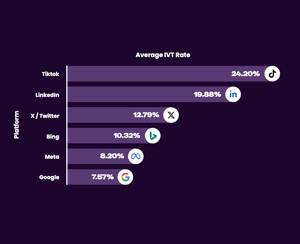
A business on Google might lose around 7.57%, while a TikTok advertiser could lose over 24%. Enter your spend above to see an estimate tailored to your platform and industry.
There's no single "normal" rate, but the all-channel average is 8.51%.
Search campaigns sit lower (around 5.21% on Google Search) because of strong purchase intent and tight controls, while display, video, and social inventory run much higher. Rates above 15–20% are common on platforms with less mature anti-fraud systems.
In our dataset, TikTok had the highest average invalid traffic rate at 24.20%, followed by LinkedIn at 19.88%.
Google had the lowest at 7.57%, reflecting years of investment in fraud detection driven by ad fraud litigation. However, even a 7% average invalid traffic rate can represent a huge drain on ad budgets.
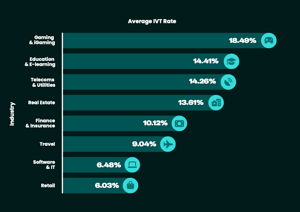
Gaming and iGaming is the most exposed industry at 18.49%, followed by education (14.41%) and telecoms and utilities (14.26%).
High-value sectors with aggressive CPC competition are the biggest targets for organised fraud. Even lower-rate industries like retail (6.03%) suffer significant financial impact due to razor-thin margins.
Sometimes, but only partially – and rarely ever easily.
Platforms like Google issue "Invalid Activity Adjustments" that refund the most obvious fraud – duplicate clicks, known bot IPs, and clear automation.
But more sophisticated "soft" invalid clicks behave convincingly enough to slip past detection and are rarely refunded, so they keep wasting budget and corrupting your optimization signals.
It's expected to. AI-powered bots can now navigate websites, solve CAPTCHAs, and mimic human browsing with increasing precision, and the rise of agentic AI (autonomous agents that browse and transact on behalf of users) will blur the line between genuine and non-human traffic even further.
Legacy rule-based click fraud tools that rely on simple blocking will struggle to keep up.
Your calculator estimate is the starting point. Now find out exactly how much ad budget is wasted.
(No credit card required!)
Leading performance marketers use Lunio