


"Should we be in AI Mode?" "Is AI Max actually working for us?" "WHY AREN'T WE RUNNING CHATGPT ADS?!?"
If you run client accounts at an agency, you've probably heard all three this year. Repeatedly.
In our new survey of 110 agency marketers, 85% said clients had already asked them about ads in AI Mode, AI Overviews or agentic shopping.
And then there's ChatGPT. When we asked attendees which channel their clients were asking about most, ChatGPT ads came out on top, way ahead of AI Max, AI Mode, Meta Advantage+ and Copilot.
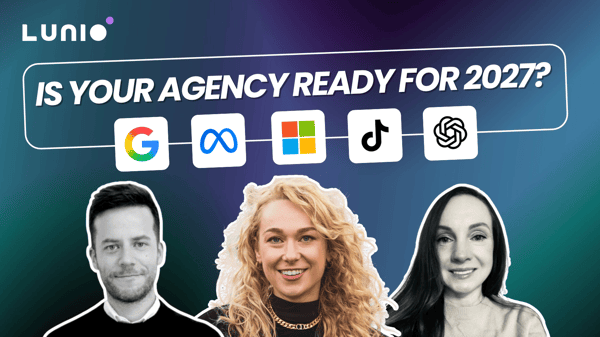
So for our final webinar of 2026, we asked three practitioners how they're handling those conversations: Fiona Darley (Founder and Director of FB Comms, a content and paid social agency managing over £250,000 in monthly ad spend), Matt Shenton (founder of paid search agency Brand Schema and host of the Paid Search NYC podcast), and Nadya Jakupova (who leads AI product innovation in search at WPP Media). James Deeney, Lunio's Head of Marketing, hosted.
Nobody on the panel pretended the measurement problems are solved. But between them, they had clear views on where agencies should spend their time (and their clients' money) in 2027.
Watch the full session on-demand here, or keep reading for the written rundown:
Timestamps:
- 0:00 - Introduction and panel intros
- 4:30 - Audience poll: what are clients asking about most?
- 8:20 - Agenda
- 10:25 - Lunio's new report: Paid Media in 2027: The Agency Playbook
- 11:30 - Google: what's changing in 2027
- 13:30 - What the AI Max migration meant for WPP's clients
- 17:45 - AI Mode and AI Overviews: opportunity or hype?
- 20:35 - Is AI Max actually working?
- 23:00 - When the platform and the CRM disagree
- 27:45 - Microsoft Ads: what's changing in 2027
- 29:50 - Why Microsoft Clarity deserves a closer look
- 31:50 - Building Microsoft natively vs importing from Google
- 36:55 - Meta: what's changing in 2027
- 42:05 - Meta: creative is the new targeting
- 44:05 - TikTok: search, creative and a case study
- 47:10 - ChatGPT ads: the panel's early read
- 55:30 - Live audience Q&A
What clients are asking about right now
James (Lunio's resident webinar host extraordinaire) admitted before the poll results came in that, if he were a betting man, he'd put his money on AI Max or ChatGPT ads being the most . He got half of it right.
Matt wasn't surprised either. Anything to do with AI search is what's coming up most for him: AI Mode, AI Overviews and ChatGPT ads. He's also had more questions about Google in the past few weeks, with clients reading the moves in Google's share price as a signal of the business's health.
"The big call out there being that they're just finding it harder to monetize these placements." - Matt Shenton
Nadya made a useful distinction. At WPP, the questions sound different depending on the platform. With ChatGPT ads, clients are curious: what is it, how does it work, how much should we invest? With Google, they're practical. They want to know what the new formats and placements mean for the activity they're already running.
The report behind the session
The whole session was built around our new report, Paid Media in 2027: The Agency Playbook. It combines a survey of 110 US agency marketers and consultants with advice from practitioners including Fiona, Matt Beswick, Navah Hopkins, Mike Ryan, Nils Rooijmans and Lunio's own David Cleave.
A few of the headline findings:
- 74% of agency marketers have at least 11% of client paid budget in AI-driven campaign types (PMax, AI Max, Advantage+, GMV Max)
- 58% have lost a client or had a retainer reduced over traffic quality or fake leads
- Only 19% are asked about ad fraud or invalid traffic in most new-business pitches
That 58% is the one James called out on the day, because it's the number that hits agencies hardest. When junk form fills reach a client's sales team, it's usually the agency that has to explain them, and that's how retainers get cut. David's section of the report covers how he talks to B2B and lead gen clients about independent traffic verification for exactly this reason.
The report is free to download, and you can get your copy here.
Google: AI Max is the default. Now what?
James set the scene with the Google Marketing Live 2026 announcements most likely to shape client accounts next year:
- AI Max becoming the default for Search, with Google auto-migrating many advertisers since September
- Ads in AI Mode and AI Overviews, eligible via AI Max, PMax or broad match, with no placement reporting yet
- Demand Gen's shift to Demand-Led Growth, replacing fixed budget caps with bidding that responds to real-time demand
- Agentic checkout through the Universal Commerce Protocol
- More predictive measurement, including Qualified Future Conversions and Meridian
For the full rundown, James recommended the Google Marketing Live 2026 recap he recorded with Jyll Saskin Gales and Duane Brown.
What the AI Max migration actually meant
For Nadya's clients at WPP, September wasn't much of a shock. The team had been preparing for a while, and by the cut-off date, clients had either fully transitioned or already run tests.
The harder part was explaining what AI Max actually is.
"The tricky part with AI Max is it's not just a single solution that is a switch on or switch off button. It consists of several elements, and it's very important to understand what they are." - Nadya Jakupova
Beyond keyword expansion, that meant talking clients through text customization and final URL expansion, and asking whether they were comfortable with each. Some chose to test AI Max with both of those switched off.
Early results looked good on the surface: CPCs generally went down. Nadya was careful not to read too much into that.
"The price of a click is not the business objective." - Nadya Jakupova
Underneath the cheaper clicks, results were mixed. Some clients saw incremental growth in leads, sales and revenue. Others, especially in lead gen, struggled to maintain lead quality.
Her team's response included tighter search query exclusion strategies and traffic quality tools like Lunio. And her advice for clients who ask "should we try AI Max?" is to decide first which features you actually want on, and how you'll measure their incremental value.
AI Mode and AI Overviews: opportunity or hype?
AI Max is one route into AI Mode and AI Overviews, but there's still no reporting that tells you when your ad appeared there. So how should agencies talk to clients about these surfaces? Matt split his answer in two.
The first part is the expansion into what he called the "search term universe". He compared it to broad match, which went from "pretty terrible" to something people would actually consider running. When his team tested the improved broad match, it worked best on accounts with a good setup, good conversion data and a niche that made sense.
AI Max follows the same rule. An account running only exact match, or with little conversion data, will have more problems switching it on than one with a wider range of match types and a solid structure.
The second part is about how people search now.
"You're matching to a million different conversations that are different in every way. And so you can't write ads yourself, really." - Matt Shenton
That pushes agencies towards dynamic headline and description features, with enough oversight and brand safety checks to stay comfortable. It also raises a question Matt thinks more agencies should be asking:
"People are changing how they search. Are we changing how we're showing up in search from an ad perspective?" - Matt Shenton
"Is AI Max actually working for us?"
Matt's answer: it's getting harder to prove either way.
"Not to try and dodge the question, but I think in some ways, a lot of these AI features are becoming really hard to measure with absolute confidence." - Matt Shenton
Google's own experiments are one option, but they rely on Google's data. From a recent deep dive, Matt's impression is that Google models more conversions for features like AI Max, because of the data that is and isn't available. He expects more modelled conversions, and more black boxes, from here.
Outside the platform, there are switch-off tests and geo tests. Beyond that, his answer came back to foundations. You can lean into AI Max with more confidence if the account is in good shape, the data going in is accurate, there's enough volume, and the right guardrails are up.
When the platform and the CRM disagree
Our survey found that only 8% of agency marketers fully trust the conversion data inside their clients' ad platforms. And only 11% treat the platform as the source of truth when it disagrees with the CRM.
Nadya picked up where Matt left off. As modelled conversions grow, so will the gap between platform data and CRM data. So the first job is education: helping clients understand what each number means, and why platform numbers will rarely match the P&L.
Some gap is expected. Numbers heading in different directions are a real problem.
"We would be in really big trouble if those numbers are very different, or moving in opposite directions." - Nadya Jakupova
Her fix is to anchor everything on the client's own first-party data, then feed it back into the platforms. Offline conversion imports in Google Ads are the ready-made route, and API integrations go further. Platform data still runs the campaigns day to day, but validated sales and CRM data decide whether they're working.
For incrementality, she recommends test environments that both agency and client understand, judged on platform and CRM numbers together. WPP ran this kind of testing on PMax last year, and she expects the same questions for AI Max and ChatGPT ads next.
If you want a practical starting point, Lunio's guide on how to audit an AI Max campaign walks through it step by step, and Google's Qualified Future Conversions announcement covers where its predictive measurement is heading.
Microsoft Ads: stop treating it as a copy of Google
Microsoft hasn't been sitting still either. James ran through the changes most relevant to agencies:
- Copilot ads, live since 2024 (James admitted he'd assumed it was more recent)
- Copilot Checkout, plus new feed-driven formats like offer highlights
- Clarity AI reporting, showing grounding queries, citations and AI bot crawling
- AI Max and PMax, which is where Microsoft's AI is heading (James did wonder why every ad product now has to be "max")
- Audience Ads, visual, native and display ads across the Microsoft Audience Network, outside the Bing search environment, where traffic quality can leave a lot to be desired
He also pointed to Microsoft Ads Unlocked, the webinar he recorded earlier this year with Navah Hopkins and Matt Beswick. Matt got impressive results by treating Microsoft as its own platform with its own strategy, rather than taking the path of least resistance with a straight Google import. There's a written summary if you're short on time.
Microsoft's own blog post, Win across all three eras of the web, lays out where it's taking the product next.
Why Clarity deserves a closer look
Of everything Microsoft is rolling out, Matt's pick for agencies to watch is Clarity. It shows how your brand appears in AI experiences, including the grounding queries behind them, and then ties that to how those visitors behave on your site.
That matters because nobody really knows yet whether people who click through from Copilot, AI Mode or AI Overviews convert better, worse or just differently from normal search traffic. Clarity is one of the few ways to start finding out.
"It's great to see Microsoft leaning into more visibility in this area, more than Google's providing." - Matt Shenton
Build it natively, or import from Google?
Plenty of agencies still run Microsoft Ads as an import from Google. It's the easiest way to start, but Matt Beswick's results suggest it leaves performance on the table. So what does Nadya recommend?
"The key to success on the platform is to use all the native unique features it offers." - Nadya Jakupova
Where a client has the budget, resource or business reason to prioritise Microsoft, WPP recommends a dedicated strategy, and often a different account structure. Features like Audience Ads and LinkedIn profile targeting don't exist on Google, so they need their own approach.
She also tied it back to Matt's point. Clarity needs a tag on the website, and that can be Microsoft's Universal Event Tracking (UET) tag, the same one used for native conversion tracking. Set up UET properly and you're ready for Audience Ads, PMax, AI Max and LinkedIn targeting, with Clarity's AI reporting on top. She expects Microsoft to connect its ad products and Clarity more closely over time.
The other reason to take it seriously is Copilot. Nadya sees Microsoft's AI campaign types as the way to reach audiences inside Copilot, and she expects those audiences to keep growing.
For clients who only want a light-touch presence, WPP still uses Google imports. They do the job, just not at an advanced level.
Making the case to sceptical clients
James skipped a slide for time, but the numbers on it are worth sharing. In our survey, 36% of agency marketers said client perception is the single biggest barrier to putting more budget into Microsoft Ads.
That perception doesn't match Microsoft's data. When James spoke to Navah Hopkins earlier this year, she pointed out that 52% of users across Microsoft surfaces are under 45, and they have 25% higher buying power than the average internet user. (The audience question came up again in the Q&A, so more on that below.)
And if you're wondering where humans still fit as Copilot generates more assets by default, Matt talks about why human expertise is still indispensable on PPC Live: The Podcast.
Get a free 14 day traffic quality audit
Discover how Lunio can help you eliminate invalid ad clicks and maximize paid media performance
Discover more
Meta: creative is the new targeting
Over to paid social, and to Fiona. James started with Meta's direction of travel: a fully automated campaign where the advertiser supplies an objective and a budget, and Meta's AI handles the creative, targeting, placements and budget. The Wall Street Journal covered that plan in Meta aims to fully automate ad creation using AI.
Some of it is already here:
- Advantage+ creative enhancements are on by default for new Sales, Leads and App campaigns
- Disclosure is now required on AI-generated or AI-modified ads
- Meta's new Business Agent works across WhatsApp, Messenger and Instagram
Then there's the slightly awkward elephant in the room: Meta's roughly $18 billion settlement over teen safety, which brings time limits for under-18s and age verification.
What agencies should check in Meta accounts now
Fiona dealt with the settlement first. For most advertisers, she doesn't expect much impact. You can't deliberately target under-18s with conversion ads anyway, and they don't have much buying power. Even for the kids' clothes, pyjamas and toys FB Comms promotes, it's nearly always a parent doing the buying.
The bigger shift is in how Meta decides who sees your ads. It reads your copy, hooks, headlines and the text on your creative, and uses all of it to find an audience. In other words, your creative is now doing the targeting.
And while anyone has been able to run a Meta ad with the boost button for years, that doesn't mean it reaches the right people.
"We still don't want to trust Meta just spending our money however and wherever it feels like it." - Fiona Darley
Her practical advice:
- Give Meta enough to work with. FB Comms runs at least four different creative types, with a minimum of six variations of each. A variation can be as small as a new hook on a video, a different background colour on a graphic, or a new message in a corner tab. Supply enough graphics, catalogue items, titles, headlines, descriptions and primary text that Meta uses yours rather than its own suggestions.
- Turn off the Advantage+ enhancements you don't want, at account level. When Meta launches a new one, it gets added to all your campaigns automatically.
- Get your account out of Meta's tests. Even with enhancements switched off, Meta still tests changes on some accounts without telling you. If you get the pop-up asking you to book a call with your account manager, don't let them talk you into more automation. Ask them to take your ad account out of those tests.
Why bother? Because the automated output isn't always on brand, or even in season. One thing she caught it doing: adding Christmas music to ads in January. The AI graphic suggestions sometimes "aren't half bad", but they're usually off-brand, so her team uses them as inspiration for new variations rather than running them as they are.
"You still need to remember that a human needs to create the strategy, because it's a human on the other end of the screen that still has to press 'buy now'." - Fiona Darley
Why human creative still wins
In our survey, 75% of agency marketers agreed that creative diversity has replaced audience targeting as the biggest performance lever on Meta. If the platform handles targeting, the agency's value moves to the inputs: creative volume and variety, control over AI enhancements, and clean signal through the Conversions API and qualified CRM data.
On screen, we showed one of Fiona's LinkedIn posts, in which she explains how her hardline anti-AI stance has softened over the past year. The post cuts off just as she gets to the one area where she hasn't budged at all, so we asked her to finish the thought.
Her point is that even AI content built from your own material is human content in the end, made for a human who makes the buying decision. That's why creator content works so well. In her experience, running ads through an influencer's or founder's profile, rather than the brand's, works "10 times better".
"AI can't make me laugh." - Fiona Darley
Humour depends on subtext and human nuance, and she doesn't think AI can replicate either. A funny headline or a short sketch is far more likely to catch someone's attention, and make them think, "actually, I like these guys."
If you want to go deeper on the mechanics, AdMove's Meta Advantage+ creative best practices for 2026 is a useful companion read.
TikTok: answer the search, then open a gap
TikTok is now a search engine, a shop and an increasingly automated ad platform. James's slide covered the three changes agencies should know about going into 2027:
- Search Ads, so you can target specific queries, not just interests
- GMV Max, automated campaigns for TikTok Shop
- Third-party AI agents, now that TikTok has opened its ad ecosystem to them
Time was tight by this point, so Fiona went straight to what works. For more depth, James pointed to the podcast episode he recorded with Fiona last year, where she runs through her TikTok ads best practices, including how she uses Search Ads. He also recommended TikTok Academy, which has free webinars, playbooks and video series. (He'd been working through it earlier in the week.)
What worked for a kids' toy brand
We showed one of FB Comms' case studies on screen: a kids' toy brand that saw strong results through TikTok Shop.
The ads targeted parents, and spoke directly to a problem they have: they get bored too. The videos showed a toy that parents would enjoy playing with just as much as their kids, and one that didn't make noise or get annoying.
Fiona's rules for TikTok creative
With Search now basically the default on TikTok ads, the best content directly answers something people are actively looking for. You can find those queries with Glimpse, or with TikTok's own search volumes for your product or sector.
Then, rather than talking about the product, create a gap the viewer wants to close. Her example was a notebook. Instead of "this is the last notebook you'll ever buy", try:
"Three months ago, I was drowning in admin. Now I have an extra two hours a day." - Fiona Darley
The only way to find out how is to keep watching. That's the time you need from someone before they'll buy in.
Finally, make sure the key search terms appear in what you say in the video and in the caption. That's how TikTok works organically too.
ChatGPT ads: an early read from the panel
For the final channel, James brought the whole panel back in. A quick recap of where things stand: ChatGPT ads launched in the US in February 2026, a self-serve Ads Manager followed in May, and ads are now live in more than 60 countries.
OpenAI offers a pixel and a Conversions API. But there are still no view-through, lift or incrementality tools, and basic functionality like precise budget controls is still immature.
If you want the mechanics, Flyweel's ChatGPT Ads Manager guide covers costs, billing and what's changed this year. The panel focused on what they're actually seeing in accounts.
Matt: the early CPC advantage has gone
Matt has watched ChatGPT ads go through phases in less than a year. When self-serve launched, there were early adopters, and probably a window where CPCs gave you an edge. He was at Croud at the time, and the accounts they set up saw CPCs slightly cheaper than Google non-brand.
Then the advertisers arrived. By his recollection, OpenAI reported advertiser numbers growing from roughly 40,000 to 60,000 over August and September. With that came more reports of weak performance, poor measurement and CPCs that no longer looked cheap. He'd also seen a detailed comparison on LinkedIn showing ChatGPT converting worse than Google, with higher CPCs.
"Six months ago, I probably would have said you've got to be on the platform to collect data... Now I think there's enough information out there to suggest that, depending on which niche you're in, you can be a little bit hesitant." - Matt Shenton
So which niches? His rule of thumb is to think about where people already use LLMs. For considered purchases, where people compare complex solutions and competitors side by side, ChatGPT feels like a natural fit. If a client's category doesn't have much mid- and upper-funnel research going on, expect lower volume, and consider putting the budget elsewhere for now.
Then there's brand safety. When OpenAI spoke at an event Matt hosted in New York, every question afterwards was some version of the same three: when are the brand safety controls coming, when can I add negative keywords, and when can I see what I'm matching to?
Nadya: treat it as a consideration channel for now
Nadya's UK experience has been different on cost. WPP hasn't seen the CPC inflation Matt described. Their CPCs have been around £3, comparable to average generic search activity, or even cheaper.
The bigger question for her is how people actually use ChatGPT, and what clients should expect as a result.
"We wouldn't position ChatGPT ads, at least at WPP, as a performance channel at this stage. It's still more of a consideration engine." - Nadya Jakupova
Results so far have been inconsistent. Advertisers in education have done well, and some clients increased budgets after strong pilots. Others stopped after an initial three or four weeks because the results weren't there.
Measurement is still the weak point. The pixel can't see data outside ChatGPT's own environment, so accurately attributing conversions is difficult. Her advice is to be wary of making ChatGPT ads part of an always-on strategy, but to run careful tests where it makes sense, to gather early learnings and see which types of client it suits.
Fiona: not her bag
Fiona's verdict was the shortest of the session.
"I've got nothing sensible to say about it, because you can't put a funny video behind it." - Fiona Darley
From the live Q&A
We ran a few minutes over, but squeezed in three of the most upvoted questions.
"My agency has always been a bit lazy on Microsoft Ads and just used Google imports, because we usually launch Microsoft as a free value-add. Should it be a separate line item?"
Matt first took it as a strategy question, and his answer was yes. With Microsoft still holding around 5-10% market share, it deserves its own strategy. If you're short on time, the import is fine. But ideally, you'd manage it natively like any other platform, and use the features Google doesn't have, such as LinkedIn targeting.
The attendee then clarified in the chat that they meant: should we charge for it? The panel didn't need long on that one. Always charge for extra work. You're doing the work, so don't give it away for free.
"Is Meta Advantage+ becoming part of a comprehensive paid search strategy?"
The attendee had heard that people now use Facebook and Instagram as search engines, but spends most of their own time in Google and Bing. Fiona's answer was that paid search and paid social should absolutely work together, and FB Comms often runs alongside PPC agencies.
If someone has visited the site, or added to cart from a Google ad, you can make sure they're reminded of that product next time they open Instagram or TikTok. Capturing high intent on search and then retargeting on Meta makes for a much cheaper purchase.
"Is there a difference between users on Microsoft and Google? Are they older?"
Nadya expects Microsoft's audience to get younger, through Copilot rather than Bing. Bing may skew towards older users, but Copilot usage is growing, and younger people are driving that growth. She also noted that Microsoft has long performed better for advertisers in certain verticals.
Then she finished with a reminder that applies well beyond Microsoft:
"Paid search is not about audience buying. It's about driving business outcomes for your clients." - Nadya Jakupova
Build a strategy for the platform, use the relevant features, then test and measure. If you rely on assumptions about who uses it, you might miss out on cheaper inventory you can't find anywhere else.
Final thoughts
Across all five channels, the platforms are taking over more of the work agencies used to do by hand: matching queries, writing ad copy, picking audiences, setting budgets. What's left for agencies is the inputs and the judgement calls. That means the conversion data you feed in, the creative you supply, the settings you choose to switch off, and knowing when a channel isn't right for a client yet.
Fiona doesn't think agencies should worry about clients leaving them for AI, if you think about why clients come to an agency in the first place:
"They need an actual human to look over it and remind them that it's always a person on the other end." - Fiona Darley
So, here's what you do now:
- Audit what's been switched on for you. Check which AI Max features are live in each Search campaign, and which Advantage+ enhancements Meta has added at account level. If Meta is testing on an account without your say, ask your rep to take it out.
- Get first-party data flowing back into the platforms. Use offline conversion imports or API integrations on Google, UET on Microsoft, and the Conversions API with qualified CRM data on Meta. Then judge results on validated sales, not platform totals.
- Give the algorithms better creative. On Meta, aim for at least four creative types with six variations each. On TikTok, write for the search query and open a gap the viewer wants closed.
- Treat ChatGPT ads as a test, not an always-on channel. Start with clients in considered-purchase categories, agree how you'll measure it before launch, and expect the measurement to be patchy for now.
Huge thanks to Fiona, Matt and Nadya for joining us. Connect with Fiona on LinkedIn, and take a look at FB Comms' case studies for more examples of human-led content working on paid social. Connect with Matt on LinkedIn, and check out the Paid Search NYC podcast on YouTube. And connect with Nadya on LinkedIn too.
This was our final webinar of 2026. We're taking a short break over Black Friday and December, and we'll be back at the end of January with our next session. Keep an eye out for the invite early in the new year.
Additional resources from the session:
- Fiona Darley - Founder and Director at FB Comms
- Matt Shenton - Founder at Brand Schema and host of the Paid Search NYC podcast
- Nadya Jakupova - Paid Search Lead at WPP Media
- James Deeney - Head of Marketing at Lunio and session host
Strategy and tips:
- Lunio: Google Marketing Live 2026 recap (Webinar)
- Google: Upgrade DSA to AI Max for Search (Article)
- Google: Qualified Future Conversions (Announcement)
- The Agile Brand, ep. 648: Breaking down silos between paid and organic search, with Matt Shenton (Podcast)
- Lunio: Microsoft Ads Unlocked, with Navah Hopkins and Matt Beswick (Webinar)
- Microsoft Advertising: Win across all three eras of the web (Article)
- Navah Hopkins: Microsoft's AI vision: transparency, control, and joy (Article)
- PPC Live: The Podcast, EP330 ft. Matt Shenton (Podcast)
- Reuters: Meta reaches $18 billion settlement (Article)
- WSJ: Meta aims to fully automate ad creation using AI (Article)
- Meta: Introducing Meta Business Agent (Article)
- Fiona Darley: On AI and Meta Advantage+ (Post)
- AdMove: Meta Advantage+ creative best practices for 2026 (Article)
- Lunio: Advertising on TikTok best practices, with Fiona Darley (Podcast)
- FB Comms: Helping a gift giant go viral (Case study)
- Flyweel: ChatGPT Ads Manager: costs, billing and what changed in 2026 (Article)
Tools and reports:

Table of Contents
On average, 8.51% of your ad budget is wasted.
But that number can be much higher. Find out how much you're spending on bot traffic.