


Lunio and ClickCease are two of the most popular click fraud detection tools, but how do they compare head-to-head? Explore the differences and find out whether Lunio or ClickCease is the right invalid traffic protection platform for your business.
ClickCease offers reliable click fraud protection for advertisers with limited budgets and channel requirements. But as soon as you expand into more channels, increase your budget, or need more hands-on support, the limitations of ClickCease start to emerge — and that’s when it’s time to consider ClickCease alternatives like Lunio.
Lunio is best for performance marketing teams with higher spends across more platforms, especially if they want support from paid media specialists. ClickCease is generally more appropriate for small businesses advertising on Google, Meta, and Microsoft channels, who want a self-serve solution with clear published pricing. ClickCease is a standalone product owned by CHEQ; Lunio was formerly known as PPC Protect.
Here, we compare Lunio vs ClickCease on clear, verifiable criteria, so you can see where each solution wins and decide on the best click fraud protection software for your PPC campaigns. Plus, find out how to make the switch effectively without losing essential invalid traffic protection.
Lunio vs ClickCease at a glance
Compare Lunio vs ClickCease in our head-to-head comparison table, detailing what each solution is best for, its detection methodology, scope, support, and more.
|
Criteria |
Lunio |
ClickCease |
|
Best for |
In-house performance marketers spending $1M+ annually on lead gen or high CPC campaigns |
Small businesses seeking a self-serve tool to protect Google, Meta, and Microsoft ads |
|
Detection methodology |
Real-time machine learning behavioral analysis plus rules-based filters. Trained on conversion data. Suspicious traffic is automatically rechecked to limit false positives |
Real-time behavioral analysis, fraud risk scoring and rules-based filters. Pixel Guard technology also prevents data and signal corruption |
|
Platform scope |
Focused on paid media across 10+ major ad platforms, including Google, Meta, Bing & all major social channels |
Google, Meta, and Microsoft Ads |
|
Lead and form protection |
Invalid traffic is excluded and blocked in real-time before it can spam forms, preventing fake leads |
HubSpot form protection from Lead Shield product |
|
False positive methodology |
Less than 1%, with suspicious traffic flagged and rechecked |
Less than 0.009% |
|
Support |
Dedicated paid media specialist customer support manager |
No account management; chat support available |
|
Compliance |
ISO 27001, SOC 2, GDPR |
ISO 27001, SOC 2, GDPR, CCPA |
|
Pricing |
Demo required to access pricing information. Free 14 day trial available |
Published pricing starts at $99 per month, covering ~5k traffic and 250 HubSpot leads across a single website |
|
G2 score (/5)* |
4.6 |
4.6 |
|
Capterra score (/5)* |
4.4 |
4.7 |
*Scores correct as of 12 October 2026.
Lunio vs ClickCease, compared by criteria
We’ve compared ClickCease and Lunio against seven important criteria for performance marketers, from platform coverage to compliance. Here’s how each solution stacks up, with a verdict for each.
Channels and coverage
Verdict: Lunio wins
Lunio protects ads across more than 10 ad platforms, including Google, Meta, Microsoft, LinkedIn, TikTok, Reddit, and more, while ClickCease only covers Google, Meta, and Microsoft. If you don’t intend to branch out into more channels, ClickCease may be enough. But many advertisers decide to scale out into new platforms to reach new audiences — and other channels have significant IVT rates.
According to our Global Invalid Traffic Report 2026, LinkedIn and TikTok have average IVT rates of 19.88% and 24.20% — a huge increase on Google and Meta, which have average IVT rates of 7.57% and 8.20% respectively. So it’s vital to have the right coverage in place when choosing your click fraud protection tool.
Detection and false positives
Verdict: Lunio wins on methodology, ClickCease wins on false positive rate
Both Lunio and ClickCease use behavioral analysis in their paid search solution. Identified invalid traffic is automatically excluded from current and future campaigns. Both brands have a sophisticated detection methodology, though Lunio edges the win here thanks to its false positive recheck process.
False positives are a hazard of click fraud protection, and happen when real users are mistakenly identified as invalid. ClickCease states a false positive rate of less than 0.009%, while Lunio’s false positive rate is less than 1%. Despite the slightly higher published rate, Lunio’s published methodology is a green flag — Lunio flags all ambiguous traffic as “suspicious”, then rechecks this before blocking or allowing the click.
Lead and signal protection
Verdict: ClickCease wins for HubSpot users; no overall winner for other advertisers
ClickCease has specific features that tackle fake lead generation (Lead Shield) and data signal corruption (Pixel Guard). Lead Shield focuses specifically on HubSpot form protection, and works on leads even if they come from organic or non-PPC channels. Pixel Guard stops Google tags firing for excluded users, keeping conversion, audience, and bidding data clean.
Lunio provides similar protection in its all-in-one solution. By blocking bots and invalid users from interacting with your ads and therefore visiting your site, Lunio prevents fake leads and data/signal corruption that can skew your analytics and impact future campaign performance.
An important difference is that Lunio doesn’t prevent form fills from invalid users that arrive organically, so ClickCease just about edges this category if you’re a HubSpot user. If you use other form builders, ClickCease offers the same protection as Lunio.
Pricing and trial
Verdict: ClickCease wins for transparency, Lunio wins for trial
ClickCease publishes clear pricing with scope to scale up or down depending on traffic volumes. If you exceed your plan’s limit, they charge an overage fee based on actual usage. If you require coverage across more channels, ClickCease may recommend upgrading to CHEQ, which is likely to cost significantly more than ClickCease (CHEQ doesn’t publish its pricing — learn more about Lunio vs CHEQ).
Like CHEQ, Lunio doesn’t publish pricing, but all potential customers can get a 14 day Lunio traffic audit free of charge (compared with a 7-day free trial for ClickCease). During your trial, Lunio is deployed across your campaigns so you can see how much IVT is affecting your campaigns, and how much you could save with our invalid traffic protection tool. It gives you tangible data based on your actual campaigns, rather than an estimate, so you can decide if it’s worth further investment.
ClickCease and Lunio are designed for different markets, so it’s worth considering the price in the context of your ad spend. Take an advertiser spending $500K a year, with 60% spent on Google, 30% spent on Meta, and 10% spent on LinkedIn. Here’s how the IVT risk shapes up:
|
Channel |
Ad spend |
Average IVT rate |
Wasted spend |
|
|
$300,000 |
7.57% |
$22,710 |
|
Meta |
$150,000 |
8.20% |
$12,300 |
|
|
$50,000 |
19.88% |
$9,940 |
This advertiser would lose $44,950 to invalid traffic over a year: just under a tenth of their spend. And the more you invest in high IVT channels like LinkedIn and TikTok, the more the risk increases.
Use our click fraud calculator to discover your industry’s IVT rate, your wasted ad spend, and how much revenue you could recover with an effective click fraud protection tool.


60 seconds, no signup. Built on Lunio's analysis of 2.7B+ ad clicks. Find out your industry's invalid traffic rate, your wasted spend, and the revenue you could recover.
from your business every year. That's $0 every month walking out the door — and another $0 every day you don't act.
Run a free 14-day audit on your live account and see your real numbers — broken down by campaign, keyword, geo and domain.
Calculations based on Lunio's Global Invalid Traffic Report 2026. Eight industries shown use Lunio-measured rates; additional industries use Lunio-methodology estimates calibrated against comparable verticals. Lost revenue applies Lunio's conservative 3:1 ROAS baseline — every $1 of wasted ad spend equals roughly $3 in missed revenue. Actual results vary by account.
Support
Verdict: Lunio wins
Lunio and ClickCease operate via two different support models. Lunio offers comprehensive account management support from paid media specialists, helping you get the most from your click fraud solution. It’s the best option for high-spend enterprises looking for hands-on support from their provider.
ClickCease offers 24/7 chat and email support, so you can get in touch with support queries at any time. This approach works best for self-serve users who just need responses to technical questions, rather than end-to-end best practice and support.
Reporting
Verdict: Lunio wins
Both ClickCease and Lunio offer insights into your traffic quality via dashboards and reports. Lunio users can break down clicks by channel, campaign, keyword, placement, location, and more, with campaign data pulled directly from Google Ads. So you can use reliable Lunio data to understand what’s driving IVT to your ads and plan future campaigns and investment.
ClickCease also provides analytics dashboards that display block reason, most click keywords, and breakdown by country, among other filters. However, some reports or filters are restricted to higher tiered paid plans, so you may need to upgrade your ClickCease plan to see all available data.
Compliance
Verdict: ClickCease wins
Both Lunio and ClickCease have very similar compliance credentials, with both accredited for ISO 27001, SOC 2, and GDPR. ClickCease has a slight edge due to being CCPA-ready and compliant with SOC 2 Type II, not just Type I.
Which should you choose: Lunio or ClickCease?
Given the criteria above and the key differences between ClickCease vs Lunio, there are clear use cases for each:
- Choose Lunio if you spend at scale across multiple ad platforms, especially outside Google, Meta, and Microsoft, and if you want the support of a paid media specialist team behind your click fraud protection setup.
- Choose ClickCease if you’re a small business running Google, Meta, or Microsoft ads, and you just need a self-serve tool with clear published pricing.
Some advertisers sit between these categories: your spend is creeping up, but you’re not planning to branch out beyond Google, Meta and Microsoft. In these cases, it’s best to get a free traffic audit for both Lunio and ClickCease so you can see the solutions in action. Run parallel monitoring-only audits to discover how much IVT each tool picks up, explore the reports, and determine which tool gives you better insights and results.
Switching from ClickCease to Lunio: what you need to know
If you’re considering switching from ClickCease to Lunio, we recommend that you discuss the switchover process with our team prior to signing up. We consider your requirements around data retention, switchover timeframe, and existing exclusions to create a bespoke switchover plan that provides continual protection throughout.
Current ClickCease customers can run a free Lunio data audit in parallel with your existing protection. This lets you see how Lunio works and how much IVT it detects, without compromising your current campaign protection. And if you decide to finalize the switch to Lunio, we’ll support you with a seamless transition.
Find out more about contract terms, subscription periods and cancellation policies in Lunio’s terms of service and ClickCease’s terms of service.
Why advertisers choose Lunio
Hundreds of advertisers have reduced their IVT exposure and boosted their ROAS with Lunio. Canto increased their qualified pipeline value by a huge $350,000 within just two months of using Lunio, while Funding Circle saw a 10% rise in their MQL conversion rate and an 81% drop in IVT over the course of a year.
Lunio’s commitment to tackling IVT doesn’t end with individual customers. Our industry research uncovers new threats, such as the impact of IVT on AI Max retail campaigns. In our Retail Invalid Traffic Impact Report, we found that IVT rose by 114% over a nine-month period in AI Max campaigns, while falling by 17% for Standard Search campaigns, revealing the risks of AI Max. And Lunio has partnered with Integral Ad Science (IAS) to enhance paid media protection across the full media buying cycle.
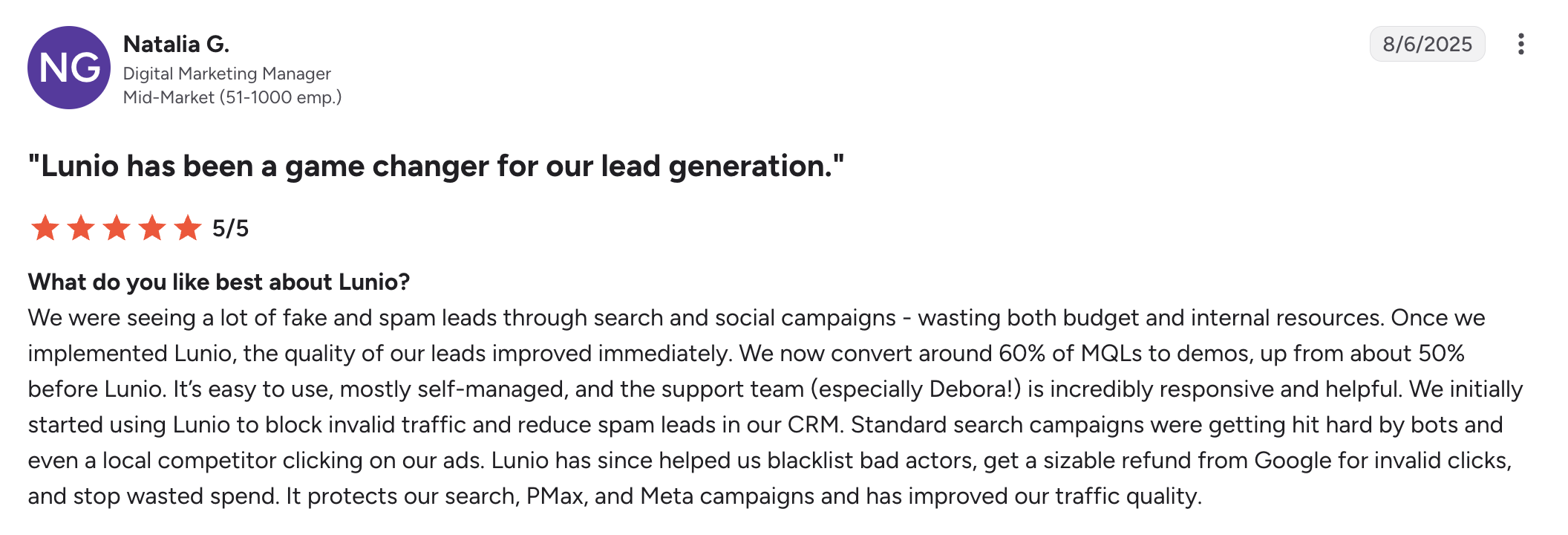
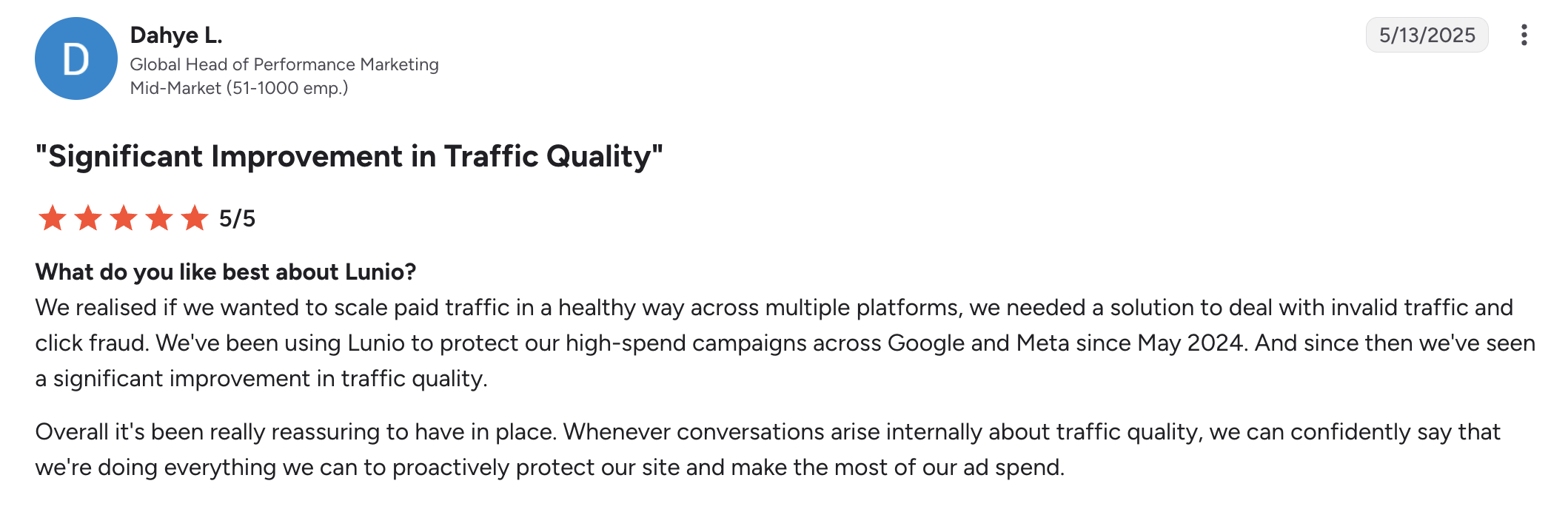
Here’s what our users say about Lunio:
Get your free 14-day traffic audit to see how much invalid traffic Lunio can detect alongside your current tool or by itself, establishing a baseline so you know if it’s time to upgrade your click fraud protection.
FAQ
Compare ClickCease vs Lunio in more depth in these frequently asked questions.
Is Lunio better than ClickCease?
Lunio isn’t better than ClickCease, but it can be more effective for high-spend enterprises advertising on channels beyond Google, Meta, and Microsoft. ClickCease is limited by channel coverage, so if you advertise on LinkedIn, TikTok, Reddit, or other social channels — where the IVT rate is often higher — Lunio is likely the best option.
Is ClickCease part of CHEQ?
ClickCease is owned by CHEQ, but it’s separate from the main CHEQ suite of cybersecurity tools. ClickCease is a standalone tool designed for small businesses, whereas CHEQ’s full cybersecurity suite is better suited for larger companies seeking protection beyond invalid traffic detection.
How much does Lunio cost compared to ClickCease?
Lunio doesn’t publish its pricing, so it’s not possible to compare like-for-like pricing with ClickCease. However, ClickCease is designed for smaller enterprises who want a self-serve IVT protection tool, so in most cases it’s likely to be cheaper than Lunio, which is built for higher spend advertisers. To cater to this market, Lunio offers broader coverage, deeper reporting insights, and dedicated paid media support compared with ClickCease.
Does Lunio protect Microsoft Ads, LinkedIn and TikTok?
Yes. In addition to Google and Meta, Lunio protects against click fraud on Microsoft, LinkedIn, TikTok, Reddit, and other social platforms. ClickCease only protects Google, Meta, and Microsoft campaigns.
Which is better for Performance Max and Smart Bidding, Lunio or ClickCease?
Both Lunio and ClickCease offer a strong Smart Bidding and Performance Max solution for advertisers relying on automated bidding strategies and campaign types. ClickCease’s Pixel Guard feature is designed to keep data and signals clean, while Lunio also prevents invalid traffic from corrupting data signals, which automated campaigns rely on to find new audiences.
Can agencies manage multiple client accounts in Lunio and ClickCease?
Yes. Both Lunio and ClickCease allow agencies to manage multiple client accounts from their account. The pricing structure for ClickCease is different for agencies, so bear this in mind when considering your options.

Table of Contents
On average, 8.51% of your ad budget is wasted.
But that number can be much higher. Find out how much you're spending on bot traffic.