


The Google Ads AI Max auto-upgrade started in September 2026 - and to say the rollout has been ‘confusing and chaotic’ would be a huge understatement.
And that confusion extends to the results many advertisers have seen so far. One advertiser on Reddit found their campaign had been ‘auto-upgraded’ on a Saturday (while the business was closed). By Monday night, they had a huge drop in CTR, and clicks from terms like "Bricklayer". They are not bricklayers.
So what on earth actually happened??
Well, Throughout September, Search campaigns using automatically created assets or the campaign-level broad match setting were auto-upgraded to AI Max, with no review step and no opt-in.
So, to work out what that actually means for your account (and whether you should keep it, fix it, or turn it off), we brought together three of the sharpest minds in paid search: Aaron Levy (Evangelist at Optmyzr), Sarah Stemen (Google Ads coach and consultant), and Boris Beceric (Google Ads consultant).
Watch the full session on-demand here, or keep reading for the written rundown:
Timestamps:
- 0:00 - Introduction
- 1:46 - Agenda and audience poll: were you auto-upgraded?
- 6:42 - AI Max is a bundle, not a new campaign type
- 9:39 - Why is Google forcing AI Max?
- 11:42 - Diagnose it: where AI Max shows up in your reports
- 15:40 - Is it AI Max, or the auction around it?
- 18:49 - Lunio data: the invalid traffic hiding in the expansion
- 20:44 - Measure it properly: is AI Max really incremental?
- 27:18 - Test it properly: running a fair AI Max experiment
- 31:54 - What do you give up if you turn AI Max off?
- 34:27 - Keep, keep partially, or turn it off
- 38:29 - Fixing AI Max: negatives and lead quality
- 46:45 - Lightning round: brand exclusions, Search Partners, text customization, location and language
- 54:33 - Turning AI Max off cleanly
- 56:52 - Recap checklist
- 58:30 - Live audience Q&A
What actually changed (and why Google forced it)
We opened the live session with a poll asking attendees whether their campaigns had been auto-upgraded. The most telling result wasn't yes or no - it was how many people still weren't sure, even a month after it happened.
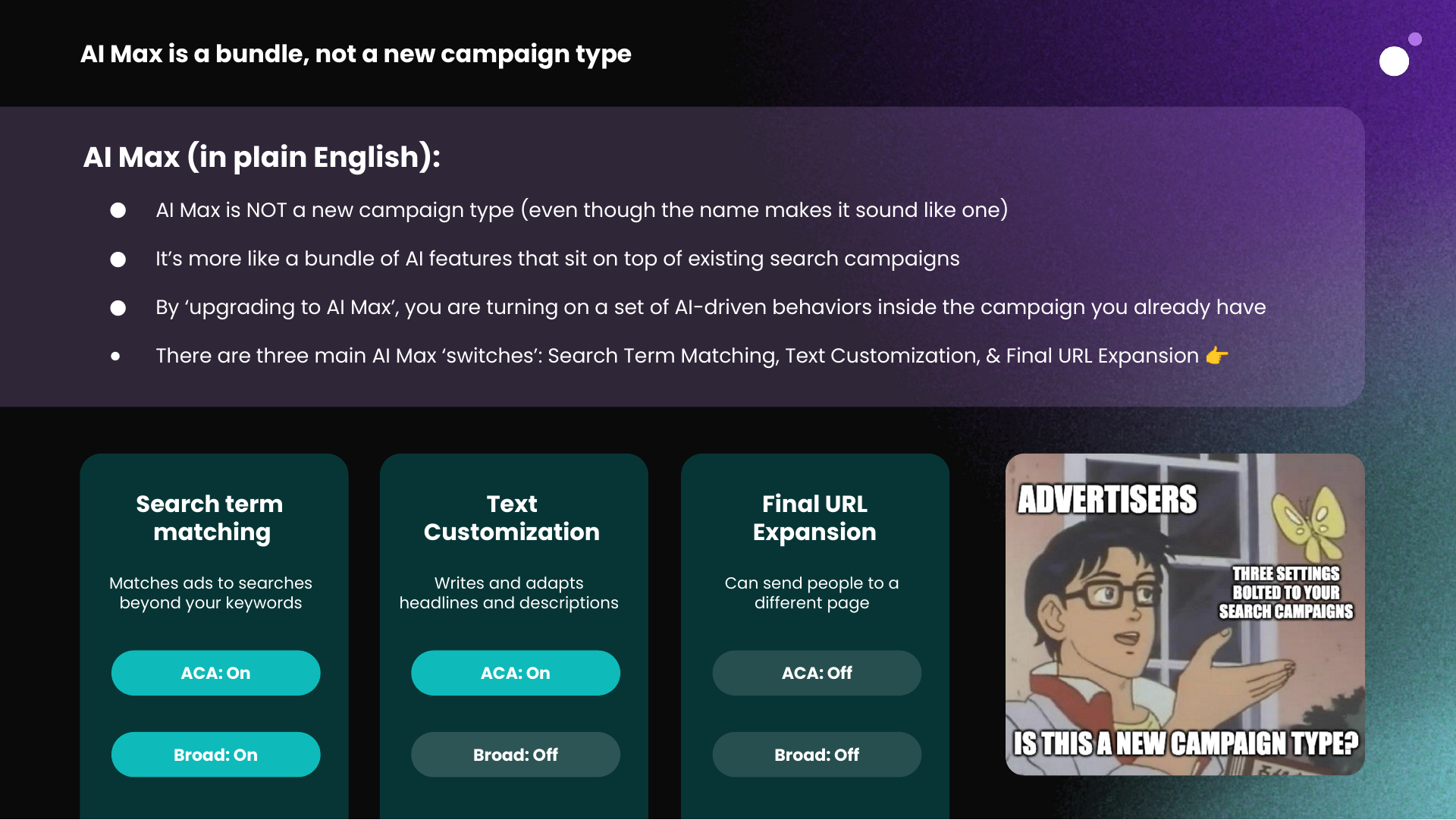
That confusion starts with the name. Despite how it sounds, AI Max isn't a new campaign type like Performance Max. It's a bundle of AI features that sit on top of the Search campaigns you already have, with three main switches:
- Search term matching matches your ads to searches beyond your keywords
- Text customization writes and adapts your headlines and descriptions
- Final URL expansion can send people to a different page on your site
If your campaigns used automatically created assets, they were upgraded with search term matching and text customization switched on. If they used the campaign-level broad match setting, they got search term matching only. Final URL expansion stayed off for both, and pinned assets are still respected.
None of the panel were fans of the approach. Boris put the question he usually asks Google directly:
"Why not just make the campaign or the feature so good that people feel stupid not to test it on their own terms?" - Boris Beceric
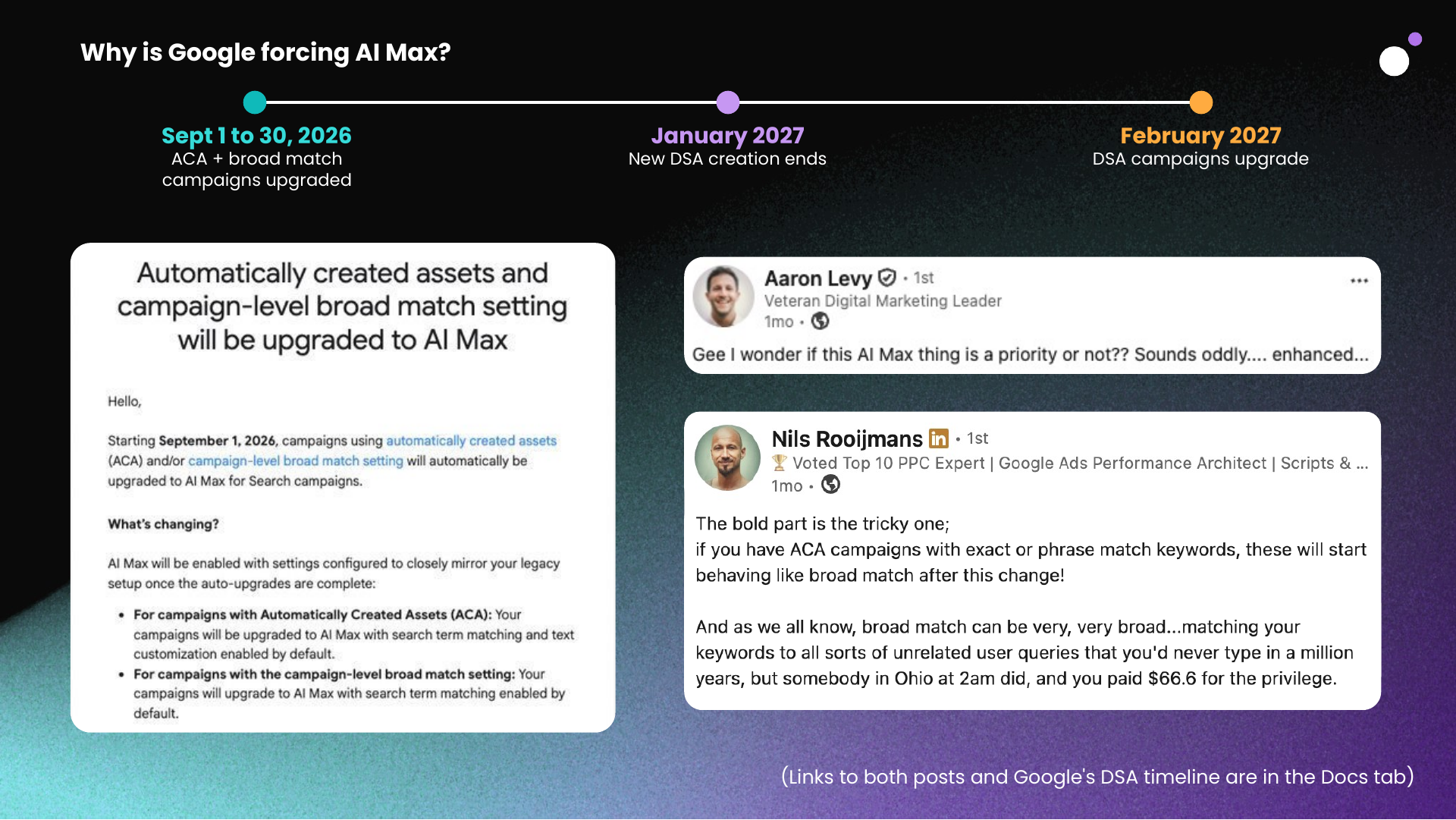
So why force it? Aaron, doing his best to land somewhere between Google apologist and Google critic, said that in his experience, a forced change usually means Google is ahead of a trend that advertisers haven't adapted to yet.
In this case, the trend is the state of search itself.
"Queries are really messy right now. Keywords are... I don't know what they are, but they're not all the way alive, and they're certainly not growing." - Aaron Levy
His read is that AI Max is Google's version of a synthetic keyword: a way to distil the meaning of a longer, conversational query, and match it without you having bid on the exact words. And he made a point that cuts through a lot of the noise around the upgrade. Strip out text customization and Final URL expansion, and what's left is essentially broad match.
Is it ready for prime time? Aaron's answer was a flat no. But, as he pointed out, neither was Performance Max at launch, and it has improved a lot since.
The other thing worth knowing: this isn't the last forced upgrade. Dynamic Search Ads campaigns are next, with Google's DSA migration currently delayed to February 2027.
Diagnose it: is AI Max actually behind your CPA change?
If your campaigns were upgraded, the first job is working out how much of your spend now runs through AI Max, before you change anything.
Boris is the right person to ask. About a year ago, he audited a campaign with AI Max switched on and summed up the search terms as "pure trash", with conversions hard to come by. His view has softened since, though not without conditions.
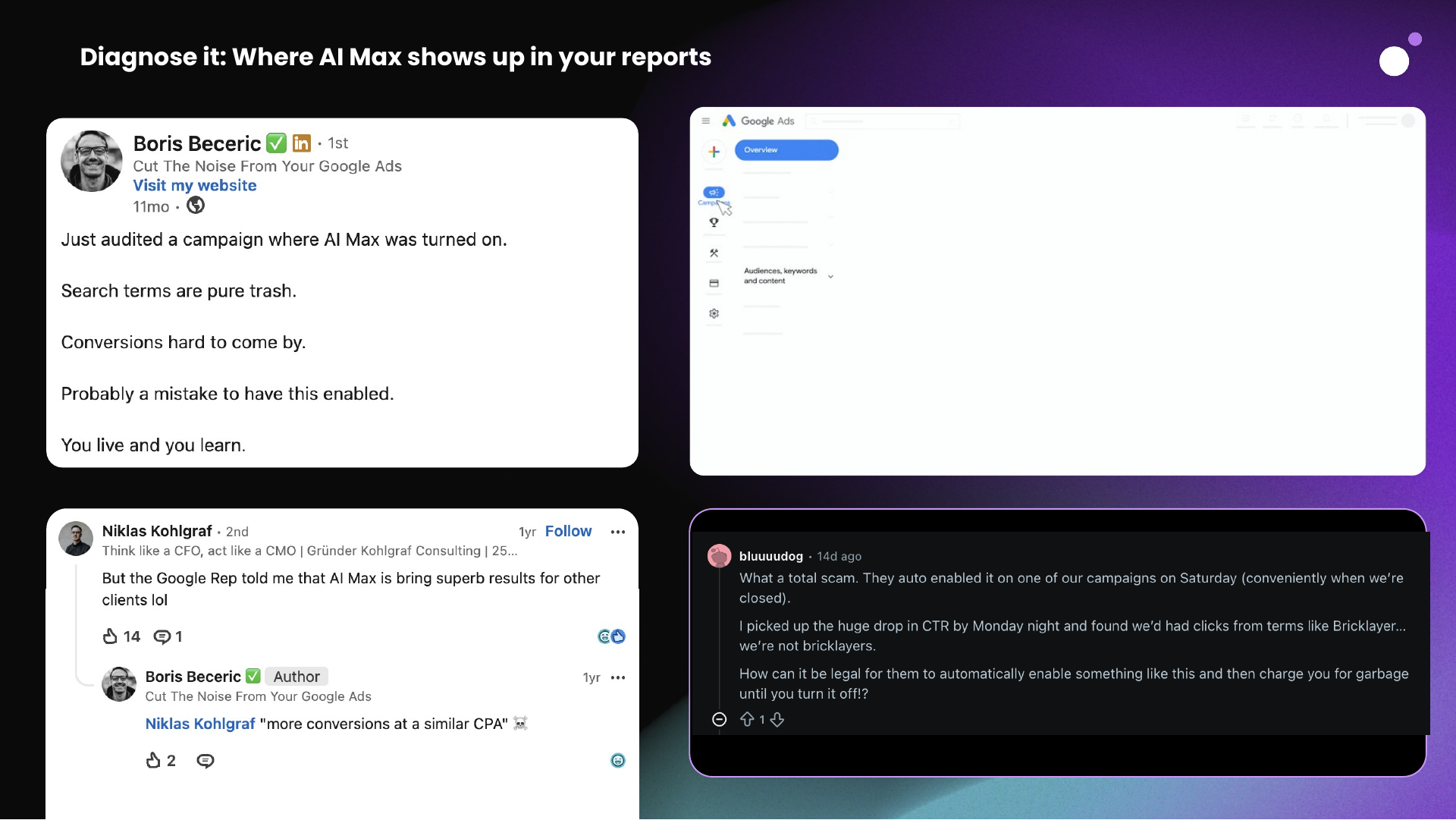
In his experience, Google features tend to launch rough, advertisers push back, and Google (somewhat reluctantly) adds the visibility and controls they ask for. AI Max has followed that pattern, and he's seen it improve in the accounts where it's enabled. But whether it works still comes down to the type of business, its data density, and how many valuable conversions it can push back into the platform.
So what should you actually look for? Sarah's first signal doesn't come from the Google Ads UI at all.
"If your sales team is complaining that lead quality is going down, it might be worth looking into the feeder of that issue." - Sarah Stemen
Aaron's advice was to monitor queries closely, run n-grams where you can, and watch for new search terms that keep appearing. In Optmyzr's data, AI Max's matching leans heavily on competitor terms and location terms. That might be fine, but it clouds the picture and often isn't the expansion you were hoping for.
He added a useful second-order tip. AI Max partly uses the content on your website to decide what to match. So if it's picking up queries you don't want, check your site for where they're coming from. Odds are other AI systems are reading the same content, so fixing it solves two problems at once.
The twist: your CPA can change even if your campaigns weren't upgraded
AI Max doesn't only affect the advertisers who have it. When your competitors were upgraded, the auctions you compete in changed too.
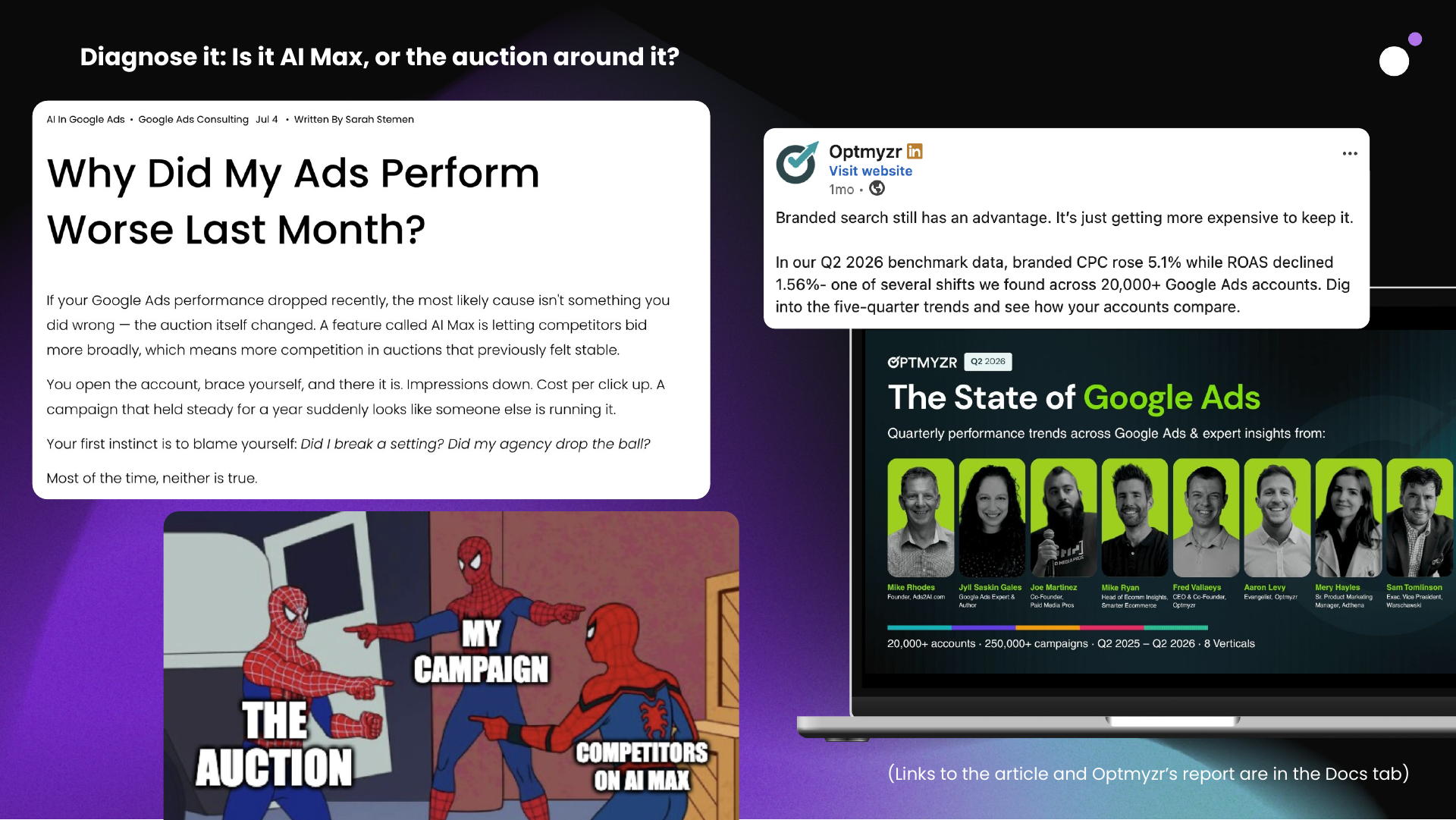
In Why Did My Ads Perform Worse Last Month?, Sarah argues that many accounts that look broken haven't changed at all: the auction around them has. To tell the two apart, she starts with change history and Auction Insights, then looks at one place in particular: your brand terms.
"You'll really notice it on your brand terms. Anyone and everyone is now on your brand terms, and it's not always on purpose." - Sarah Stemen
Her advice is to search your own brand (yes, self-Googling). If a competitor is showing on your brand terms without a direct attack or a value add over you, there's a good chance AI Max put them there by accident.
Optmyzr's State of Google Ads Q2 2026 report found branded CPCs rising across more than 20,000 accounts. And Aaron shared that an early draft of Optmyzr's Q3 data shows the trend holding, with brand CPCs still climbing, likely because of these accidental competitors.
His suggestion for what to do about it: treat it as a prompt to rewrite your brand ads.
"A lot of people have written them over the years with the expectation that it's just an open doorway and there's no competition, so we don't have to sell. But now you might." - Aaron Levy
That means testing new value props, and putting in the things you beat your competitors on that you might never have needed before.
The cost hiding in the expansion
There's one more thing that can move your CPA after an upgrade, and it doesn't show up in the search terms report as anything unusual.
In Lunio's Invalid Traffic Impact Report for Retail, we compared Search campaigns with and without AI Max in the same accounts. By Q2 2026, AI Max campaigns carried an invalid traffic rate 72% higher than standard Search. They drove 55% of retail Search clicks, but 68% of the invalid ones.
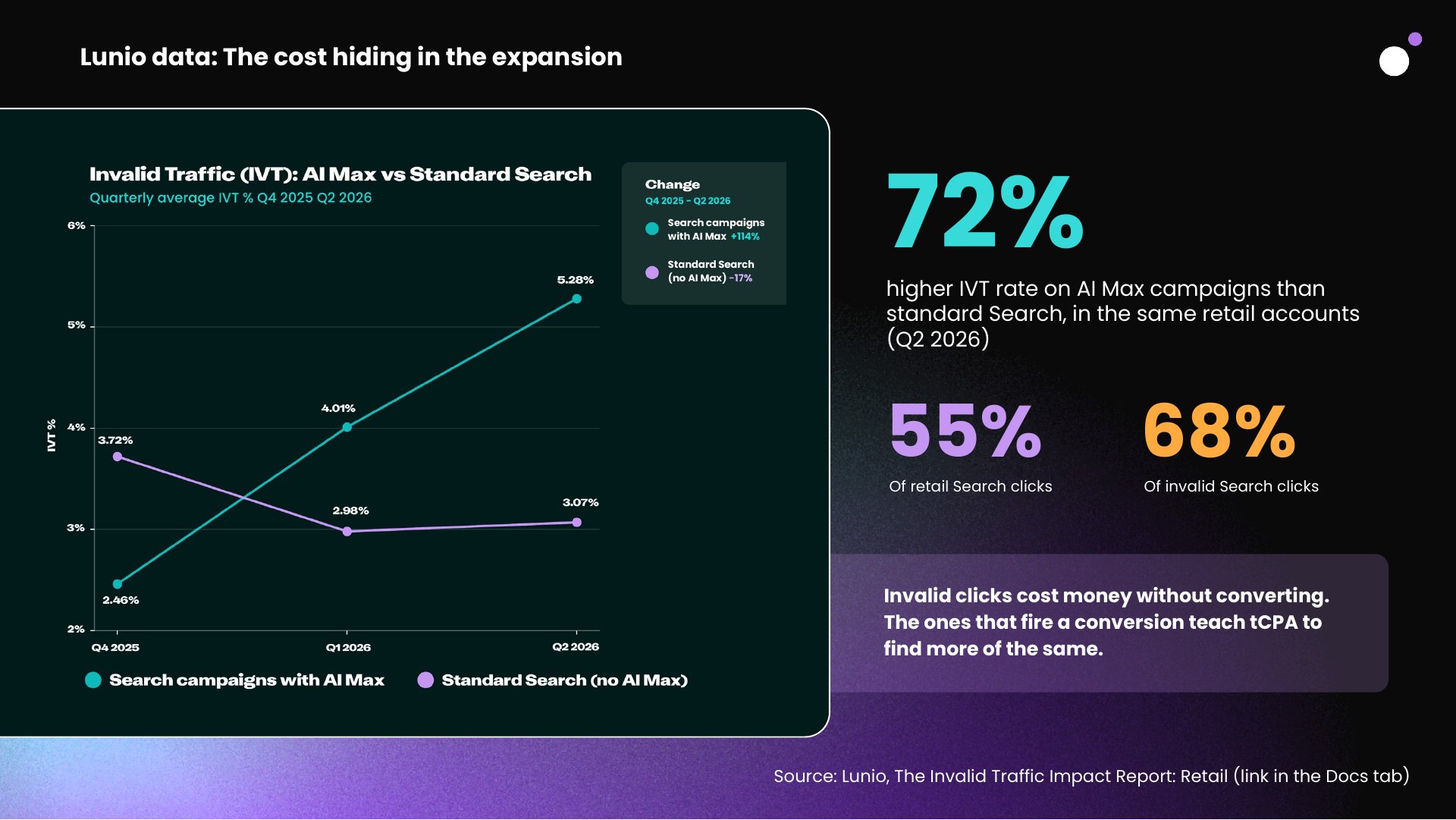
If you bid to a CPA target, that hurts twice. Invalid clicks cost money without converting. And the ones that do fire a conversion, like bot form fills, teach Smart Bidding to go and find more of the same.
The full report is ungated, so you can read the methodology in full. And if you work in education, Lunio has also just published a new invalid traffic report for that sector, available on the Lunio website.
Measure it properly: is AI Max actually adding anything?
To decide whether AI Max is worth keeping, you need to know which of its conversions are incremental: the ones you only got because of AI Max, rather than ones you'd have won anyway.
That's harder than it sounds. Smarter Ecommerce found that more than a quarter of exact match impressions in AI Max campaigns are now being expanded by search term matching. So some of what AI Max reports as its own could be traffic your existing keywords would have caught regardless.
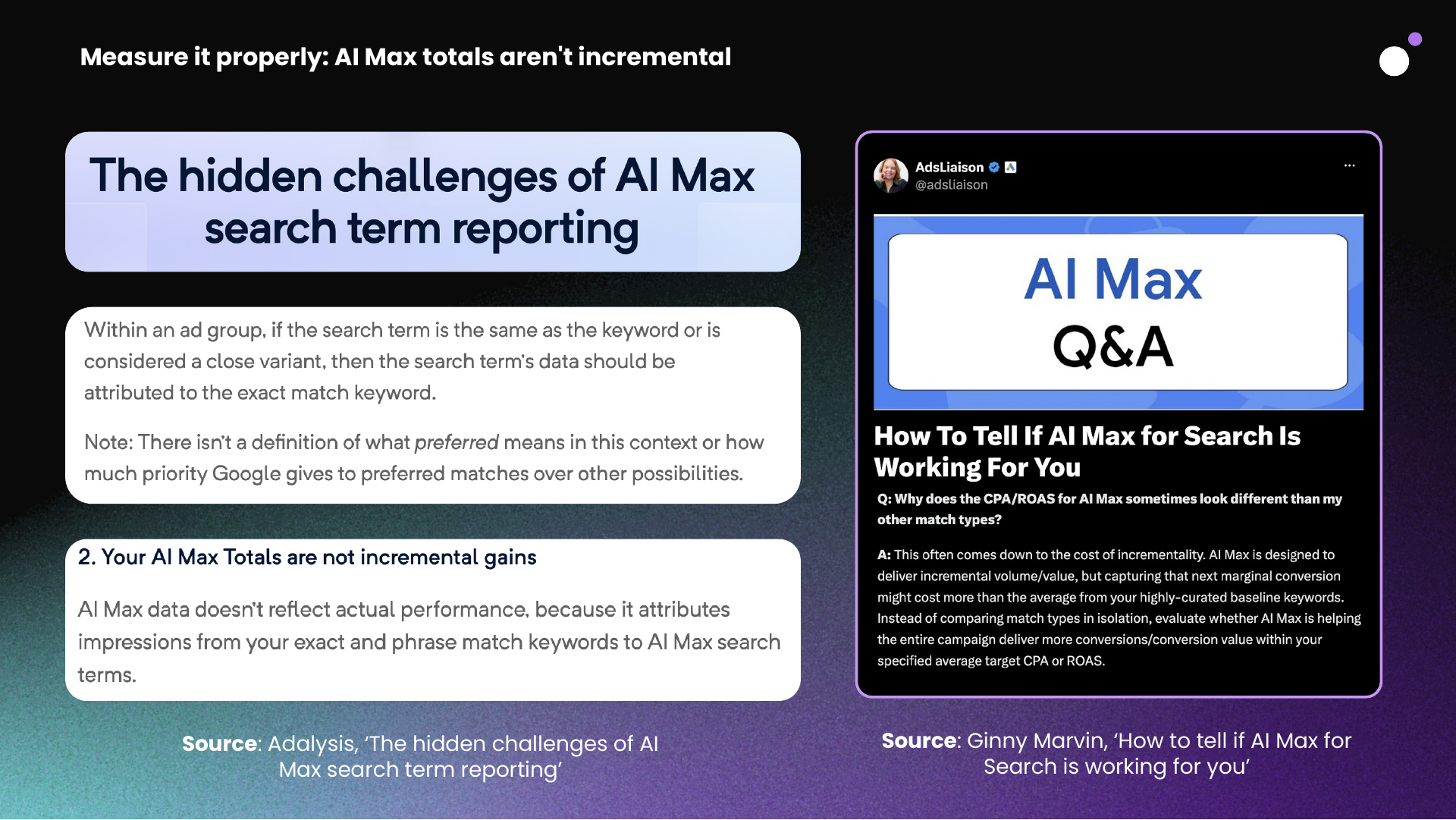
On screen, we put two views side by side. Adalysis argues that AI Max totals aren't incremental gains. Google's Ginny Marvin says to judge AI Max at campaign level, and to expect genuinely new conversions to cost more. We asked Aaron who's right.
He opened diplomatically ("I'm seeing Ginny next week, so I love her to death"), then explained why Optmyzr hasn't published any AI Max data yet: it's genuinely difficult to report on. The match type column tells you how a search term was matched, but not necessarily which keyword it was bid on.
"It's really, really hard to tell if AI Max is truly incremental, or if it's just moving food around your plate." - Aaron Levy
He also pointed out that Google's own headline promises have moved around over the years, from 14% to 7% to "20-something" to 2%. AI Max is exploratory by design, and Aaron has seen it find genuinely new terms, particularly in research-heavy industries with strong educational content. But a term can fire from exact match one day, AI Max the next, then Performance Max or a leftover DSA campaign.
His practical answer: run a before-and-after or a holdout test. It isn't perfectly scientific, but it's the best option available. The encouraging part is that Google mostly follows its own prioritisation rules, and performance tends to hold up regardless of which campaign a query fires from.
Sarah has written that you should never adopt AI Max without a strong baseline. The auto-upgrade took that choice away from a lot of advertisers, so we asked how she'd build one now. Her answer reframed what a baseline actually is.
"When I say baseline, I mean really locked-in conversion tracking. I mean you're really confident that those actions mean something for your business." - Sarah Stemen
For clients with long lead times, she was clear that AI tools get exponentially harder to judge. Her fix is deliberately manual: work out the real time to purchase, and compare click data against what actually lands in the CRM, rather than layering AI on top of AI to read the results.
Does that mean a pile of spreadsheet work that people assume AI could do instead? Yes. Does it work better? In Sarah's words: "Absolutely."
Test it properly: running a fair AI Max experiment
Once you have a baseline, the next step is a proper test. Since Google's August 20th update, AI Max experiments split traffic inside the same campaign, with an AI Max-off control, and you can keep brand and location controls switched on.
You'll find it under Campaigns > Experiments > + > Campaign features and settings > AI Max for Search campaigns.
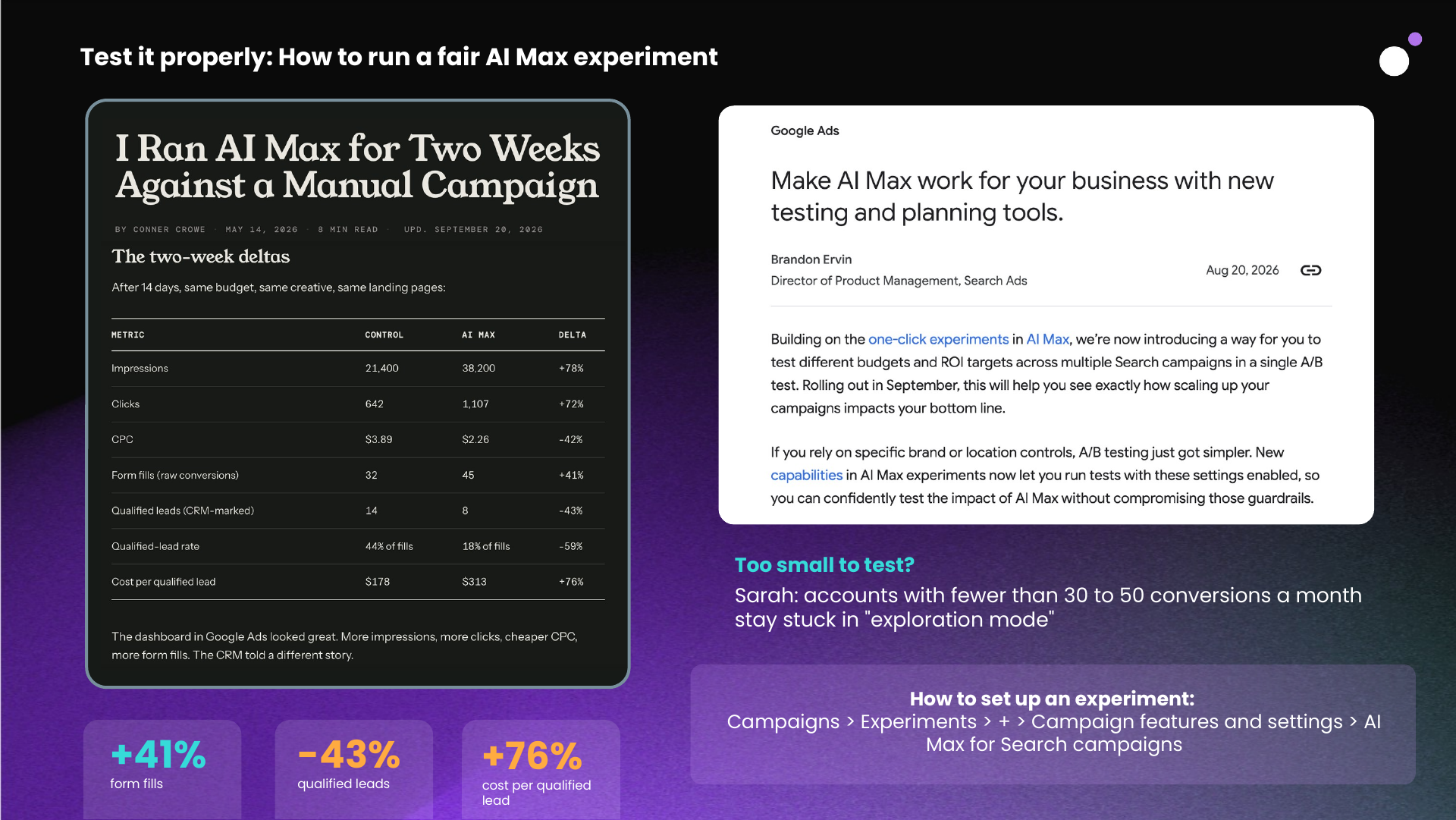
Conner Crowe recently published a two-week AI Max test on a service-business account: 41% more form fills, but a 76% higher cost per qualified lead. We asked Boris whether he'd trust a 14-day test like that.
He'd already run a statistical analysis on the numbers ("I was geeky enough"), and his answer was no. Not because the result is wrong, but because 14 days is an arbitrary window. Depending on conversion volume and how long leads take to qualify, it might be long enough to spot a serious problem, or the leads might simply backfill later.
"Two to three conversion cycles should be more than enough, provided that you have enough volume in your account. Then you could trust that analysis a lot more than just fourteen days." - Boris Beceric
What about smaller accounts? Sarah has argued that accounts with fewer than 30 to 50 conversions a month stay stuck in "exploration mode". Surprisingly, she thinks those accounts can still test AI Max, as long as their conversion tracking is solid.
Her comparison was Dynamic Search Ads. Low-volume advertisers used to add a DSA campaign to capture long-tail searches they knew people were making, but which Google labelled as low search volume. AI Max can play the same role, which makes it a good candidate for testing whether it finds the incremental volume Google promises.
Aaron added a caveat worth remembering when you read any AI Max test result.
"I expect AI Max's CPA to be higher, because by nature it's expansionary. Assuming you're good at your job, you already got all the good stuff covered." - Aaron Levy
In his view, Google does itself a disservice by promising more conversions at the same CPA, because that's unlikely to happen. But a higher CPA doesn't automatically mean AI Max is bad. It means you're climbing higher up the tree, because you've already picked the low-hanging fruit.
What do you give up if you turn AI Max off?
If a test points towards turning AI Max off, it's worth knowing that it isn't a binary choice between AI Max and your old setup. Switching it off entirely also switches off a set of features that now only exist inside AI Max, from text customization assets already serving to ad group-level locations of interest.
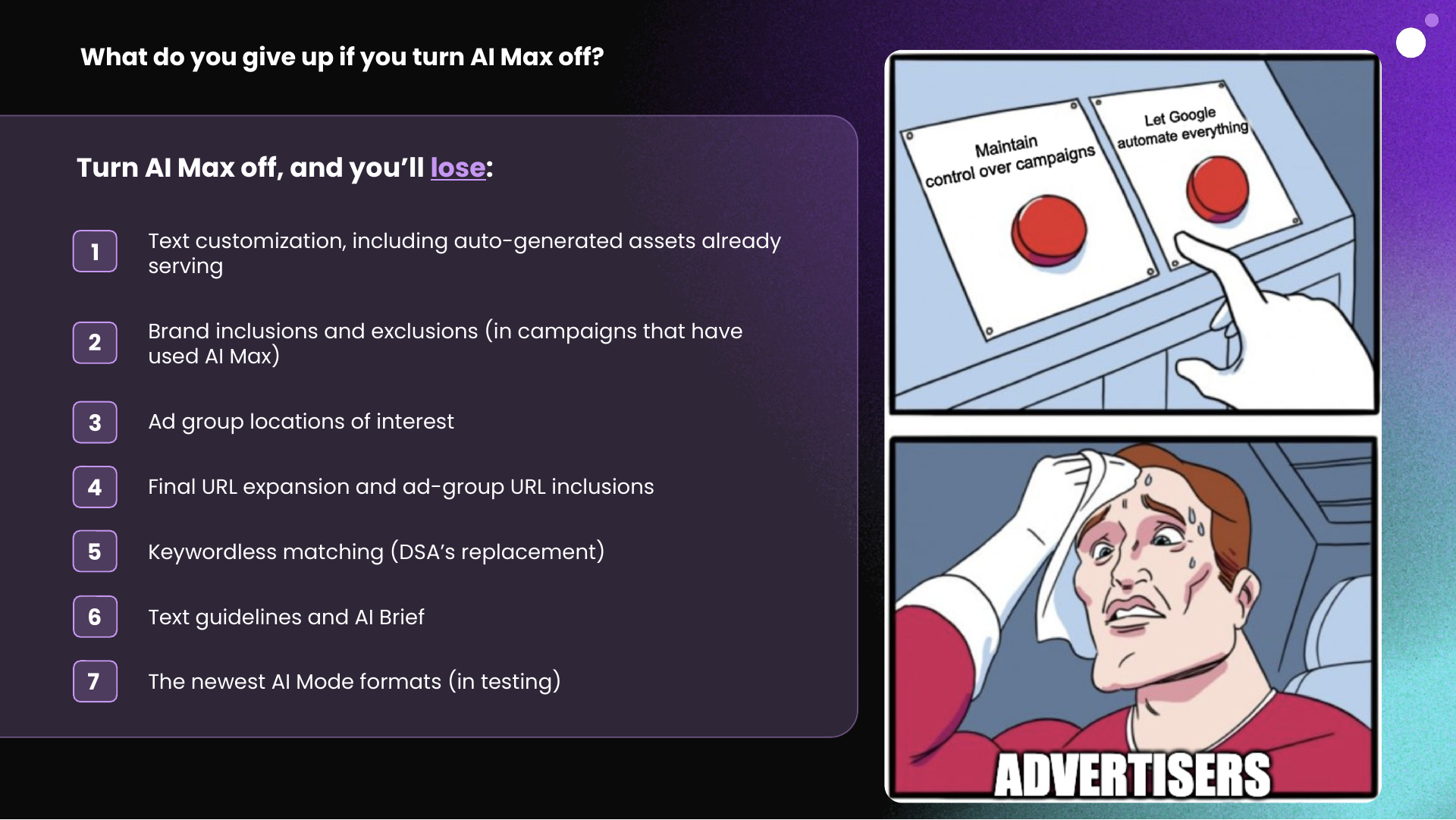
The alternative is keeping AI Max on, and turning search term matching off only in the ad groups where it's hurting. So is "partially on" usually the smarter move? Aaron gave the answer he tries never to give on stage.
"I do my best never to say this word in conferences or presentations, but I will. It depends." - Aaron Levy
What it depends on, mostly, is why you're running AI Max in the first place. If the only reason is to get ads into AI Mode, Aaron's advice was to cut it. In his experience those ads appear around one in every 5,000 times right now, and they also show from Performance Max, with Google testing other match types there too.
But beyond that, he sees genuine value worth testing. Ad group-level locations of interest is the feature he finds most interesting, and one he's seen almost nobody write about. It's especially useful for accounts with small data problems, or niche advertisers targeting a whole country or worldwide. Text customization can be valuable too.
"We get a lot of toggles and buttons... so why not try them all?" - Aaron Levy
Keep, keep partially, or turn it off?
To bring the section together, we pulled the advice flying around since September into a set of starting points for each option, and asked the panel which ones they'd throw out.
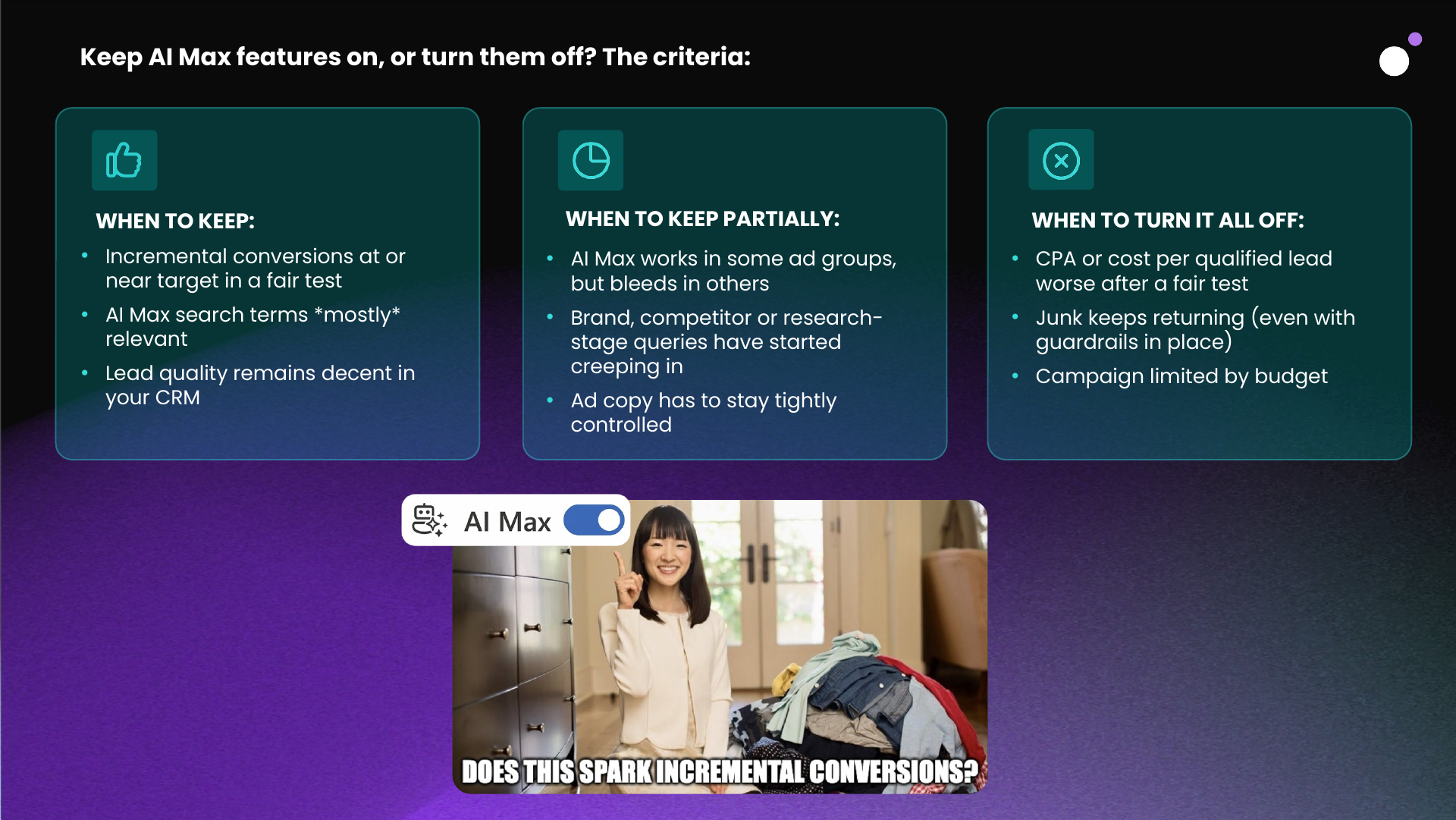
Boris wouldn't throw any of them out. He'd add two more: incrementality and conversion quality, because just because AI Max reports a conversion doesn't mean you wouldn't have got it anyway. But the part he liked most was the middle option.
"If only a couple of ad groups are causing problems, then I'd much rather disable search term matching there instead of switching everything off. Keep the good stuff, and away with the bad." - Boris Beceric
Sarah's approach starts with the client rather than the framework. If they keep saying they're not getting enough volume, she leans towards keeping AI Max on, or partially on. If they're complaining wildly about costs, she leans towards turning it off. Either way, the call comes back to the business goal, and what phase the business is in.
Aaron added the question he thinks every advertiser should ask first: why did you turn it on? What were you hoping it would accomplish, did it accomplish that, and if not, why not?
And if the answer is to turn it off, that doesn't have to be permanent.
"Google has a tendency to take their delicious baked goods out of the oven before they're ready to go... It doesn't have to be dead forever. You can try it again later, in a new world with more data." - Aaron Levy
Which prompted Boris to point out that he'd only turned it on because Google promised to max his AI. Aaron, it turns out, was almost named Max.
Get a free 14 day traffic quality audit
Discover how Lunio can help you eliminate invalid ad clicks and maximize paid media performance
Fixing AI Max: negatives and lead quality
For the campaigns where AI Max does show promise, the obvious first fix is negative keywords. Both Sarah and Boris think most advertisers are overdoing them.
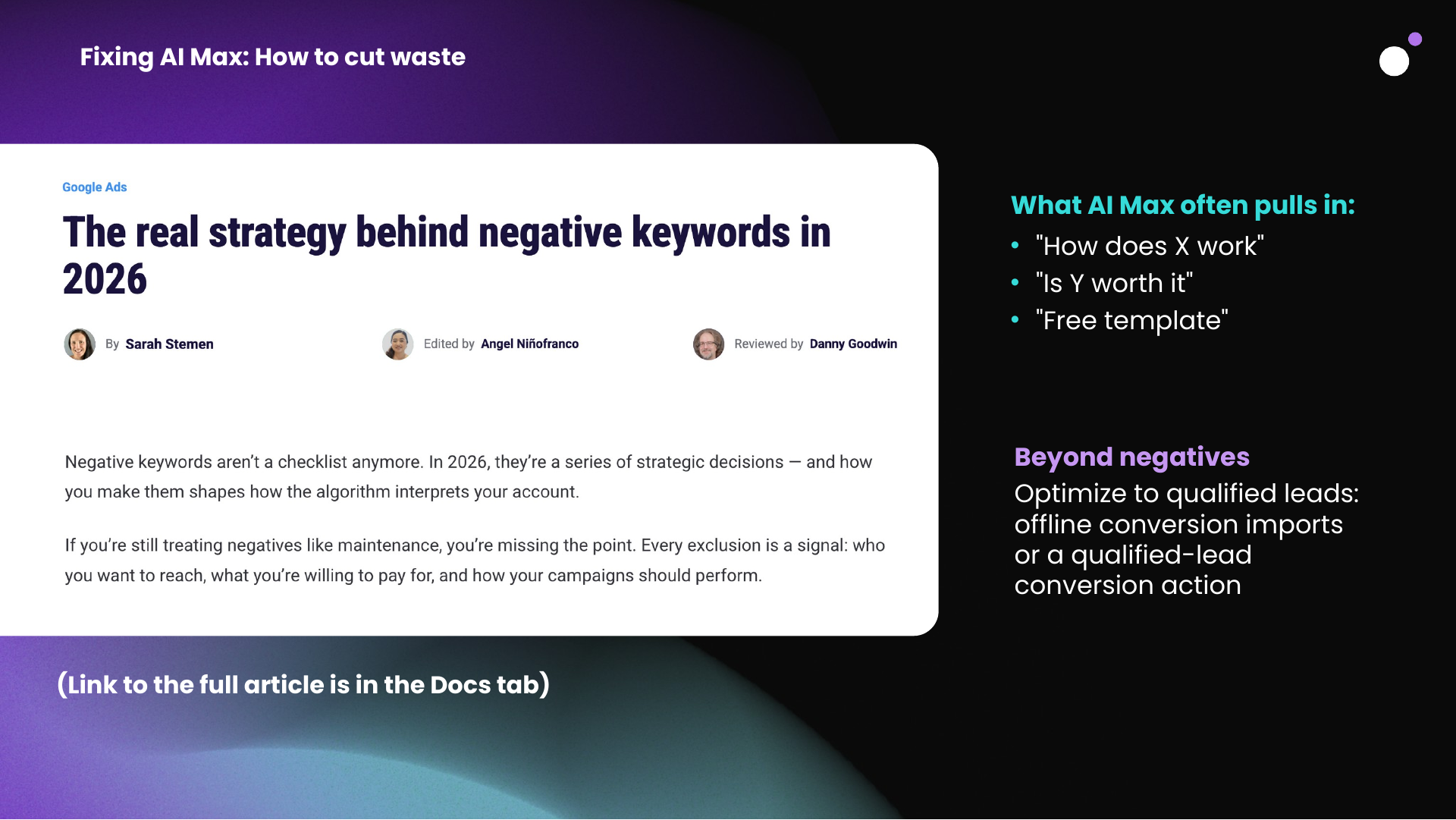
In The real strategy behind negative keywords in 2026, Sarah describes every exclusion as a decision, and a signal to the algorithm about who you want to reach. Her warning for the AI Max era is blunt.
"I think there's gonna be an epidemic of negatives. I think that's because the chatbots say just add negatives, or your account is bleeding all the time." - Sarah Stemen
She takes a lighter approach, based on what she calls the billboard effect. If a search term isn't a great fit but nobody's clicking on it, it isn't really costing you anything, and it's fine within your tolerance. Google knows far more about the person searching than you do.
She does add negatives when there are symptoms: a terrible ad rank despite perfectly aligned ads, or matching that drifts out of your industry (into home searches for a B2B advertiser, say). But then it's as a signal to Google about who you serve. And an account packed with ten years of negatives, she says, is usually a sign the offer is misaligned with what people are searching for.
Boris has found the same thing in his audits. He now regularly clears out old negative keyword lists, because keywords don't work the way they used to, and over-negating usually hurts performance. His one exception: if you're on a tight budget, be ruthless.
Lead quality isn't a keyword problem
For lead gen, AI Max will happily find cheap form fills from people who are still researching. Boris's view is that you won't fix that with negatives.
"If you tell Google every form submission is a conversion, then Google will just get you more form submissions. Simple as that." - Boris Beceric
His fixes start before the click and end in your CRM:
- Set expectations in the ad. Use negative signaling to put off the wrong people before they click, for example by stating that you work with teams above a certain monthly spend.
- Fix the conversion tracking. Connect your CRM, or use a Google Sheets and Zapier workaround to mark qualified leads and push them back to Google Ads.
- Find where leads drop off. Listen in on sales calls, or read the AI transcripts, to pinpoint the sticking point in the conversation.
Aaron added a shortcut for smaller advertisers. You don't need a perfect, end-to-end CRM loop ("that's a nice dream, but nobody really has that"). Even marking leads as good or bad, or filtering on the next step in your funnel, gives Google something better to optimise towards.
"AI Max and Performance Max are really good at following directions we're really bad at giving them." - Aaron Levy
If everything's working, especially on a tight budget, a consolidated exact match campaign is still a perfectly valid setup. You should probably test AI Max at some point. But there's no rule that says you have to.
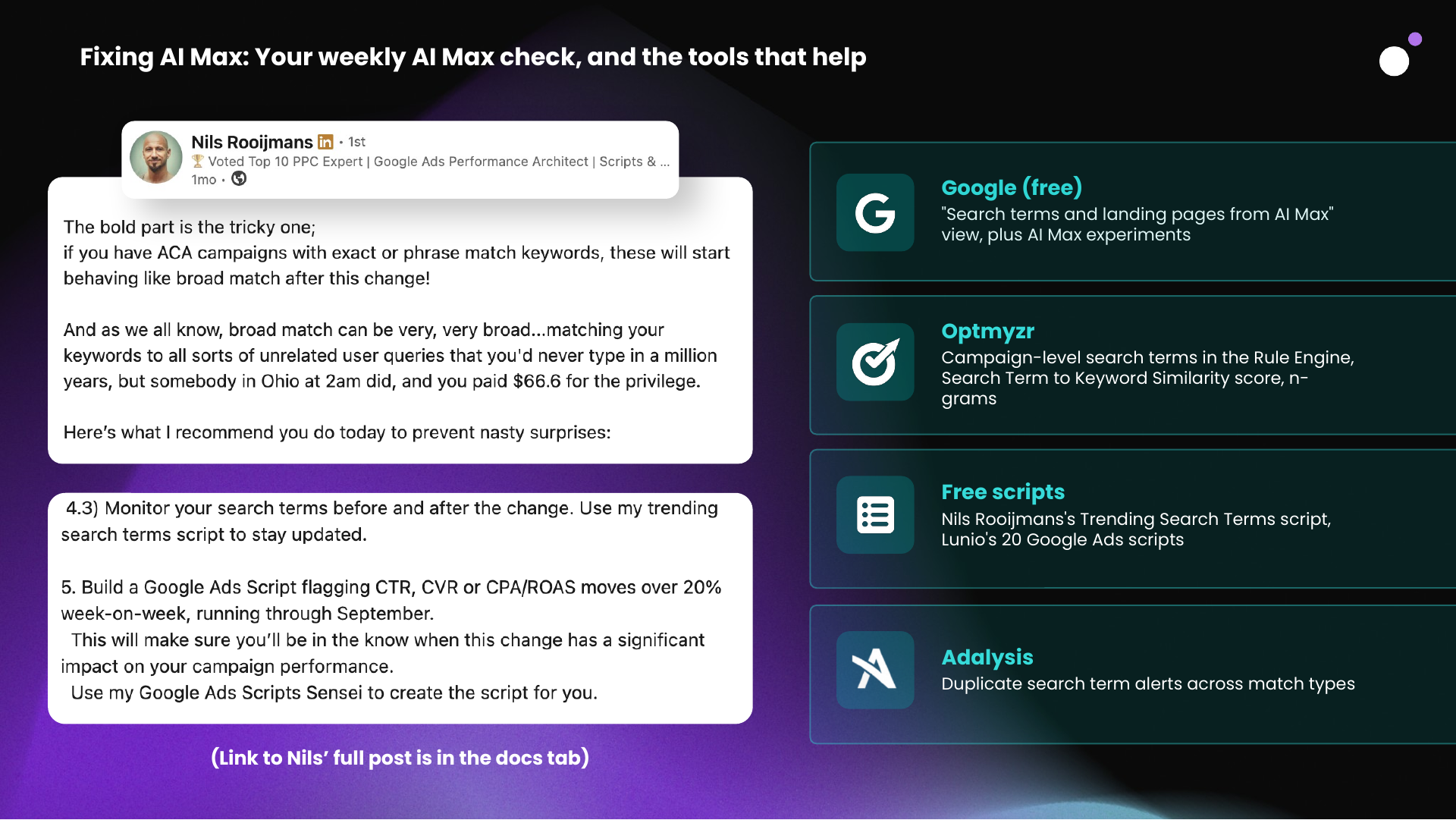
If you do keep it on, reading AI Max search terms row by row doesn't scale. Tools that help include Google's own AI Max search terms reporting and experiments, Optmyzr's Search Term to Keyword Similarity score and Rule Engine, free scripts like Nils Rooijmans's Trending Search Terms script, and Adalysis's duplicate search term alerts. For a full walkthrough, see Lunio's guide on how to audit an AI Max campaign.
Lightning round: must-use, situational, or overrated?
To finish the fixes, we ran through four AI Max controls in quick succession.
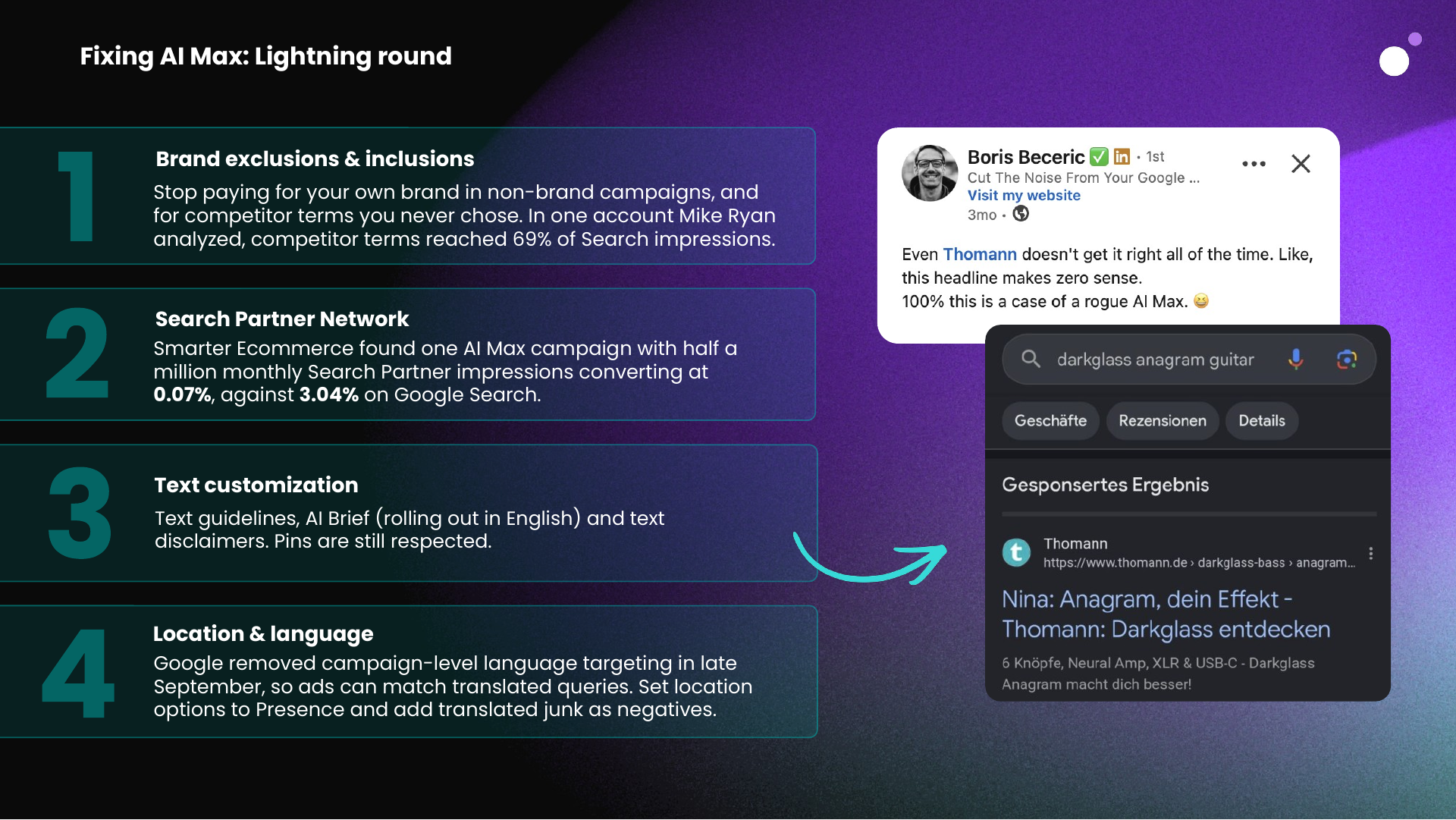
Brand exclusions and inclusions. Sarah didn't hesitate: "Overrated, for sure." In her experience, they're easily cancelled out by other campaign types and match types. Aaron would test them, but noted it's hard to play whack-a-mole with every competitor you might ever have. He also warned against the toggle that restricts ads by branded or non-branded searches, because Google doesn't really know what your brand is unless you tell it, and he's seen it tank volume. Boris, meanwhile, prefers shared negative keyword lists of competitor terms, applied across every campaign. "Problem solved."
The Search Partner Network. Smarter Ecommerce found one AI Max campaign with half a million monthly Search Partner impressions, converting at 0.07% against 3.04% on Google Search. Aaron's advice was to judge it on your own data, and exclude it if it's performing poorly. Sarah usually leaves it on (while switching off Display), and has only seen it cause real problems around 2% of the time. Boris was more cautious: Search Partners are rife with click fraud, and he suspected a lot of the invalid traffic in Lunio's AI Max data came from there.
Text customization. Boris isn't a fan, especially in regulated industries, where he'd handle it with extreme caution. He welcomed Google's new option to preview auto-generated headlines and descriptions, but it isn't enough to win him over. Sarah has used it since the early days of automatically created assets, and learned to check her clients' site content first, after it once pulled an old sale into an ad. Her take on AI Brief so far is that it gives much the same results as before, though it does feel more "with the times".
Location and language. Aaron summed it up in one line.
"Language targeting was terrible before, and now it's gone, and that is also terrible." - Aaron Levy
Google's AI still struggles with many non-Western languages, he said. Advertisers in the US may not notice much, but in the rest of the world, it's going to cause problems.
Turning AI Max off cleanly
For some campaigns, the right answer will be to turn AI Max off entirely. The problem is that there's a lot of conflicting information about what actually happens when you do.
One reply in a Reddit thread on r/googleads claims that turning AI Max off restores the campaign to exactly what it was before, in about 30 seconds. Google's own documentation suggests otherwise. Once a campaign leaves the campaign-level broad match setting, its broad keywords are no longer treated as exact match for prioritisation, and the legacy settings can't be recreated.
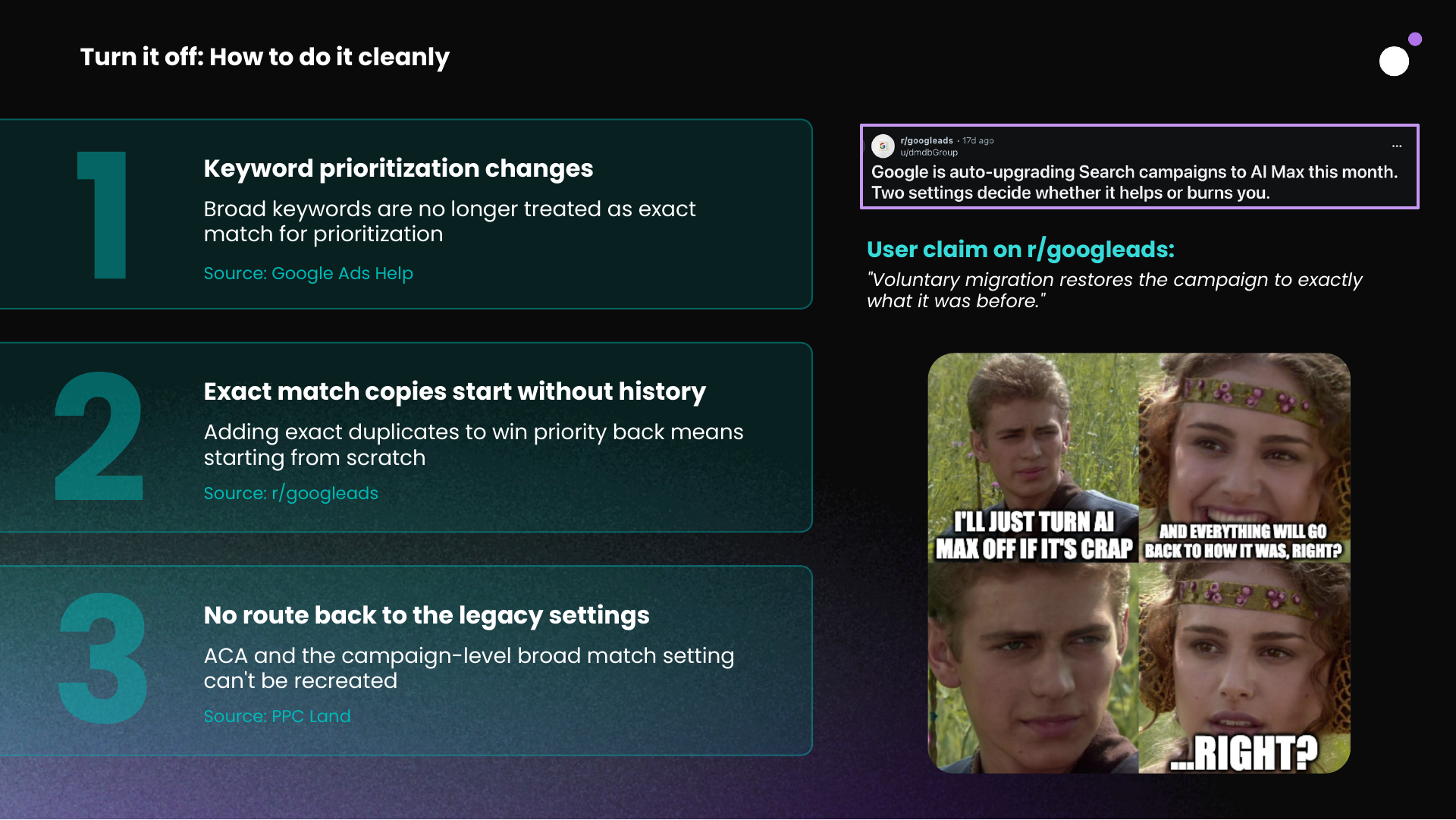
Boris's answer was to look past both, and let the data speak. Google learns largely from the last 30 days of data flowing through your account, and that data is now different. So switching AI Max off won't simply put the campaign back the way it was.
Performance might come back better, in which case you probably shouldn't have turned it off. It might come back worse, in which case it'll take time to crawl back to where you were. What it almost certainly won't do is restore everything neatly.
"The goal is more to remove the problem without introducing a completely new one." - Boris Beceric
In practice, that might mean switching off a couple of features rather than all of them, or switching AI Max off completely and adding your previously well-converting queries back in as exact match.
Final thoughts
The thread running through the whole session is that AI Max isn't good or bad on its own terms. It's a bundle of switches, and each one needs judging against your own data, your own conversion quality, and the reason you'd want it on in the first place.
The auto-upgrade took the timing out of advertisers' hands. It didn't take away the decision. You can keep AI Max, keep parts of it, or turn it off cleanly, as long as you measure it properly first.
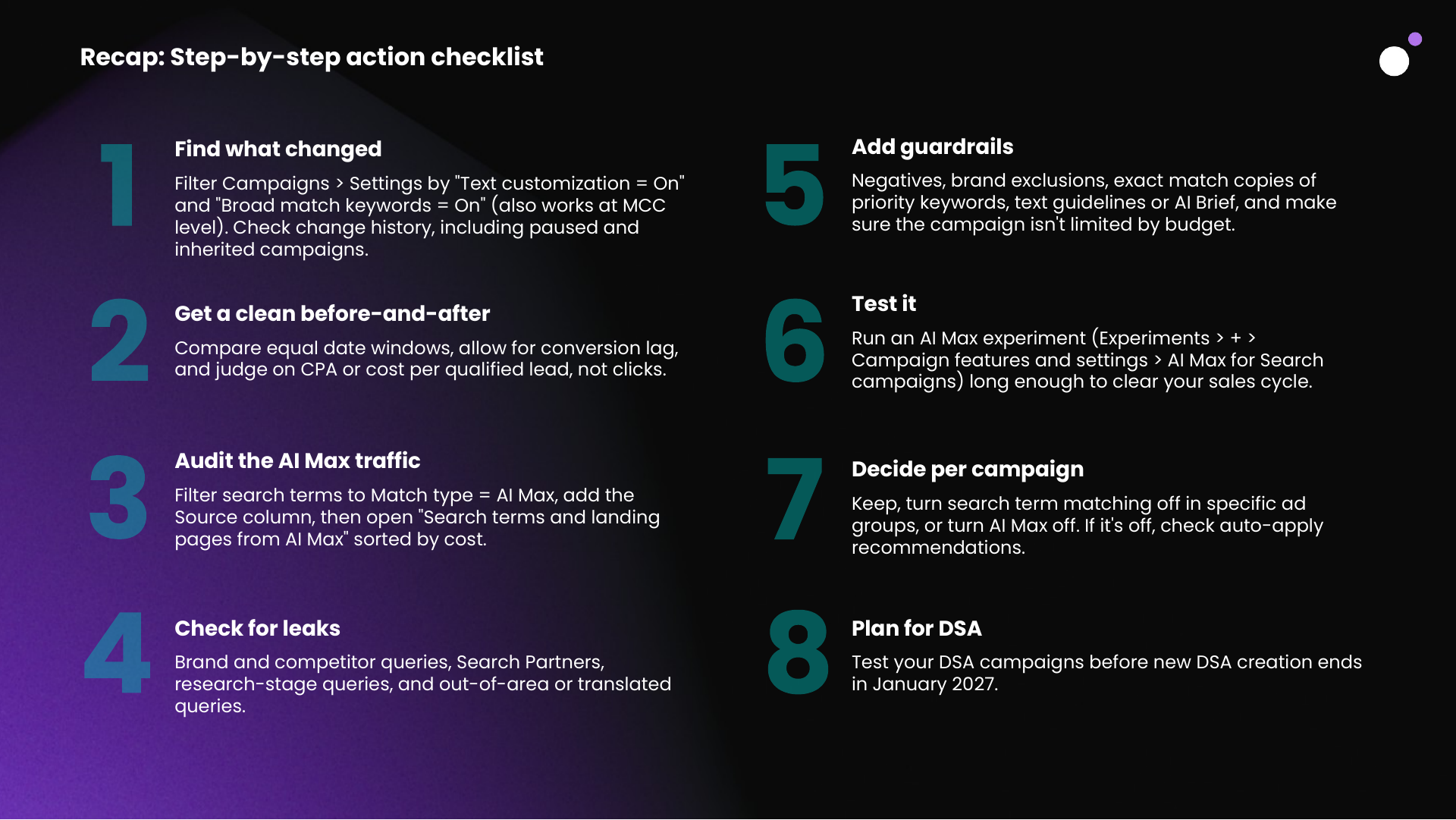
So, here's what you do now:
- Find out which of your campaigns were upgraded, and how much of their spend now runs through AI Max. Check the search terms for competitor, location and research-stage queries.
- Test before you decide. Run an AI Max experiment over two to three conversion cycles, and judge it on qualified leads or real revenue, not AI Max's own totals.
- Fix it at the right level. Turn search term matching off in the ad groups where it's hurting rather than everywhere, and fix lead quality in your conversion tracking rather than your negative keyword list.
One last piece of advice from Aaron, for anyone also running Dynamic Search Ads: with Q4 shopping behaviour so different from the rest of the year, he wouldn't migrate DSA campaigns to AI Max before peak. Prepare now, and make the move in the quiet period between Christmas and New Year, or in January.
There's a solid live Q&A at the end of the recording, covering whether to keep a flat-performing AI Max campaign live to future-proof it, what to do when 90% of your AI Max search terms are brand related, and how to judge Demand Gen against Performance Max. Worth watching from 58:30.
Huge thanks to Aaron, Sarah and Boris for joining us. Follow Aaron on LinkedIn, and keep an eye out for Optmyzr's upcoming Q3 State of Google Ads report. Follow Sarah on LinkedIn and take a look at thesarahstemen.com, where her blog goes deeper on AI Max, negatives and measurement than we had time for here. And follow Boris on LinkedIn too, where (in his words) you'll be inundated with a slew of memes, all of which come from a good place.
Additional resources from the session:
- Aaron Levy - Evangelist at Optmyzr
- Sarah Stemen - Google Ads coach and consultant at thesarahstemen.com
- Boris Beceric - Google Ads consultant at borisbeceric.com
- Ben Harris - Content manager at Lunio and session host
Strategy and tips:
- Sarah Stemen: Why Did My Ads Perform Worse Last Month? (Article)
- Sarah Stemen: The real strategy behind negative keywords in 2026 (Article)
- Sarah Stemen: Google Expands Text Guidelines in AI Max (Article)
- Sarah Stemen: Google Ads: Intent vs. Predictions in 2026 (Article)
- Boris Beceric: AI Max search terms audit (Post)
- Boris Beceric: The rogue Thomann headline (Post)
- Aaron Levy: Repost of Google's AI Max auto-upgrade announcement (Post)
- Optmyzr: The State of Google Ads Q2 2026 (Report)
- Ginny Marvin: How to tell if AI Max for Search is working for you (Post) [insert link]
- Adalysis: The hidden challenges of AI Max search term reporting (Article)
- Conner Crowe: I ran AI Max for two weeks against a manual campaign (Article)
- Nils Rooijmans: AI Max auto-upgrade checklist (Post)
- r/googleads: Google is auto-upgrading Search campaigns to AI Max (Thread)
- Google: Make AI Max work for your business with new testing and planning tools (Article)
- Google Ads Help: How AI Max for Search campaigns works (Documentation)
- Google Ads Help: About reporting in AI Max for Search campaigns (Documentation)
- Google Ads Developer Blog: Dynamic Search Ads automigration timeline (Article)
- PPC Land: Google Ads broad match campaigns face AI Max auto-upgrade (Article)
- PPC Land: Exact match loses 1 in 4 impressions to AI Max (Article)
- Search Engine Land: AI Max increases revenue 13% but drives higher CPA (Article)
- Search Engine Land: Google Ads is removing language targeting from Search campaigns (Article)
Scripts and tools:
- Trending Search Terms script (Nils Rooijmans)
- Search Term to Keyword Similarity and Rule Engine search terms scope (Optmyzr)
- 20 Google Ads scripts to increase performance and save time (Lunio)
- How to audit an AI Max campaign: a step-by-step framework for 2026 (Lunio)
- The Invalid Traffic Impact Report: Retail (Lunio)
- Get a 14-day free traffic quality audit

Table of Contents
On average, 8.51% of your ad budget is wasted.
But that number can be much higher. Find out how much you're spending on bot traffic.