


Some things are always changing.
Fashion. Slang. The list of foods that are apparently killing you.
But few things change as quickly as Google Ads. Some weeks it feels like Google's personal mission is to ensure that anyone who takes a two-week holiday comes back to a completely different platform.
Such is the pace of Google Ads right now, and Google Marketing Live 2026 poured fuel on the fire:
We got Gemini-powered ad formats for AI Mode, agentic commerce and the Universal Commerce Protocol, a Gemini assistant called Ask Advisor, a rebuilt Asset Studio, and a fresh set of predictive measurement metrics.
The problem with a firehose of announcements is that almost none of it comes with an instruction manual for the marketers who have to run accounts on Monday morning.
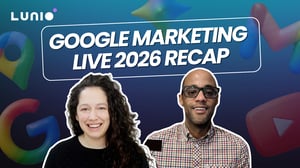
So, after a month spent kicking the tires of the new GML-announced tools, features, and placements - we spoke to Jyll Saskin Gales (Google Ads Coach, Consultant, and Founder of Inside Google Ads, who spent six years working at Google) for her take on what’s actually useful vs. what’s just noise.
Alongside her was Duane Brown (Founder and Head of Strategy at Take Some Risk, a performance marketing agency that scales PPC for eCommerce, DTC, and SaaS brands across three continents).
Both have strong opinions on GML, both work in accounts every day, and, coincidentally, both happen to be Canadian. If you want to know where PPC is headed (and what you should be doing about it), this session is a must-watch.
Watch the full session on-demand here - or keep reading for Jyll & Duane’s key takeaways from GML 2026:
Video timestamps:
0:00 - Intro & Icebreaker poll
07:58 - Session agenda
10:20 - Key announcements from GML 2026
12:15 - AI Mode ad format advice
18:09 - The new agentic buying journey
25:06 - New Ask Advisor: Should you trust it?
30:01 - New Asset Studio: Should you use AI gen assets?
35:16 - What to do right now, following GML 2026
42:50 - IVT by Google campaign type
46:26 - The GML attribution problem
51:48 - Key resources from Jyll & Duane
55:07 - Live audience Q&A
AI Mode ads: Timeline & how to set them up for success
The headline feature from GML was the new set of Gemini-powered ad formats built into conversational search, things like Conversational Discovery ads and Highlighted Answers.
Jyll recorded a clip for Google at the event where she called herself excited but nervous:
So the obvious first question was whether, a month on, any of it has actually materialized in real accounts.
Short answer: not quite yet.
But there are two separate things to watch here: whether these ads are appearing in the wild, and whether you can tell if your own account served one.
On the first, you may start seeing them in the wild. On the second, there is currently no reporting whatsoever that lets you know if you're serving ads in AI Mode.
"You cannot look at your Google Ads account today and know if you showed an ad in AI Mode or an ad in AI Overviews, because that reporting's just not there." - Jyll Saskin Gales
You can certainly make yourself eligible to appear in these surfaces by turning on AI Max, Performance Max, or broad match - and by enabling features like text customization and final URL expansion.
But you have no way to confirm you are showing up, no way to measure how it performs, and no reporting infrastructure to catch you if it goes wrong.
"It's sort of a leap, before the parachute is there to catch us if needed."
- Jyll Saskin Gales
Duane's advice was to resist the fear of missing out and apply some basic math. If AI Mode surfaces represent a tiny fraction of your traffic today, they deserve a proportionally tiny slice of your attention.
"If you have 1% of your traffic from everything AI Mode related, we shouldn't be spending more than 5% of our time on that 1% potential return."
- Duane Brown
But, as Duane suggested: Get your brand inputs in order now.
Nail down how you talk about your brand, what your customers actually care about (mining your last thousand reviews is a fast way in), and the messaging and business data you will feed the machine. Those are the housekeeping items everyone plans to do tomorrow, and tomorrow never comes.
The agentic shift: How to deal with the whole buying journey happening inside AI
Underneath the ad formats is Google's much bigger bet: moving the whole research-to-decision journey inside AI.
The framework splits into two paths after the shortlist stage:
- eCommerce with native checkouts and AI-built offers
- Lead generation via a new business agent for leads that triages inquiries on your behalf
The trade-off is the one you would expect. You gain reach and reduced friction, and you give up targeting control and ownership of the brand experience.
Duane has been tracking the Universal Commerce Protocol - the standardization effort that lets your products surface across AI agents like ChatGPT, Copilot, and Google. Think of it as schema markup, except aimed at agents rather than browsers. Here’s Duane’s verdict:
"Unless you're already seeing tons of traffic from there, maybe it's not a thing you need to work on today. Maybe focus on something like SEO, because a lot of people still sleep on SEO."
— Duane Brown
On the business agent for leads, Jyll was equally measured, calling it a nice vision she would not expect to see live in accounts before the next GML.
And when we asked both guests to put a timeline on this agentic future, the answers were pretty telling. Jyll drew a sharp line between the platform changing and human behavior changing:
"By 2028, keywords will truly, truly, truly be dead. Our jobs, in my prediction, will be completely unrecognizable from what we did in 2022."
— Jyll Saskin Gales
But she does not believe consumers will hand their whole lives to an agent.
Buying toilet paper or a new water bottle, maybe. But things like clothing and flights? Pretty unlikely. Rand Fishkin summed it up the sentiment in his episode of the Paid Media Lab (which is well worth a watch):
“I’m not gonna tell AI to buy my airline tickets. I don’t trust them to pick the seats correctly, and if they mess up, who’s to blame? Do you think Sam Altman is gonna be like ‘oh, sorry, I’ll upgrade you to first class next time?’ No!” - Rand Fishkin
People want control and reassurance when making bigger purchases. A world where brides-to-be hand their wedding dress purchase over to an AI Agent won’t be upon us any time soon. Businesses won’t be pinning their tech stacks solely on what an AI Agent thinks is best. You get the idea.
Duane mentioned a helpful benchmark that's worth stealing:
Don’t treat agentic commerce as serious revenue until the money it brings a business eclipses what that business already earns from Microsoft Ads.
Is Google Ads’ Ask Advisor accurate yet, or still a work in progress?
Google leaned hard on the word "agentic" when describing Ask Advisor, its Gemini assistant that now spans Ads, Analytics, and Merchant Center.
Jyll has tested it repeatedly; first when it launched as Ads Advisor back in November, then again more recently after its GML update.
In the account she tested, it recommended putting locations "on observation instead of targeting," a setting that has never existed.
"Google calls it agentic, agentic, agentic. Agentic means it can go take action. And right now, Ask Advisor is a chatbot." — Jyll Saskin Gales
Part of the issue is by design. Ask Advisor draws on the whole open web rather than only Google's own documentation, which stops it being a pure sales tool for turning up your budget, but also means it confidently repeats things that are simply wrong.
Jyll’s Ask Advisor test in Google Analytics produced a perfect illustration: she asked for her top landing page by conversion rate, and it surfaced a page with exactly one session and one conversion.
"It was technically correct, but no human would have given me that answer."
— Jyll Saskin Gales
So, if you plan on using Ask Advisor, take its answers with a huge heap of salt. Or, until we see notable improvements, maybe just stay away altogether.
That said, Jyll is optimistic about where it goes. It is being trained on account data, Google's teams clearly want it to work, and the in-tool feedback mechanism is reviewed by the people building it. So if you do test it and get a bad answer, it’s worth spending the 30 seconds it takes to flag it to Google.
The moment it can actually act on a recommendation rather than just describe one, the conversation changes entirely.
Google Ads Asset Studio: AI creative that's finally good enough to use?
The rebuilt Asset Studio, powered by Nano Banana Pro, can now generate image and video creative from a text prompt with brand guidelines baked into the process.
This is the announcement Duane was most enthusiastic about, and for one specific reason: it changes the economics for smaller advertisers.
Plenty of the brands his agency works with (usually businesses doing half a million to a million a year in revenue) do not have a designer on staff. Their alternative has usually been Canva, and Duane was very honest about how that tends to go:
"Everyone thinks the thing they made in Canva is beautiful, but half the time, it's really ugly."
— Duane Brown
Because these tools can pull real assets from your website, your Merchant Center, and YouTube, they give a small brand a running start rather than a blank page. And the output is often close enough to on-brand that a client will sign off.
The catch is that "often" is not "always," and the risks scale with your industry. In finance, pharma, or anything heavily regulated, auto-generated creative is close to a non-starter for now.
The two dangers Duane flagged are worth keeping in mind:
- First, intellectual property: if a tool pulls assets you did not provide, you may end up running something you never had the rights to use.
- Second, plain accuracy: does the copy say something you are not legally allowed to say? His agency's fix is a human-review checkpoint before launch, plus a habit of re-checking ads live twelve to twenty-four hours after they go out (because the preview is not always what ships).
Jyll added a technical footnote every account should act on:
Automatically created assets are an account-level setting, and if you have not checked it recently, you may be surprised what is already running alongside your ads, including images pulled from your site that you may not have the rights to advertise with.
GML: Hype vs. substance, and thriving in shades of gray
So, two months after Google Marketing Live, which of the new features are actually moving the needle?
Jyll's answer was lead generation, an area that usually gets left behind while ecommerce takes the spotlight. Beyond the main stage, the announcements document listed roughly a dozen new lead-gen betas, and the one she is most bullish on is journey-aware bidding. Her reasoning ties back to one hard truth about the discipline:
"The number one struggle for lead gen advertisers is getting that proper conversion data foundation via offline conversion tracking. It's not sexy, but it's needed more than ever."
— Jyll Saskin Gales
Duane was, generally speaking, more skeptical of the event as a whole. Outside the creative tooling (including Pomelli, a separate Google creative product he is testing for clients who refuse to hire a designer) he felt most of GML was a repackaging exercise.
"It's no Steve Jobs iPhone 2007 type thing. It's everything we talked about over the last twelve months, but they're telling you again so you don't forget."
— Duane Brown
He even reached for a cautionary comparison to voice search circa 2017 - all hype, little revenue movement. Though he was careful to say he expects AI to fare better than voice ever did.
Jyll's writing on thriving in "shades of grey" is a useful mindset to take forward following GML. The trap, she argued, is binary thinking. The old playbook of keywords, bids, and hand-crafted ads still works today, which is precisely why it is so hard to abandon, and why so many advertisers keep running 2016 tactics that only sort of work in 2026.
"I actually think you're wasting your client's money if you're only still doing what was working in 2016. You're not setting them up for success in the future."
— Jyll Saskin Gales
The mindset she recommends is not to throw away two decades of expertise, but to stop treating automated bidding and automated creative as experiments and start treating them as table stakes.
Or, in the line that summed up the whole session:
Your data is the control you need to feed the automation to do what you want it to do.
Traffic quality and attribution: When conversions hide inside AI
There is a quieter consequence running through every one of these announcements. As Google pushes ads onto broader, more automated AI surfaces, more of your budget flows into places you cannot fully see, and broader automated matching inevitably scoops up more low-quality traffic along with the good.
That visibility problem bleeds straight into attribution, which only gets murkier as conversions and lead submissions start happening inside conversational journeys rather than on clean click-to-landing-page paths.
Google's answer is more modeled, predictive measurement: namely a new metric called Qualified Future Conversions, and continued work on Meridian, its open-source marketing mix model. Jyll admitted she laughed out loud when she first read the QFC announcement, then reconsidered:
"The yardstick, at the end of the day, is your bank account." — Jyll Saskin Gales
Her point is that for lead gen and B2B, where neither you nor Google knows whether a click converts until months later, a metric that predicts likely converters earlier could really help.
None of it is perfect, which is why the ultimate test stays the same: your analytics, your Shopify dashboard, your profit and loss.
Duane's addition was that plenty of advertisers still have no real analytics set up, and a store platform is not an analytics platform.
"That would put more businesses ahead than trying to buy a Northbeam or a Triple Whale, tools that cost tons of money but no one's really going to use."
— Duane Brown
Final thoughts
GML 2026 was less a set of finished products than a map of where Google intends to take advertising, some of it arriving now, much of it a vision for the next few years.
The through-line from both experts was the same:
The foundations of Google Ads have not changed, the fundamentals of quality, offer, and data still decide who wins, and the smartest response is to keep testing the new automated features without gambling the account on any single one.
Or, as Jyll’s shades-of-grey argument goes:
Don't leap blindly into the future, but don't try to turn back time either.
For the parts we couldn’t fit into this recap blog, make sure you watch the full webinar. It includes a live Q&A covering small-budget AI Mode strategy, setting up auto-created assets safely, campaign structure, and advice for anyone just starting out.
And of course, a huge thank you to Jyll Saskin Gales and Duane Brown for the honest, hands-on read on what GML actually means for the rest of us.
Make sure to follow Jyll on LinkedIn and check out her Inside Google Ads podcast, especially the GML 2026 recap with Google's Ginny Marvin, and follow Duane on LinkedIn for his ongoing perspective at Take Some Risk.
Session docs, resources, & articles:
Follow our guests:
Catch up on GML 2026:
- Inside Google Ads — Ep 121: GML recap w/ Google's Ginny Marvin
- Google's official GML 2026 announcement hub
- Search Engine Land: GML 2026 explained
- Marketing O'Clock GML recap (ft. Jyll)
- Maximilian vom Eyser on the newly revamped Asset Studio
Show up in AI Mode & the agentic shift:
- Jyll's free Inside Google Ads blog
- Google Ads × Jyll: reacting to ads in AI Mode
- Duane on “guiding the machines” (Strategy Sessions)
What to do now (the practical toolkit):
- Jyll's “shades of grey” post
- Inside Google Ads: Canada's Google Ads conference at the CN Tower, Oct 29 2026
- Jyll's book: Inside Google Ads (Audience Targeting)
- Mike Ryan’s UCP presentation
- Nils Rooijmans — PMax Placement Exclusion script
- Nils Rooijmans — 400+ script library & app-exclusion guide
- Mike Rhodes — PMax Insights / “Whisperer” script
Protect traffic quality & measurement:
- Lunio - 2026 Global Invalid Traffic Report
- Lunio - IT & Security Invalid Traffic Impact Report
- Google Meridian - open-source marketing mix model · GitHub
- Lunio - plain-English Meridian explainer
- Take Some Risk (Duane’s PPC consulting & performance marketing agency)
- Audit your traffic quality (for free!)

Table of Contents
On average, 8.51% of your ad budget is wasted.
But that number can be much higher. Find out how much you're spending on bot traffic.