


Invalid traffic consists of bots and humans who interact with your ads without any interest in your ad content or product.
It’s the source of billions in wasted ad spend — so while it’s very common, it’s also important to understand what invalid traffic is and how to tackle it.
If you’re seeing an uptick in ad clicks but no change in conversions, you could be a victim of invalid traffic.
So what is invalid traffic? Here, find out the industry definition of IVT, why it’s harmful for advertisers, and how to detect and prevent it effectively.
Key takeaways
- With bots now accounting for 53% of all internet traffic and an estimated $63 billion lost to IVT in 2025, invalid traffic is a major challenge for digital advertisers in 2026.
- IVT is divided into general invalid traffic (GIVT) and sophisticated invalid traffic (SIVT). Built-in ad platform filters can detect most GIVT, but they identify only around 40% of SIVT, which uses tactics such as residential IPs and human-like behavior to evade detection.
- The financial and operational impact of IVT extends beyond wasted ad spend. IVT also corrupts Smart Bidding and automated campaign algorithms, damaging future campaign performance.
- Effective IVT prevention requires advanced methods that go beyond platform-level filters and rules-based approaches. Lunio monitors 100% of traffic with machine learning-driven detection, blocking IVT before it can waste budget or pollute campaign data.
What is Invalid Traffic (IVT)?
Invalid traffic (IVT) refers to any online activity (such as clicks, impressions, and video views) which is generated by users who have no real interest in the content they’re interacting with.
IVT leads to wasted advertising budget, lost revenue, distorted performance metrics, and automated campaign corruption.
According to Imperva’s Bad Bot Report 2026, 53% of all internet traffic is made up of bots — a 2% increase on 2025. For advertisers, this equates to billions wasted annually. $63 billion was lost to invalid traffic in 2025, according to our 2026 Global Invalid Traffic Report.
The problem is growing as more campaigns rely on automation to run effectively. Our research found that enabling AI Max on Google campaigns increased the average IVT rate by 35% — and Google is pushing more widespread adoption of AI Max starting in 2026.
Tackling IVT is essential for performance marketers who want to get the best return on their ad spend and feed future campaigns with accurate data. In this guide, you’ll learn about the different types of IVT, how invalid and bot traffic affects performance and spend, and the signs of IVT to look out for in your campaigns.
Understanding invalid traffic (IVT)
The Media Rating Council (MRC) sets the industry standard for monitoring and measuring invalid traffic. The MRC IVT definition is:
“Traffic or associated media activity (metrics associated with ad and content measurement including audience, impressions and derivative metrics such as viewability, clicks and engagement as well as outcomes) that does not meet certain quality or completeness criteria, or otherwise does not represent legitimate traffic that should be included in measurement counts.”
Invalid traffic can consist of:
- Bots and botnets — Automated software programs that generate fake clicks, impressions, or online activity.
- Click farms (both human and automated) — Groups of people or systems that artificially generate clicks, views, or interactions.
- Accidental clicks — Unintentional ad clicks made by real human users who didn’t mean to interact with the ad.
- Malware — Malicious software that can hijack devices to generate fraudulent ad clicks, traffic, or other unauthorized activity.
- Competitor sabotage — Intentional clicks on a competitor’s ads, designed to exhaust their advertising budget or distort campaign performance.
- Pre-fetch activity — Automated webpage or ad loading before a user intentionally accesses them.
Importantly, IVT doesn’t include real users with low intent. These users purposely click the ad, but usually have a non-malicious motive that doesn’t reflect your conversion goal. Low-intent users might be job hunters, existing customers, or competitors doing genuine market research.
Invalid traffic is often deployed with malicious intent, but not always. Accidental clicks, SEO crawlers, and other basic bots can easily generate invalid interactions, but aren’t usually considered malicious.
While malicious IVT is the most damaging type, it’s important to filter all IVT out of your campaigns. Any type of IVT can drain your ad budget, pollute your data, and lead to poor performance marketing decisions.
Invalid traffic vs click fraud: what’s the difference?
The terms ‘invalid traffic’ and ‘click fraud’ are sometimes used interchangeably, but they have distinct meanings.
-
Invalid traffic is a catch-all term for any kind of online activity generated by users without genuine intent to interact with your ad. It doesn’t always have a specific motive.
-
Click fraud is a type of malicious invalid traffic which is designed specifically to sabotage your PPC efforts.
GIVT vs SIVT
Invalid traffic is split into two categories: general invalid traffic (GIVT) and sophisticated invalid traffic (SIVT).
This distinction is the key to whether your click fraud detection platform works effectively — if it only blocks GIVT, your ads are vulnerable to the most sophisticated attacks.
The table below demonstrates the key differences between GIVT vs SIVT:
|
Criteria |
GIVT |
SIVT |
|
Intent |
Accidental and/or innocuous |
Intentional and/or malicious |
|
Examples |
Accidental clicks; basic bots; known crawlers |
Botnets; agentic bots; malware |
|
Mimics human behavior/biometrics? |
No |
Yes |
|
Ease of detection |
Easy |
Difficult |
|
Detection evasion techniques |
None (uses data center IPs, no attempt to mimic human behavior) |
Uses residential IPs and mimics scrolling and other human behaviors |
|
Detection method required |
Rules-based filters |
Machine learning and behavioral analysis |
|
How much do built-in platform filters detect? |
~95% |
~40% |
|
Risk |
Low — easy to detect and filter out |
High — easily evades detection |
Built-in ad platform filters are generally quite good at detecting GIVT, but more than half of SIVT goes undetected. SIVT is the most harmful type of IVT, so it’s essential that your click fraud detection solution can identify SIVT as well as GIVT.
The true cost of invalid traffic
According to our 2026 Global Invalid Traffic report, the average IVT rate across all major ad platforms is 8.51%. So here’s the real IVT cost breakdown: for every $10K you spend on paid media, $850 is spent on invalid traffic that won’t convert.
But the damage doesn’t end there. Smart Bidding and automated campaigns like Performance Max are trained on your previous click and conversion data.
Feeding these algorithms with IVT-heavy signals endangers future campaign performance, leading to skewed attribution, decision-making based on poor data, and a CRM full of spam leads.
Some ad platforms will refund invalid clicks they identify, but this happens after the click, when the damage is already done. While you will get the click cost back, your data has already been polluted with problematic data from invalid traffic, creating a negative feedback loop that results in poor performance.
We’ve seen businesses experience this first-hand. Funding Circle received some “invalid activity adjustment” refunds from Google, but felt sure some IVT was flying under Google’s radar. And they were right — a Lunio traffic audit established they had an IVT rate of 16.84%.
Lunio filtered out the offending traffic, reducing their IVT rate by a huge 81.4%. This led to a 10% increase in their MQL conversion rate, and a 5.8% reduction in wasted ad spend. Read more in our Funding Circle case study.
How much IVT is draining your ad budget in 2026?
The average IVT rate across all channels is 8.51%, but this varies widely by platform.
While Google and Meta have the lowest IVT rates of all major ad platforms (7.57% and 8.20% respectively), advertisers on TikTok and LinkedIn are exposed to the highest IVT rates (24.20% and 19.88% respectively).
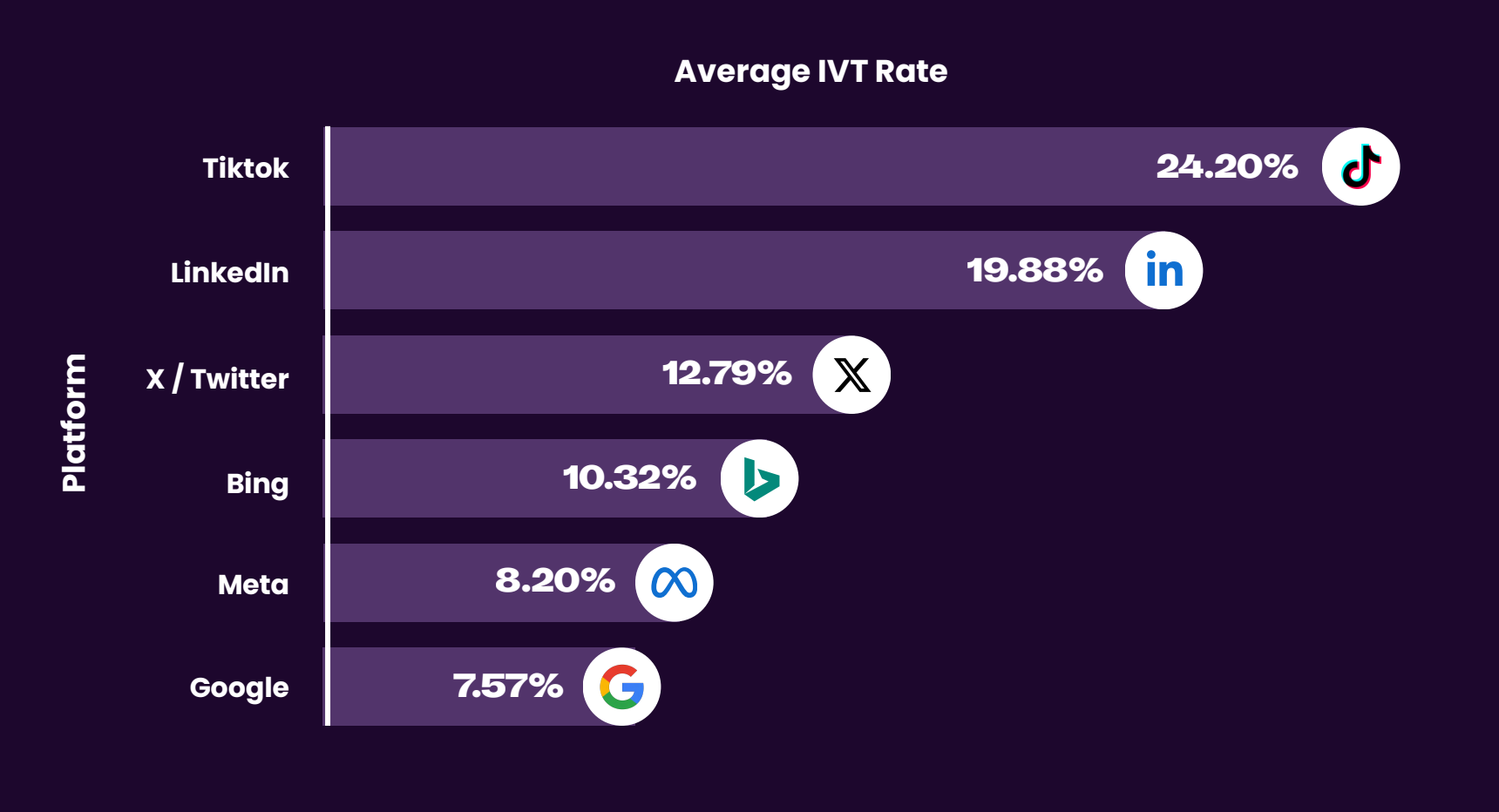
Let’s put these figures in context for a hypothetical business with a $1M annual spend across TikTok, Meta, and Google:
|
Platform & proportion of ad spend |
Total ad spend |
Total wasted ad spend |
|
Google (60%) |
$600,000 |
$45,420 |
|
Meta (20%) |
$200,000 |
$16,400 |
|
TikTok (20%) |
$200,000 |
$48,400 |
|
Overall (100%) |
$1,000,000 |
$110,220 |
This breakdown shows that even if a relatively small proportion of your budget is spent on a high-IVT platform, it can cost a lot. Lead gen businesses are at particular risk. Lead gen campaigns experience 32.07% higher average IVT rates compared with eCommerce models, according to our 2026 Global Invalid Traffic Report.
And the downstream impact inflates these costs even further. When every decision you make is based on distorted data, the issues become embedded into your sales and marketing processes. More time is spent chasing non-existent leads, and more money is spent on low-performing campaigns.
To put these figures into real terms for your ad spend, our click fraud calculator gives you a strong indicator of how much IVT is costing you:


60 seconds, no signup. Built on Lunio's analysis of 2.7B+ ad clicks. Find out your industry's invalid traffic rate, your wasted spend, and the revenue you could recover.
from your business every year. That's $0 every month walking out the door — and another $0 every day you don't act.
Run a free 14-day audit on your live account and see your real numbers — broken down by campaign, keyword, geo and domain.
Calculations based on Lunio's Global Invalid Traffic Report 2026. Eight industries shown use Lunio-measured rates; additional industries use Lunio-methodology estimates calibrated against comparable verticals. Lost revenue applies Lunio's conservative 3:1 ROAS baseline — every $1 of wasted ad spend equals roughly $3 in missed revenue. Actual results vary by account.
Why IVT breaks Smart Bidding & automated campaigns
Automation is becoming increasingly ingrained in paid media platforms. Automated features and campaigns like Smart Bidding, Performance Max, and AI Max rely on clean, accurate data to work effectively.
When invalid traffic infiltrates your data, it starts a death spiral that corrupts algorithms and impairs future performance:
- Sophisticated invalid traffic enters your datastream (if IVT is detected after the click, it can be refunded but can’t be retroactively filtered out).
- Smart Bidding algorithms treat IVT as legitimate and optimizes towards this traffic.
- You spend more on IVT, leading to more invalid clicks.
- More SIVT enters the datastream, restarting the cycle.
Invalid traffic can artificially deflate your cost per click, making performance appear better than it really is. For example, let’s say you generate 50K clicks from a $100K spend. This suggests an average cost per click of $2.00.
Now let’s factor in invalid traffic at a rate of 8.51%. Of 50K clicks, 4,255 clicks are invalid, leaving 45,745 clicks from genuine users. So the true cost per valid click is $2.19 (based on a calculation of 100,000 ÷ 45,745) — a huge swing of 9.3%. That means you could be basing important decisions like spend allocation and campaign scaling on misleading data.
On campaigns where human oversight is lowest — like AI Max and Performance Max — the risk is highest. Advertisers have less control over targeting and variables within these Google automation campaigns, putting you at risk of dodgy placements and high exposure to IVT. Plus, limited in-platform reporting capabilities obscure exactly how much of your traffic is invalid.
To find out if Smart Bidding is being trained on invalid data in your PPC accounts, get a free Lunio traffic audit. We’ll monitor your campaigns for 14 days to show the true impact of IVT.
8 warning signs your campaigns have an IVT problem
If you think you might have an IVT problem but you’re not sure what to look for, this diagnostic checklist tells you which warning signs of invalid traffic to look for in your ad platform reports and Google Analytics 4:
-
Sudden click-through rate spikes with no conversion uplift — Increased clicks should correspond with a rise in conversions if clicks are generated by real users.
-
High bounce rates (>80%) and near-zero session duration — Visitors leaving immediately with little on-page engagement suggests accidental clicks, bots, or incentivized traffic.
-
Traffic from irrelevant locations — Significant traffic originating from regions outside your target market can indicate IVT and poor-quality placements.
-
Repeated clicks from narrow IP ranges — Multiple clicks from the same IP addresses or a small group of IPs may suggest automated activity or coordinated click fraud.
- High impressions, zero engagement — Campaigns generating large numbers of impressions but few meaningful interactions may indicate low-quality placements, ad stacking, and invalid traffic.
- Unusual click timing patterns — Watch out for high click volumes occurring in short bursts when your target audience is normally inactive; review hourly traffic patterns in your reports.
- CRM leads with invalid contact data — An increase in spam or fake leads often indicates fraudulent form submissions, so make sure to audit your CRM lead quality.
- Smart Bidding deficiencies with no obvious cause — If your bidding strategy suddenly becomes less efficient despite no changes to targeting, budget, creative, or market conditions, invalid traffic may be corrupting Smart Bidding signals.
Did you check multiple boxes? Find out how much invalid traffic is affecting your campaigns with a conclusive traffic audit from Lunio. It’s free for 14 days, so book a demo to get started.
How invalid traffic is detected
There are three approaches to invalid traffic detection: platform-level controls, rules-based detection methods, and machine learning (ML) strategies. The table below offers a side-by-side comparison of each IVT detection method:
|
Platform-level |
Rules-based |
ML-based |
|
|
How it works |
IVT controls built into the ad platform |
Basic filters like IP exclusions filter out known crawlers and accidental clicks |
ML models learn about advanced bot behavior to filter out the most sophisticated IVT |
|
GIVT detection |
Most |
Most |
All |
|
SIVT detection |
Minimal |
Minimal |
Most |
|
False positive rate |
Low |
High |
Low |
|
Manual input |
Low, but manual refund requests may be required |
High — Static thresholds and exclusion lists must be updated manually |
Low — ML tools learn automatically and update relevant thresholds and models daily. Human interpretation may be needed in borderline cases |
|
Traffic monitoring method |
Limited sampling |
Limited sampling |
100% of traffic is monitored |
|
Detection timing |
Post-click |
Post-click (or pre-click for known IVT) |
Pre-click |
Built-in platform-level filters are largely unreliable, and not just because they only filter out the most obvious GIVT. Ad platforms have an inherent conflict of interest; they profit from all clicks, whether they’re invalid or not. Refunded clicks amount to a tiny proportion of their revenue.
The profit they stand to gain from invalid clicks is far higher, so there’s not really much incentive to tackle the problem properly. (And it’s worth noting that Google issues ad credits, not refunds — so you’re effectively forced to reinvest in their platform.)
That’s why third-party invalid traffic detection tools are essential. And if you choose a solution that uses advanced ML models to detect the most sophisticated types of IVT, you can protect your campaigns from wasted spend, distorted data, and poor performance.
How to protect your campaigns from invalid traffic with Lunio
You don’t need to write invalid traffic off as the cost of doing business just because built-in platform filters can’t detect SIVT. With the right tools, SIVT is measurable and preventable.
Lunio’s invalid traffic detection solution monitors 100% of your traffic using advanced machine learning tools that are constantly learning about developing bot behavior. It identifies and filters out the most sophisticated types of IVT, including agentic bots driven by AI.
Lunio is built for performance marketers, not IT teams — so it’s easy to implement, with no cookie dependencies or site performance problems. We can have you up and running in less than 1 hour.
Ready to see what you're up against? Get a free 14 day traffic audit from Lunio. We’ll monitor your campaigns to give you a true picture of the GIVT and IVT infiltrating your PPC efforts.
FAQ
Discover more about invalid traffic and invalid clicks in these frequently asked questions.
-
Is bot traffic the same as invalid traffic?
Bot traffic is a subset of invalid traffic. All bot traffic is invalid, because it’s not generated by humans with a vested interest in your brand — but not all invalid traffic comes from bots. Human click farms and accidental clicks by real human users are both types of invalid traffic.
-
What percentage of my traffic is likely invalid?
The average IVT rate is 8.51%, but you can get a slightly more accurate estimate of your IVT rate based on which ad channels you’re using. The average IVT rate varies widely by platform:
- TikTok — 24.20%
- LinkedIn — 19.88%
- X/Twitter — 12.79%
- Bing — 10.32%
- Meta — 8.20%
- Google — 7.57%
The IVT rate varies even within each channel. For example, Google Video
Partners have much higher IVT rates than Search, PMax, and Demand Gen campaigns.
Other variables can also affect your invalid traffic rate (for example, lead gen businesses are at higher risk of IVT than ecommerce companies).
Note: Use our Click Fraud Calculator to get an accurate picture of how much invalid traffic is eating into your ad budget:
-
Can Google Ads completely prevent invalid traffic?
In most cases, no — Google Ads does filter out some IVT, but not all of it by a long shot. Additionally, Google Ads doesn’t really prevent IVT, as it only identifies it after the click. So some invalid activity might be refunded but this doesn’t prevent data distortion or skewed campaign performance reporting.
-
How do I know if my campaigns have invalid traffic?
Use our diagnostic checklist to find out if your campaign has an invalid traffic problem. Check your analytics platforms for:
- CTR spikes with no corresponding increase in conversions.
- >80% bounce rates with near-zero session duration.
- Significant traffic from irrelevant or unexpected locations.
- Repeated clicks from narrow IP ranges.
- High impressions with zero engagement.
- High click volumes at unexpected times (out of hours).
- CRM leads with invalid contact data.
- Smart Bidding deficiencies with no obvious cause.
You can also use a dedicated click fraud detection tool like Lunio to discover your IVT rate and block invalid users from interacting with your ads before the click.
-
Do I need a specialized IVT detection tool?
Yes. Advertisers need a specialized third-party IVT detection tool because ad platforms aren’t incentivized to properly tackle invalid traffic. Refunds don’t do anything to stop data pollution or corrupted Smart Bidding signals that impair future PPC performance.
Independent IVT blocking tools that detect and stop IVT before the click are essential, especially as the industry moves increasingly towards automation and limited human oversight.
Larger advertisers can (and have) appeal to Google for more substantial refunds with evidence from third-party IVT detection tools.

Table of Contents
On average, 8.51% of your ad budget is wasted.
But that number can be much higher. Find out how much you're spending on bot traffic.