


Diagnosing invalid activity in your performance marketing campaigns isn’t easy, especially as agentic and AI-driven bots enter the frame. But there are some telltale invalid traffic signs that indicate potential IVT infiltration — you just need to know what to look for.
Here, discover how to detect invalid traffic in your paid media campaigns with these 7 key invalid traffic signs. Find out how to tell if your traffic really is invalid with our helpful self-diagnosis tools, and see what you can do to reduce the risk of IVT today.
Key takeaways
- Invalid traffic (IVT) is any click or impression that doesn't come from a genuine, interested user. It hides inside metrics most marketers check every day, so you might be able to spot it early — when you know what to look for.
- No single metric proves you have an IVT problem. Rather than looking for one overarching marker, you’ll need to identify a pattern across several symptoms. The more boxes you tick in our IVT diagnosis checklist, the more likely it is you have a problem.
- Bots now make up the majority of all web traffic, with AI and LLM-driven bots driving this rise. So the symptoms of bot traffic infiltration have moved beyond bounce rates and click spikes into lead quality and automated campaign performance.
- Spotting the signs of invalid traffic is just the first step to tackling it. Next, you need to quantify your IVT exposure, so you know what invalid traffic detection measures to take. Lunio’s free 14-day traffic audit gives you a baseline benchmark, so you can see exactly how much invalid activity is affecting your campaigns.
As a performance marketer, invalid traffic can creep up on you. While the early signs are there — slowly increasing CPAs; no response from leads; budget gone by lunchtime — it’s hard to know definitively just how much IVT is affecting your performance marketing campaigns.
But there are usually signs of invalid traffic in your analytics and ad platforms — you just need to know what to look for.
The clearest signs of an invalid traffic problem are traffic or CTR spikes with no increase in conversions, high bounce rates with virtually no dwell time, high click volumes from unexpected locations, scheduled bot-like traffic patterns, rapid budget depletion, fake leads in your CRM, and poor results from automated ad platforms.
If you’re seeing any of these signs, there’s a chance your budget is being spent on bot traffic. According to Imperva’s 2026 Bad Bot Report, 53% of all web traffic is now automated rather than human. And with the rise of AI, it’s getting much more difficult to block the most subtle, sophisticated types of IVT, driving the cost of invalid traffic even higher.
Spotting one of these signs isn’t usually enough to confirm your suspicions. But when you see multiple indicators, it’s time to investigate further. Here, you’ll learn more about the 7 signs of invalid traffic, how to confirm it, and how to fix it.
First, what counts as invalid traffic?
According to Google, the definition of invalid traffic is any activity that doesn't come from a user with a real interest in your product or service:
“Invalid traffic is any activity that doesn't come from a real user with genuine interest. It can include accidental clicks caused by intrusive ad implementations, fraudulent clicking by competing advertisers, advertising botnets and more.”
Not all IVT is malicious. IVT is typically split into two categories: general IVT (GIVT) and sophisticated IVT (SIVT). Where GIVT is normally benign and easy to filter out, SIVT is designed to evade detection and affect campaign performance. Many platforms can catch GIVT but miss most SIVT, which is why you’ll still see invalid traffic signs despite built-in platform filters.
|
Category |
General invalid traffic (GIVT) |
Sophisticated invalid traffic (SIVT) |
|
Intent |
Generally benign |
Generally malicious |
|
Sources |
Accidental clicks from real users, VPNs and proxy servers, test accounts, data centre traffic, non-malicious bots |
Click farms, malicious bots, any bot attempting to impersonate a human user |
|
Detection methods |
Filters and parameters, click fraud prevention software |
Advanced analytics and human intervention, click fraud prevention software |
|
Why it matters |
Despite the lack of malicious intent, GIVT can still skew results and affect bidding algorithms, especially if it’s only detected after the click |
SIVT is built to evade detection, so rules-based filters can’t always remove SIVT. Agentic bots are making SIVT even harder to detect |
Both GIVT and SIVT can cause invalid clicks and wasted ad spend, so you need to eliminate both types of IVT from your ad traffic.
The 7 signs you have an invalid traffic problem
Discover the 7 most common signs of invalid traffic, including what to look for in your reports, why it could indicate IVT, the specific metrics and thresholds to look for, and what to do next.
1. Increased clicks with no lift in conversions
Sign: An uptick in genuine human traffic would usually lead to a corresponding rise in conversions (assuming no changes to your ads or landing pages). Bots behave differently, and won’t complete any on-site transactions — so a spike in clicks or click-through rate with no corresponding increase in conversions could signal IVT.
Data signature: A significant rise in clicks and/or CTR, but conversions stay flat. Check this in Google Analytics 4 (GA4).
What it might look like: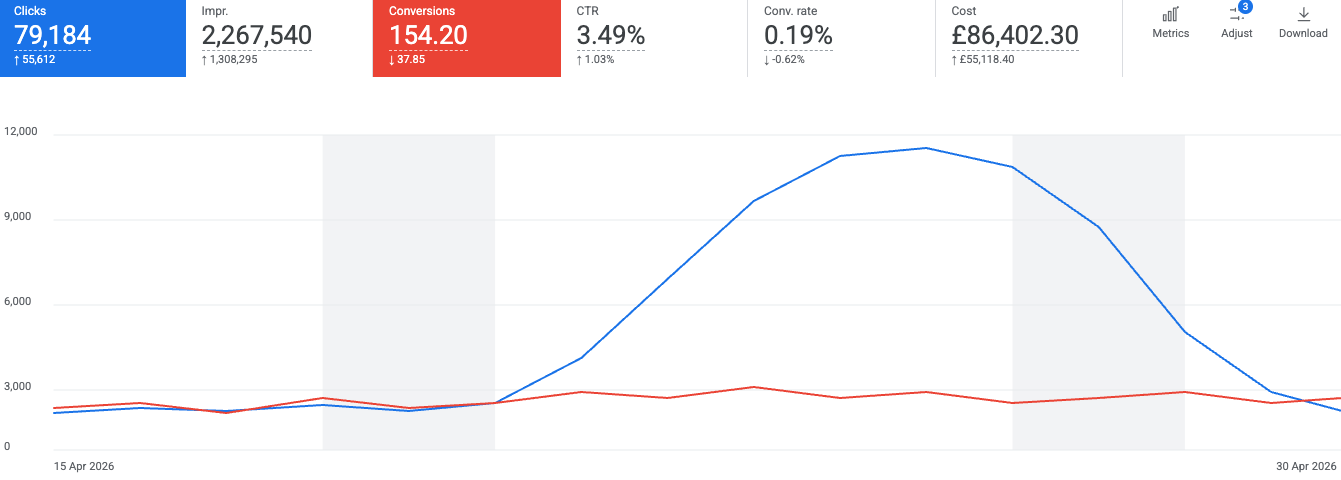
What to do: Segment the data by campaign, placement, and geography to identify where the additional clicks are coming from. Clicks from made-for-advertising websites and unexpected locations may be more likely to indicate IVT.
Top tip: check Display Network and Search Partners first, as they’re known for driving low-quality traffic. According to our Global IVT Report 2026, Display has a 12.02% IVT rate, compared to 5.21% in Google Search. Adjust your placements and campaign settings accordingly when you’ve located the IVT source.
2. High bounce rates with near-zero dwell time on paid traffic
Sign: Bots don’t hang around after they’ve clicked through to your website, which manifests as engagement collapse: higher-than-average bounce rates and very low session times.
Data signature: The bounce rate on paid traffic is much higher than your normal bounce rate (bounce rates above 70% are normally considered high). The average session duration is much lower than normal (a healthy session duration is normally anywhere from 35 seconds to 2.5 minutes).
What it might look like:
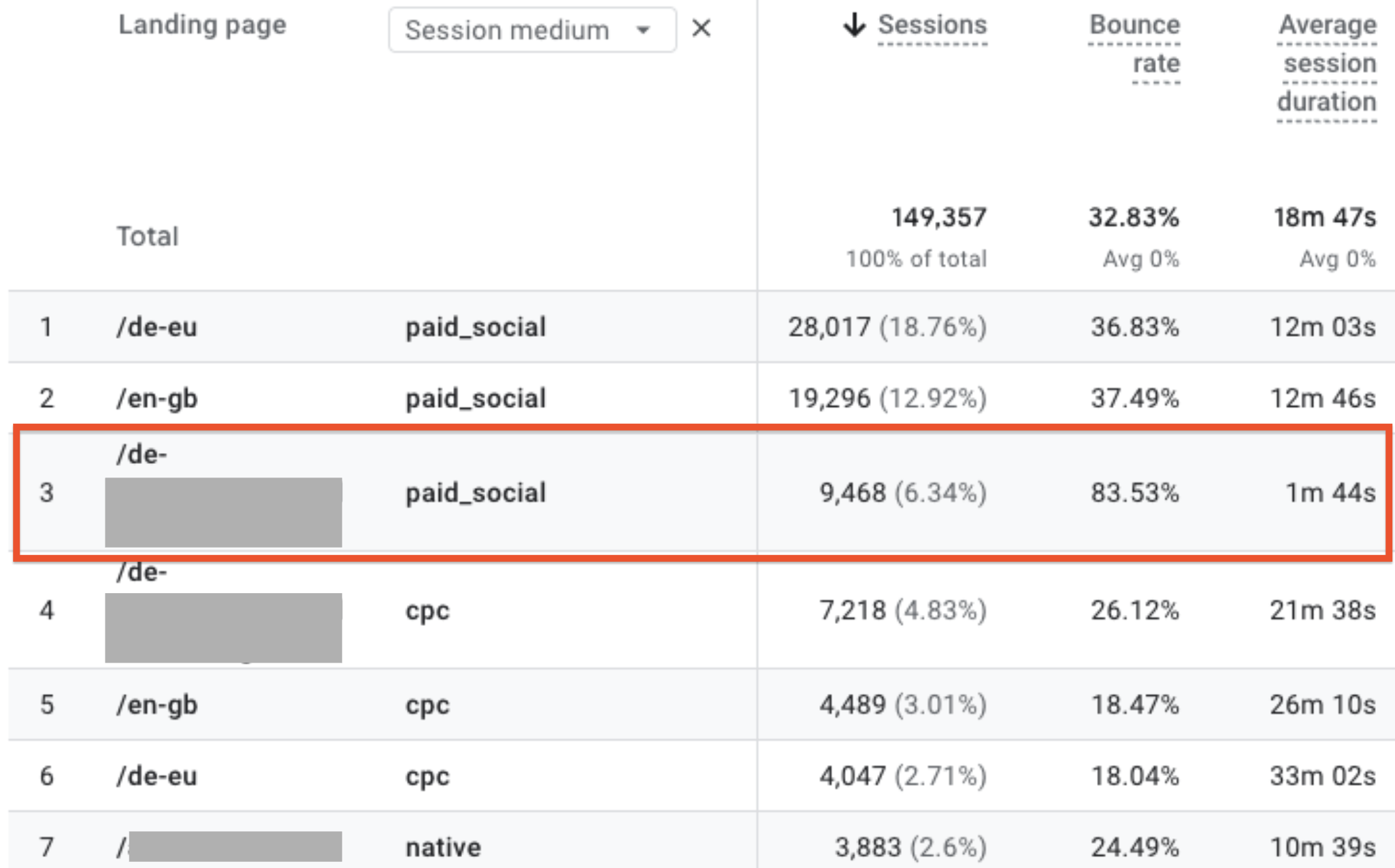
What to do: Cross-reference your data by source/medium to see which channels and campaigns are generating the high bounce rate/low session time visitors.
Isolate the problem campaigns and investigate further to see if there’s another reason for these metrics (such as targeting changes or landing page relevance issues). If not, you may be dealing with IVT.
3. Surge of clicks outside target geographies
Sign: An unexpected rise in clicks from outside your targeted locations often indicates IVT because humans are unlikely to have been exposed to your ads in these regions.
Data signature: GA4 shows an unexpectedly high number of clicks or sessions from regions you don’t target or do business in.
What it might look like:

What to do: Check your ad location targeting settings. If you have broad geo targeting switched on, your ads may be shown in areas that Google deems to have “presence or interest” in your region, even if they’re located elsewhere. In this case, your traffic may be genuine (even if it’s less likely to convert).
Next, investigate whether a significant proportion of the traffic originates from regions commonly associated with click farms. Research shows click farms are more common in Asian countries like India and Indonesia.
4. Scheduled or repeated traffic patterns from the same sources
Sign: It’s normal to see general patterns emerging in your traffic data (for example, B2B advertisers often see fewer site visits at the weekend) but normal traffic is varied and unpredictable. If you notice identical patterns that repeat frequently and come from the same sources, this can suggest IVT.
Data signature: Identical traffic curves on a fixed schedule, or repeat clicks from a narrow range of IPs or residential proxies. Check the audience over time graph in GA4 to see if these patterns exist.
What it might look like:
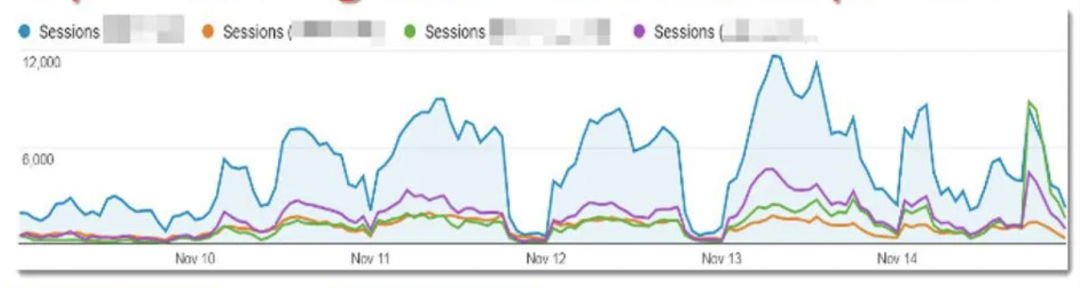
What to do: Google limits the number of IP addresses you can manually exclude, so check to see if you’ve hit Google’s manual 500 IP exclusion limit. If you haven’t, you can add these IPs to the list, but bear in mind most advertisers hit the limit quickly. This is the point at which it becomes much harder to tackle IVT yourself, and many advertisers turn to click fraud detection platforms to automate the process.
5. Your daily budget is spent before your best hours
Sign: If your budget is drained early in the day — especially before your typically top-performing hours — it can indicate IVT. Rapid automated activity exhausts your ad budget quickly, and doesn’t always align with your normal traffic patterns.
Data signature: Your data shows spikes in spend out-of-hours, especially earlier in the day. These spikes don’t usually have a corresponding increase in conversions.
What it might look like:
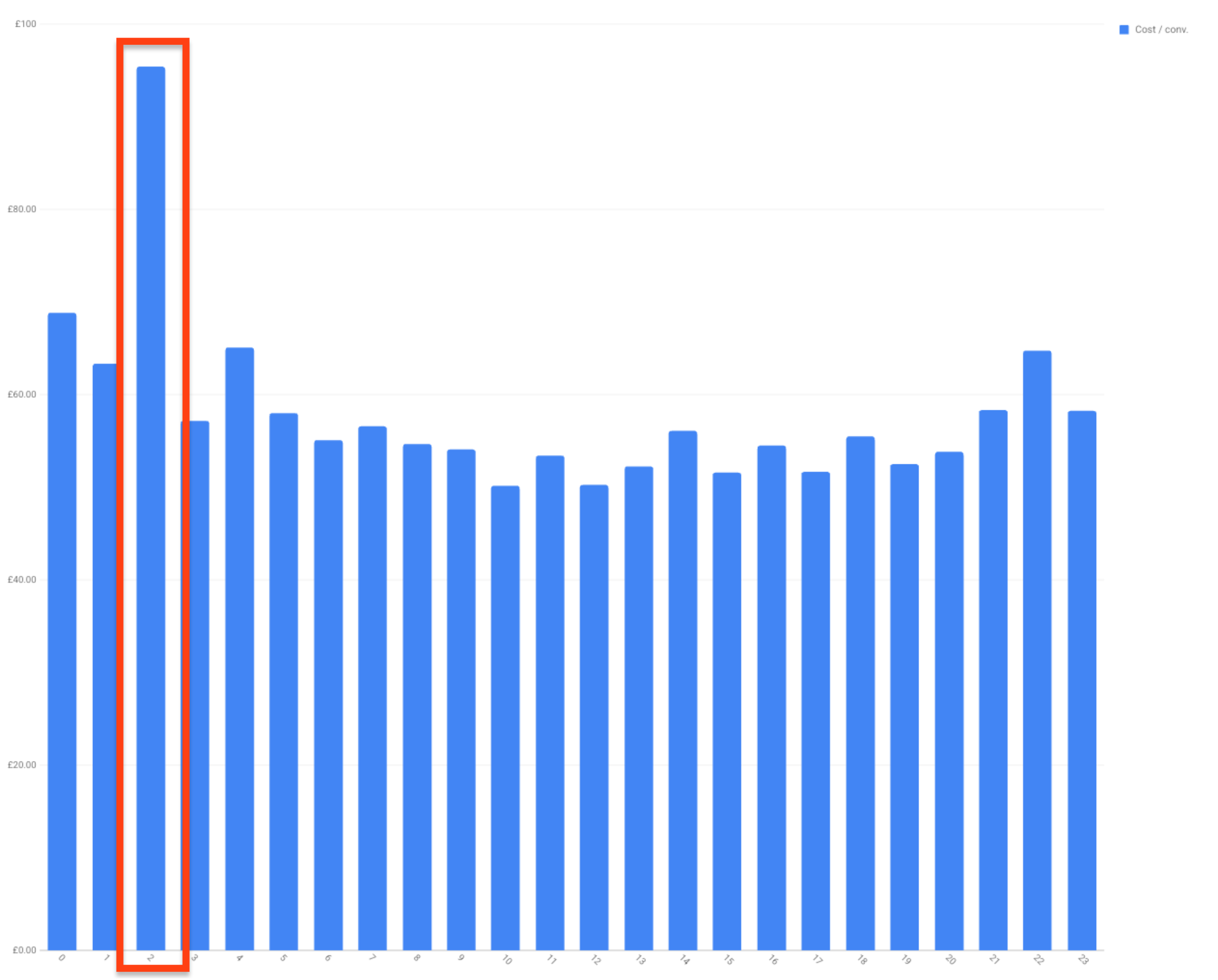
Chart showing average cost/conversion for every hour of the day.
What to do: Review your ad schedule settings to check your ads are only being shown during your preferred hours. If not, adjust your ad schedule.
If your ad schedule looks OK but your budget is still being depleted unusually early, you’ll need to investigate the click bursts for other signs of invalid activity (e.g. check to see if they coincide with high clicks and flat conversions, or high bounce rates with low session duration).
6. Your CRM contains spam and fake leads
Sign: If you’re seeing obviously fake leads in your CRM (i.e. forms are filled with gibberish) or you’re not getting responses when you follow up on paid media leads, spam leads may be a symptom of invalid activity.
Data signature: Lead volumes are steady or even increasing, but your MQL to SQL conversion rate is dropping. Forms contain invalid email addresses and phone numbers, mismatched names, or leads that never engage with your sales team.
What to do: Add server-side validation (such as validating field values and formats) to prevent automated invalid lead form submission. Additionally, trace the campaigns that are generating spam form fills and adjust them as needed. Consider changing your ad schedules or targeting, or pausing low-performing campaigns.
According to Lunio’s 2026 State of Click Fraud Report, 22.1% of marketing leaders say corrupted CRM data is the most damaging consequence of invalid clicks. Eliminating lead gen fraud is one reason why businesses like Funding Circle turn to Lunio — we increased Funding Circle’s MQL conversion rate by 10% and reduced IVT by 81.4% over 14 months, boosting lead quality and driving highly qualified pipeline.
7. Performance Max, AI Max & Smart Bidding are generating low-quality traffic
Sign: PMax, AI Max and Smart Bidding rely on high-quality traffic data to seek out similar audiences and achieve strong conversion rates. If you notice that these automated campaigns are generating poor quality traffic, it may be because the algorithms are being fed with IVT.
Data signature: Automated campaign traffic data shows a rise in traffic or click volume, but a decrease in conversion quality. PMax, AI Max, and Advantage+ campaigns scale into placements or audiences you can’t see, making it hard to assess traffic quality. Retargeting lists contain high volumes of non-converting traffic.
What it might look like:
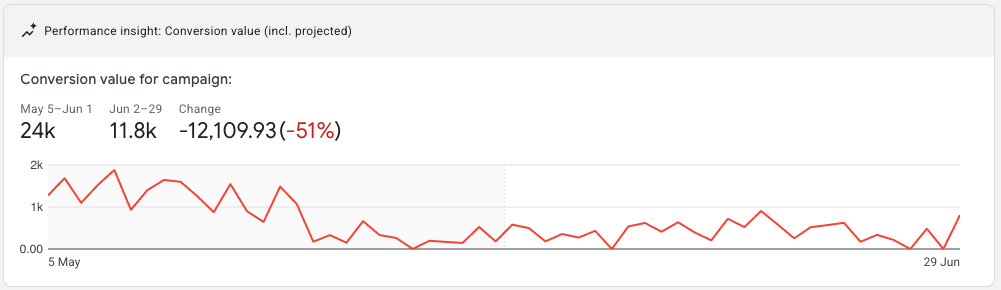
What to do: Lunio research shows that 51.1% of marketing leaders cite automated bid optimization towards bot traffic as a top risk, while almost a third (29.8%) suspect automated campaign types are increasing their exposure to IVT. High invalid traffic rates in AI Max campaigns are already causing concern among advertisers. So as Google continues its push towards PMax and AI Max, it’s important to improve your data quality so automated campaigns can work effectively.
Tighten your automated campaign signals so they’re focused on conversion quality rather than volume. Follow Performance Max best practices such as auditing placements and removing MFA sites to improve the quality of your data feed. Review your retargeting lists and remove medium- to long-term non-converters to improve your data signals.
How to confirm it's actually invalid traffic
On their own, most of these signs have benign explanations. High bounce rates could be explained by landing page changes, while a surge of clicks outside your target location may just be due to wayward targeting settings. But the more boxes you tick, the more likely it is that you’re experiencing IVT.
Lunio’s click fraud calculator can give you an IVT estimate in just 60 seconds. See the IVT rate in your industry and your estimated wasted ad spend in just 3 steps:


60 seconds, no signup. Built on Lunio's analysis of 2.7B+ ad clicks. Find out your industry's invalid traffic rate, your wasted spend, and the revenue you could recover.
from your business every year. That's $0 every month walking out the door — and another $0 every day you don't act.
Run a free 14-day audit on your live account and see your real numbers — broken down by campaign, keyword, geo and domain.
Calculations based on Lunio's Global Invalid Traffic Report 2026. Eight industries shown use Lunio-measured rates; additional industries use Lunio-methodology estimates calibrated against comparable verticals. Lost revenue applies Lunio's conservative 3:1 ROAS baseline — every $1 of wasted ad spend equals roughly $3 in missed revenue. Actual results vary by account.
If all signs are pointing towards IVT, it might be time to get a free professional audit. Lunio offers a free 14-day traffic audit to see how much IVT is actually affecting your campaigns, so you can decide if it’s worth investing in a click fraud detection solution.
Before you ask — Google does detect and filter some bot traffic. But it’s not usually enough to actually eliminate the problem. Google says:
“Our dedicated Ad Traffic Quality Team uses live reviewers, automatic filters, machine learning, and deep research to detect and filter as much invalid and fraudulent activity as possible.”
“When we find something wrong, we try to make it right as soon as possible. We suspend or disable invalid accounts, and may withhold payments to the publisher. When appropriate and possible, that money is credited back to the advertisers — not only for the month where we found the invalid activity, but often for the previous month, as well.”
The key things to focus on here are the use of “as much [...] as possible” and “when appropriate and possible”. “As much as possible” acknowledges that some SIVT will bypass their prevention methods. And with the explosive pace of development in automation and AI, bot activity is getting better at avoiding detection by the day.
Offering refunds “when appropriate and possible” points to the fact large amounts of invalid activity routinely slip through the net. Claiming a refund from Google Ads can be arduous, so most advertisers never recover ad spend lost in this way.
Commenting on why Google has yet to categorically resolve the problem of invalid traffic, Kasim Aslam, founder of Solutions 8, said:
"I think Google doesn’t want people to see: ‘Oh, I didn’t realise how much fraudulent traffic was there.’ So they almost have to keep the problem going, because if they solve the problem overnight, it’s an instant recognition of just how bad this was."
— Kasim Aslam, Founder & CEO, Solutions 8
Google and other ad networks have no real incentive to aggressively crack down on invalid activity. So IVT continues to thrive, leading to wasted ad spend, skewed analytics, and the need for platforms that actually tackle the problem.
How to fix an invalid traffic problem
If you’ve identified invalid traffic signs in your paid media campaigns, it’s time to take action. Here’s what you can do right now to reduce invalid activity:
- Understand your baseline — To spot anomalies and suspicious activity within your traffic, you need to know what normal traffic patterns look like. Become familiar with your audience and combine this information with conversion and reach data from your Google Ads account to better understand how PPC is feeding traffic to your website.
- Prune low-quality placements — Make sure the ad networks you’re advertising on are legitimate and trustworthy. Avoid junk placements like MFA sites, and be wary of advertising on networks like Google Display Network and Google Video Partners, which are known to drive high levels of IVT. Download and exclude our Google Ads placement exclusion list and PMax placement exclusion list to minimize exposure to these junk placements.
- Never buy traffic — No matter how much you want to see an increase in site traffic, it’s never a good idea to pay for it. Services that claim to send more traffic to your site almost always use bots to make up the numbers they’ve promised. These will skew your figures and make reporting unreliable.
- Use GA4 referral exclusions for one-off domains — Use GA4 referral exclusions to exclude domains from your data if you notice a significant anomaly coming from a single domain. This will give you a more accurate picture of your results, but it won’t actually tackle IVT. Manual exclusions are reactive and limited, so they won’t scale up with growth.
The only way to fix an IVT problem at the source is with an effective click fraud prevention platform like Lunio. Lunio monitors 100% of your traffic in real-time and detects even the most sophisticated IVT before the click, thanks to its advanced behavioral analysis functionality.
Genuine users aren’t affected — any ambiguous activity is marked as suspicious and rechecked before blocking, keeping our false positive rate under 1%.
Our powerful click fraud software gives you cleaner data, better bidding signals, higher lead quality, and retained ad spend you can use to facilitate genuine conversions. Find out how Lunio can protect your campaigns and see exactly how much of your traffic is invalid with a 14-day free traffic audit from Lunio.
FAQs
Discover more about the signs of invalid traffic in these frequently asked questions.
What is the most common sign of invalid traffic?
There’s no consensus on the most common sign of invalid traffic, but some are easier to spot than others. Often, the first sign of IVT infiltration is an uptick in spam or fake leads in your CRM. If your sales team is complaining about lead quality, it may be time to investigate your PPC data.
You might also spot unexpectedly high click volumes (without a corresponding increase in budget or conversions), or more clicks from untargeted locations. These tend to be easier to spot compared with a drift towards low-quality traffic in automated campaign types and bot-like traffic patterns. Keep a close eye on your data for all the common signs of invalid traffic so you can tackle them quickly and effectively.
Can a high bounce rate alone mean I have invalid traffic?
Not always. A high bounce rate can have many different causes, including slow page load speeds, a landing page that doesn’t match the ad promise, or poor mobile optimization.
However, if a high bounce rate is accompanied by a low average session duration, IVT may be more likely. Monitor traffic on the affected pages for other signs of IVT, and check for any background context that may be causing a higher-than-expected bounce rate.
Does Google Ads automatically remove invalid traffic?
Google filters out some IVT, but not all of it. For one thing, there’s no real incentive for Google (or other ad networks) to eradicate IVT, as they profit from all clicks — not just the valid ones.
Additionally, Google filters out some IVT after the click, which means your data and bidding algorithms are still affected, even if you manage to get a refund for the invalid clicks. This leads to poor future performance and more manual work involved in cleansing your data.
How do I check for invalid traffic in Google Analytics (GA4)?
See the invalid traffic Google has detected by adding the ‘invalid clicks’ column to your campaign data table. Select Columns and search for ‘invalid clicks’, then select apply to add it to your report.
This data won’t include IVT Google doesn’t detect. Deep-dive into specific GA4 and Google Ads reports above to look for the signs of invalid activity that platform-native filters don’t identify.
Is invalid traffic the same as click fraud?
Not exactly, though the two terms are often used interchangeably. Invalid traffic encompasses all types of invalid activity, including malicious bot-driven attacks, accidental clicks from real users, and useful bots that can still affect performance.
Click fraud is a subtype of invalid traffic that’s defined as the malicious, intentional act of draining your ad budget and skewing your results. So unlike IVT, click fraud is always malicious and purposeful.
Can invalid traffic affect my Performance Max and Smart Bidding performance?
Yes. Both Performance Max and Smart Bidding rely on clean, valid data to prospect for new similar audiences. So if your data is corrupted by invalid traffic, this is fed back into the platform, creating a negative feedback loop that results in more IVT, more spam leads, and fewer genuine conversions.
The longer this process continues, the worse the problem becomes. So watch your automated campaign results closely and make sure to eliminate junk placements to reduce the risk of heavy IVT infiltration in these campaign types.

Table of Contents
On average, 8.51% of your ad budget is wasted.
But that number can be much higher. Find out how much you're spending on bot traffic.