


"AI agent" is, without a doubt, the most overused term in marketing right now.
Every SaaS tool with a chatbot bolted on is suddenly "agentic", every workflow with an API call is "autonomous", and somewhere in the noise, the actual useful idea (software that can pursue a goal in your Google Ads account and get measurably better at it) is getting buried.
Meanwhile, the problem agents are suited to solve keeps getting worse.
AI Overviews are compressing SERP clicks, nudging advertisers toward Broad Match, AI Max, and PMax to stay eligible for the new surfaces. Wider nets catch more junk. And some teams are still filtering search terms by hand, one excruciating spreadsheet session at a time.
Well, we wanted to change all that. And fortunately, Nils Rooijmans (Google Ads Scripts Evangelist and one of the most respected voices in PPC automation) did too.
Nils has been thinking about agents since long before they were fashionable. He wrote his university thesis on multi-agent systems and reinforcement learning in 2000, and he's spent the years since building scripts and automations used extensively across the PPC community. More to the point, he's actually built and A/B tested a Negative Keyword Agent on live client accounts, so this session came with receipts.
Watch the full session with Nils Rooijmans here, or keep reading for the written rundown:
Timestamps:
0:00 - Intro
5:00 - [Icebreaker] Google's MCP server
7:05 - Session agenda
11:25 - What an AI agent actually is
14:47 - The automation continuum
19:15 - Why wasted spend is getting worse
28:22 - Nils' top 5 scripts
30:35 - Building a Negative Keyword Agent
38:42 - The agent confidence threshold
41:30 - Does it work? (Case study)
44:56 - Your Monday morning (where to start)
49:17 - Transferring your knowledge into an agent
54:00 - Live Q&A with Nils Rooijmans
What actually counts as an AI agent?
Agents aren't new.
Nils was studying them in the nineties, and graduated with a thesis about multi-agent systems combined with reinforcement learning. The theory (autonomy, adaptability, reactivity, goal-directedness) has been sitting in academia for three decades.
The new ingredient is the LLM. Used as a reasoning engine, they’re able to read messy real-world inputs and make judgment calls about them. Nils’ gave us his actual definition on what an ‘agent’ actually is early on in the session:
"A true agent is a system that pursues goals through autonomous adaptive decision-making and action." — Nils Rooijmans
Translated into Google Ads terms: the agent observes the state of your account (campaigns, keywords, assets, metrics), reasons about it against a goal you've set (say, maximize revenue while POAS stays above 150%), takes or suggests actions, then observes what happened and updates its own understanding of what good PPC practice looks like.
If a system isn't doing all of that, it's not an agent. It's a script, a rule, or a chatbot wearing a trench coat.
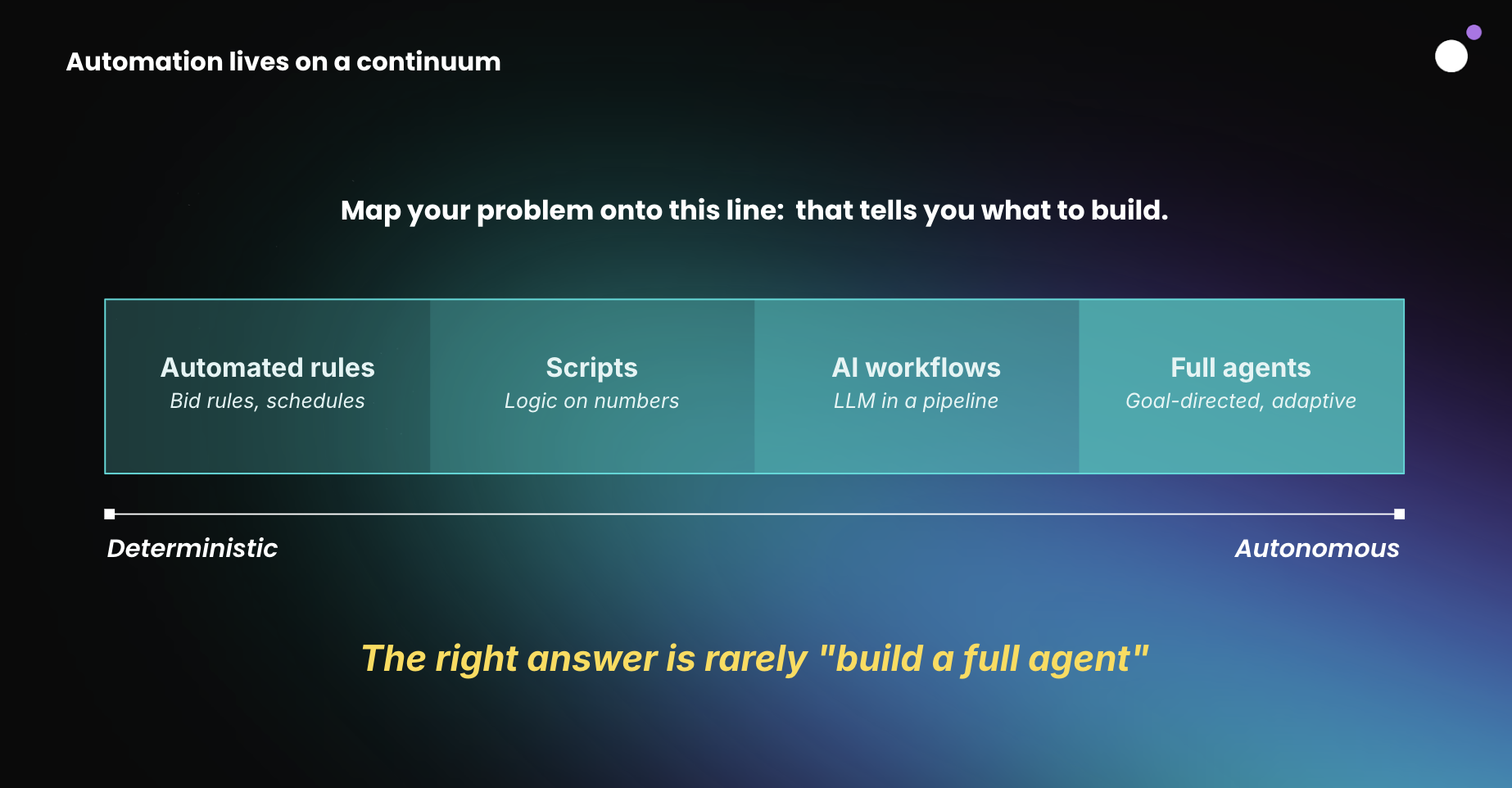
Crucially, Nils is adamant that automation lives on a continuum, from deterministic automated rules, through scripts, to AI workflows, and finally full agents. And the right answer is rarely "build a full agent".
He gave the example of a client pausing campaigns for a two-week holiday shutdown. You want those campaigns paused at 6pm Friday and re-enabled at 9am Monday, every time, no interpretation required.
"You don't want an agent thinking, 'well, it's sort of six-ish, let me wait.' You want the deterministic rule."
— Nils Rooijmans
So map your problem onto the automation continuum first, and that’ll tell you what to build. Agents are hard to configure, non-deterministic, and capable of creative failure. Rules and scripts are boring, and boring is often exactly what the job requires.
The junk you can see, and the junk you can't
The economics pushing advertisers toward agents start with keyword expansion.
If you want your ads eligible for AI Overviews, Broad Match, AI Max, or PMax are effectively non-negotiable. And that additional reach comes bundled with low-intent, non-converting traffic that inflates your CPA.
Nils argues that junk traffic carries two costs, and the second is the more dangerous one. The first is more obvious: every irrelevant click is paid for, and on accounts with $50–100 CPCs, the total compounds fast.
The second is invisible: Smart Bidding is machine learning, and machine learning learns through trial and error - on your budget. The algorithm samples user queries across a "fitness landscape", trying to predict which ones convert. Junk queries poison that training data. Bad data in, bad decisions out.
"It's your money that's being wasted during this learning period."
— Nils Rooijmans
The real kicker is that Google benefits from the exploration either way. Your spend trains its models at scale.
But as an individual advertiser, you know things the algorithm doesn't: your ideal client profile, your seasonality, the terms that look plausible but never close.
Excluding known-irrelevant areas of the landscape doesn't just stop the bleeding, it steers Smart Bidding's exploration budget toward queries with an actual chance of converting.
"It always makes sense to monitor your search terms like a hawk, and start negating completely irrelevant search terms very quickly."
— Nils Rooijmans
We also shared an exclusive first look at new Lunio data on how AI Max affects invalid traffic for retailers specifically.
Across a sample of roughly 115 million clicks from Lunio customers in the retail vertical, retailers who switched on AI Max saw their IVT rate more than double in six months (from 2.46% to 5.28%), while the same retailers' standard search campaigns without AI Max actually got slightly cleaner over the same period.
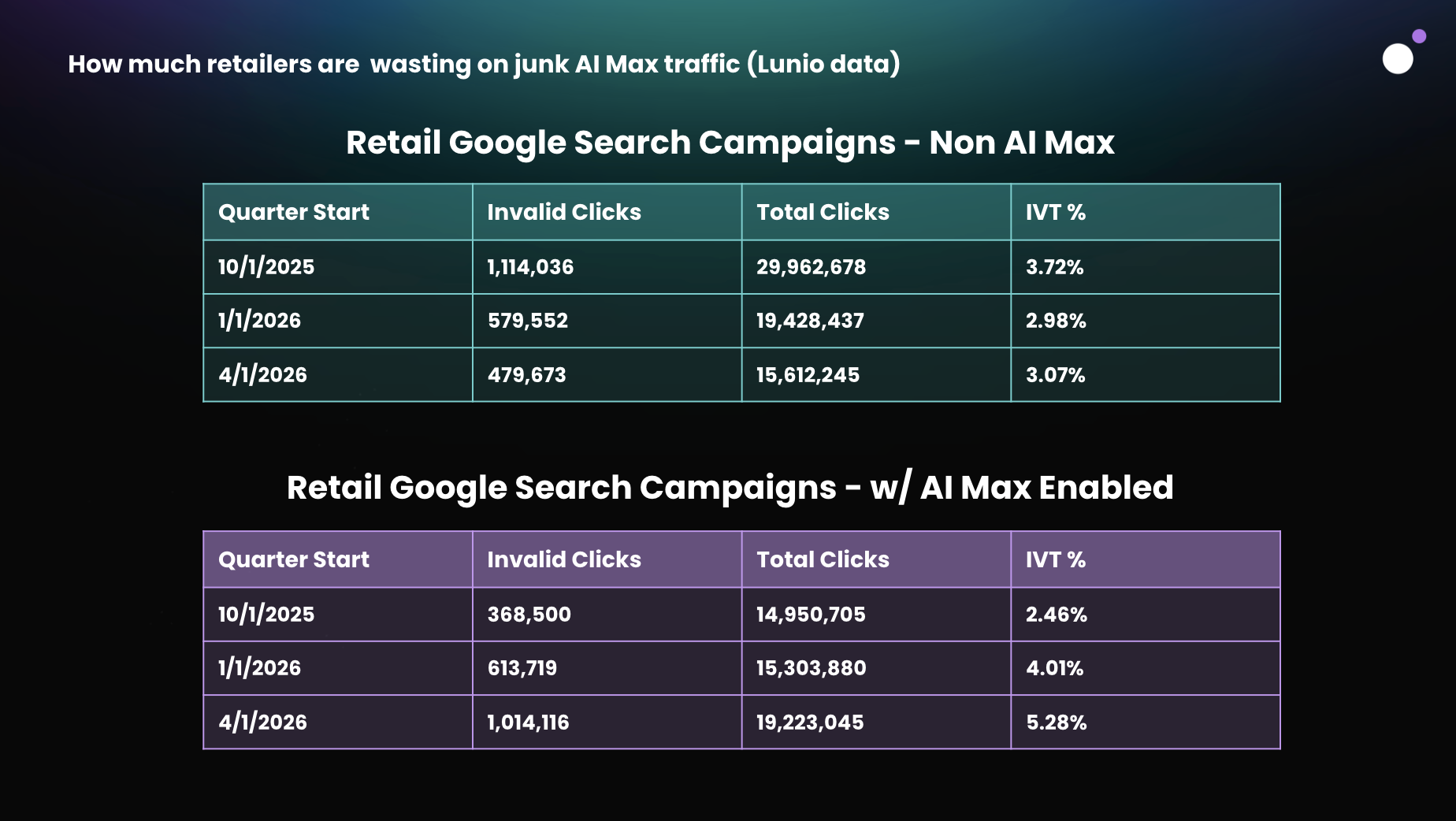
With Google migrating many retailers onto AI Max automatically from September, weeks before Black Friday budgets ramp up, that's a spike in incremental waste worth planning for now. Our full retail report drops soon, and if you want to see how your own AI Max campaigns compare, you can request a free traffic audit.
Anyway, back to the agents:
Build the script first: The three-stage model behind the Negative Keyword Agent
The heart of the session was the model Nils uses to build agents that are actually safe to run on client accounts: script first, then AI, then agent. Skip a stage and you're almost certainly going to piss money up the wall.
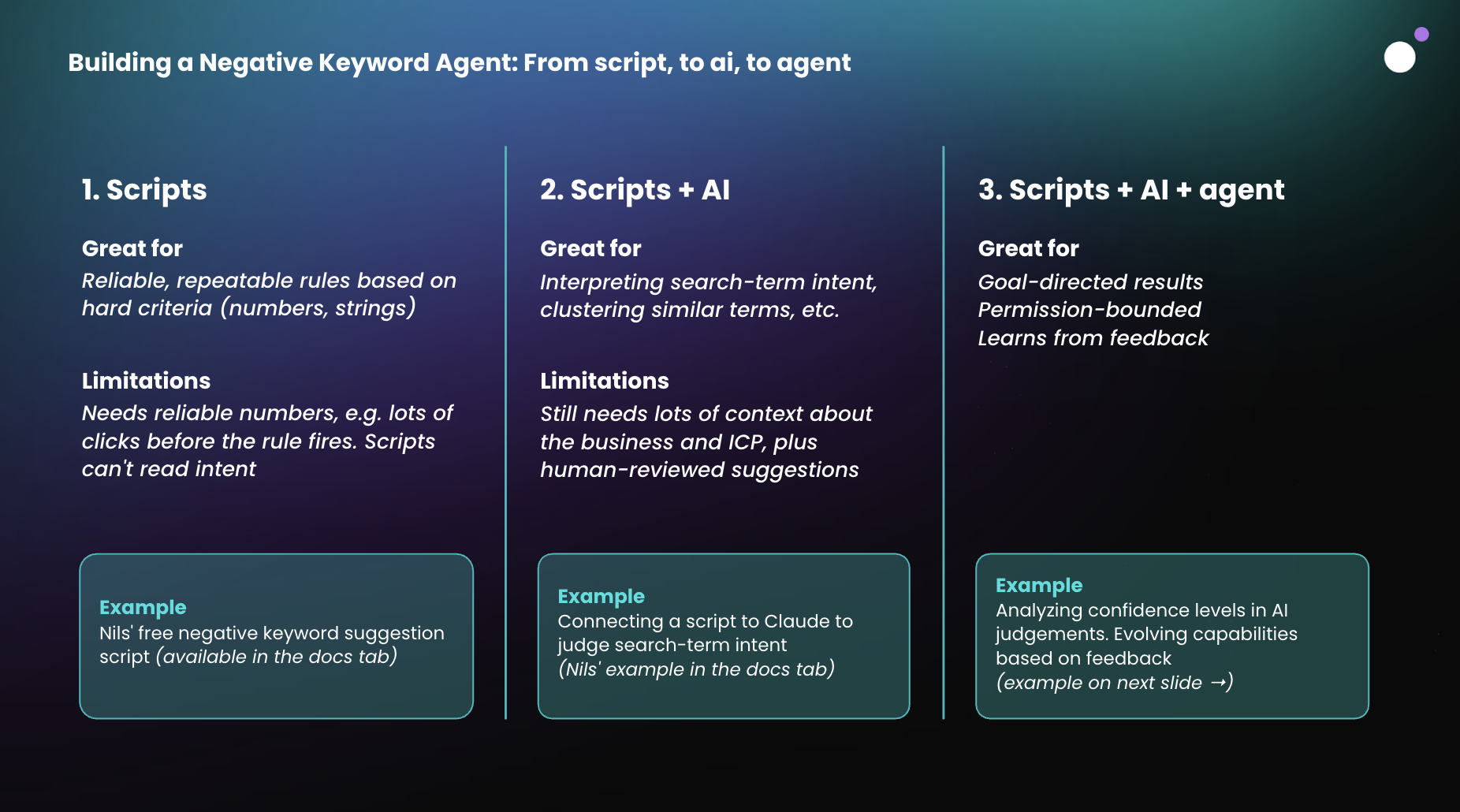
Stage one is a plain deterministic script. LLMs are language models — they're not reliable with numbers. Scripts are. A rule like if clicks > 100 and conversions == 0, suggest as a negative will never miss a term and never get creative with the threshold. Nils has his push suggestions into a Google Sheet where his team decides what to do with each one.
"Scripts are really good with numbers. LLMs, much less so." — Nils Rooijmans
The catch: a script that only reads performance metrics needs a lot of clicks before the rule fires, and that's already wasted spend. It also misses the long tail entirely. Ten clicks on an irrelevant term looks like noise to a script, but at $100 per click in high-ticket lead gen, that "noise" is a thousand dollars.
Stage two adds the LLM as a judge. The script sends search term data to the model via API, along with ad copy and landing page content, and the LLM interprets intent: is this query relevant to the business or not? That's how you catch "chopper insurance" matched against a car insurance keyword before it racks up a hundred clicks. The script still does everything mechanical. The AI only does the judging, and a human still reviews every suggestion.
Stage three hands the goal to an agent. Now the system doesn't just suggest negatives; it explains its reasoning, attaches a confidence score to every judgment, learns from your feedback, and eventually acts on its own within permissions you control.
Which brings us to the most important dial in the whole build:
How an agent earns autonomy: the confidence threshold
What makes this safe to run on real client accounts is that autonomy is earned, not granted.
The agent starts with 0% autonomy. Every single suggestion goes to the sheet, and a human approves each one.
As feedback accumulates and the confidence scores calibrate, you slide that autonomy threshold right: auto-adding at ad-group level around 75% autonomy, flagging campaign-level at 85%, auto-adding campaign-level at 95% with account-level changes still escalating to a human.
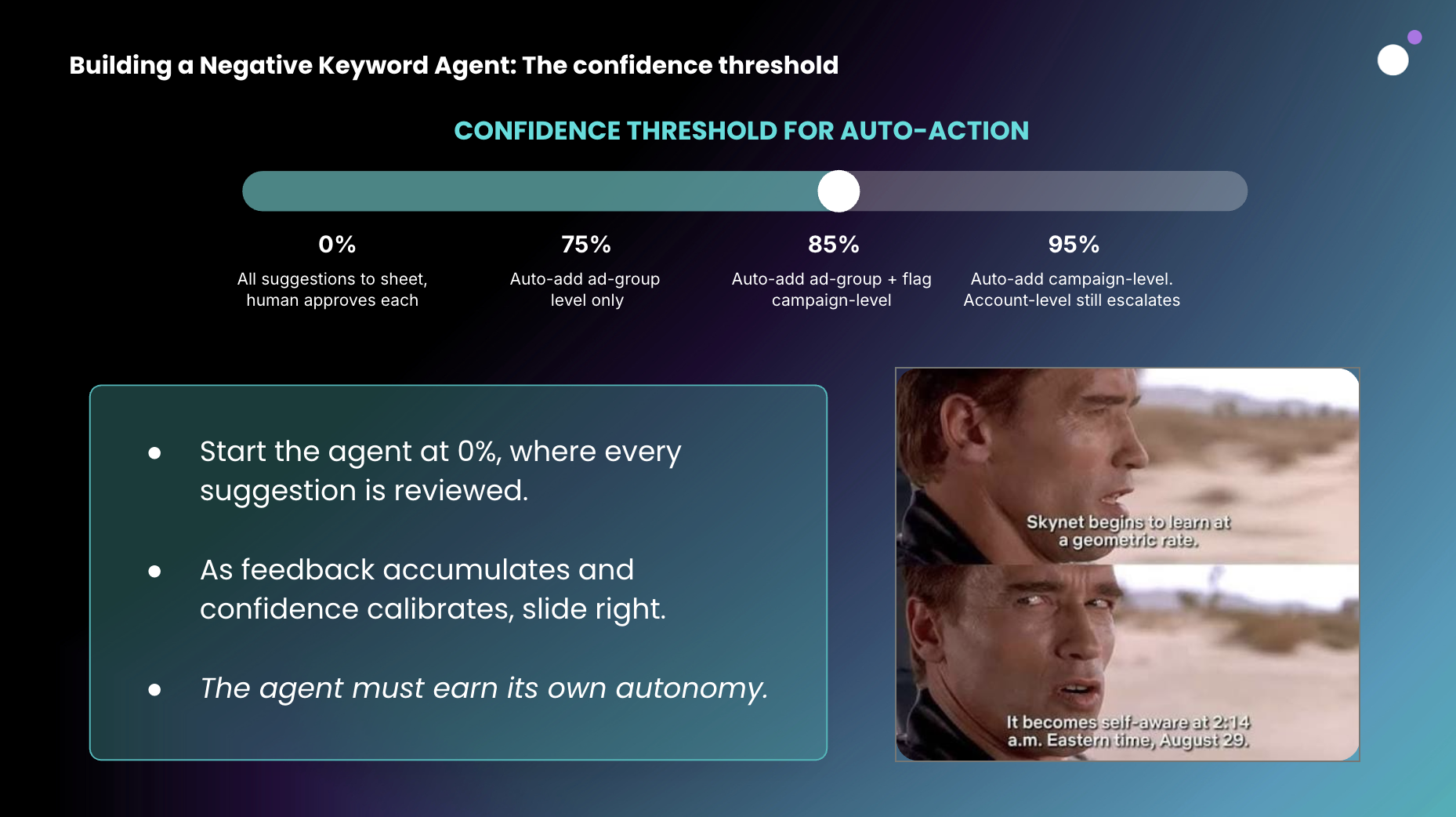
Nils' analogy for the confidence score is a new colleague. Ask them whether a term should be negated in week three of an engagement and an honest answer is "I'm not sure yet, I don't know if this client offers rentals." That's a 0.2.
Ask them about an obvious competitor brand term when the client has explicitly said no competitor bidding, and it's a confident 0.9-plus. The agent has to develop the same calibrated honesty, and it only gets there through feedback.
"Be ready to provide feedback on hundreds of search terms before you get to where you want to be."
— Nils Rooijmans
Interestingly, Nils is not convinced the 'ad group -> campaign -> account' hierarchy is necessarily the right way to structure escalating permissions.
The principle that matters is the process: zero permissions to start, monitor the confidence scores, and only expand autonomy once suggestions above your threshold are right 99 times out of 100. And one rule is non-negotiable regardless of trust level:
"If it excludes something autonomously, always have it log and send you an email with the changes it made." — Nils Rooijmans
Does it actually work? The A/B test results
Nils ran these as proper Google Ads experiments, not vibes-based case studies.
The Negative Keyword Agent ran on a high-ticket lead gen account with SQL tracking in place - a campaign with 15 broad match keywords across three ad groups, Max Conversions bidding, limited budget.
The agent suggested negatives from the incoming broad match search terms, Nils' team fed back on the suggestions in the sheet, and within three to six weeks the share of suggestions needing human feedback dropped to roughly 10%. The rest cleared the confidence bar and were negated automatically; including the long-tail terms that never surface in a normal search query report because they only pick up a handful of clicks each.
The agent-managed arm came out ahead. (One wrinkle Nils flagged: the experiment was set up with the agent adding negatives to the control arm rather than the treatment arm, so the on-screen metrics read as the inverse - a good reminder that even automation experts fat-finger an experiment setup occasionally.)
The Quality Score Agent ran on a valet parking service account: around 100 exact match keywords, six ad groups, Max Conversions, effectively unlimited budget. This agent analyzed search term data and landing page content, then suggested improvements to headlines, descriptions, assets, and landing pages, with permission to change ad copy directly. The treatment arm won decisively: conversions up 67.7% and cost-per-conversion down 11.9%.
Notably, in the first experiment nobody was doing manual negative keyword management on the untouched arm, so the test was effectively the agent versus Google's broad match algorithm (with the agent doing all the heavy lifting a human team rarely has time for).
Your Monday morning: where to start (and where the real value is)
If you want to start next week with zero code written, Nils has a simple exercise for you.
Every morning for one week, write down your answers to three questions: Where did your time actually go over the last few weeks, and which PPC task ate the most hours? What mistakes have you made in the past six months that you'd want to prevent at all costs (tripled budgets, a negative that killed your best converting term)? And what frustrates you most in your work?
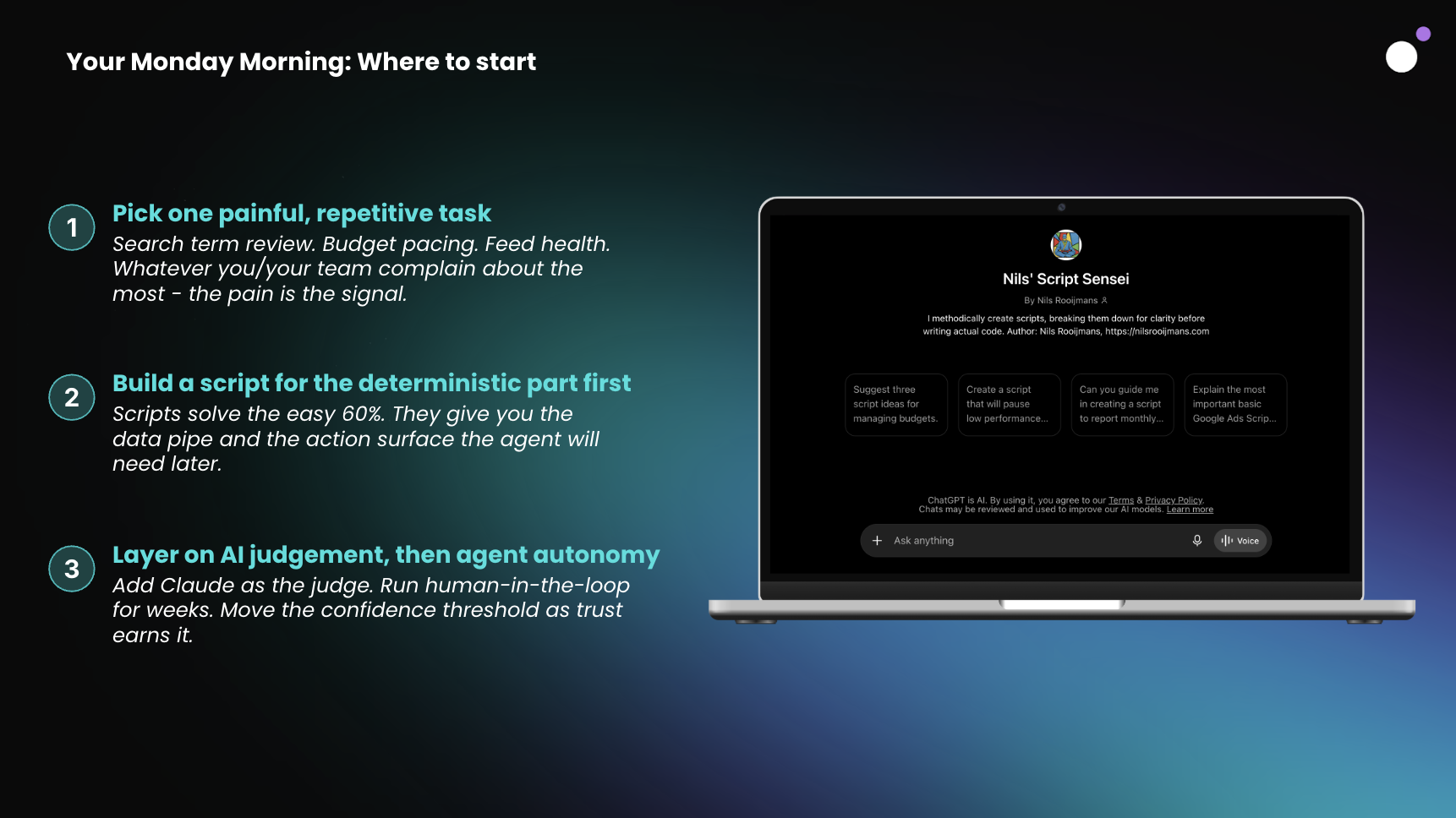
One week later, you'll have a list of automation opportunities. Pick the smallest, easiest one, and build the script for the deterministic part first - most likely with help from Nils' Script Sensei custom GPT, which walks you through script creation step by step. Then, and only then, layer on AI judgment and agent autonomy.
But Nils was emphatic that the technology is not where the real work (or the real value) lies. The plumbing (MCPs, APIs, harnesses) is changing every three months and can largely be delegated to the LLM itself.
The durable work is educating the agent on the commercial knowledge that currently lives only in your head: margins, sacred products, seasonality, the terms that look good but never close.
"The real work is in teaching the agent, just like you would teach a PPC intern how to do its job properly." — Nils Rooijmans
His most practical technique is to end your prompts by asking the AI to interview you.
Before it performs a task, have it ask the questions that would help it perform the task better, then instruct it to fold your answers and corrections back into its skill or knowledge base, so you never have to give the same feedback twice.
That accumulated education, Nils argues, is becoming the actual moat in PPC:
"A big part of your IP, your moat, your competitive advantage, is in how you educate your agents."
— Nils Rooijmans
It's also why he shares his scripts freely but keeps his best skills private. The skills are the taught expertise.
Final thoughts & additional resources
Agents aren't magic. They aren't even new.
But they're the top end of an automation continuum, and the teams getting real results are the ones who respect the sequence:
- Deterministic script
- then AI judgment
- then earned autonomy
And treat agent education as the most valuable work. Start small, start with the deterministic layer, and (importantly) start now.
We wanted to extend a massive thanks to Nils for sharing the frameworks, the advice, the A/B test results, and all the other marketing gold he bestowed upon us throughout the session.
The full session recording includes a live Q&A covering the mid-August AdWords budget changes, skill security, and more - well worth watching through to the end.
Make sure to follow Nils on LinkedIn if you're not already, and sign up for his newsletter for PPC tips, scripts, and automation ideas delivered straight to your inbox.
Session docs, resources, & articles:
- Follow Nils on LinkedIn
- Follow James on LinkedIn
- Nils’ Script Library
- Nils’ Newsletter
- Nils’ SEM Stories Slides
- Agentic script support calls w/ Nils
- GPT: Script Sensei
- Script: Negative Keyword Suggestions
- Script: PMax non-converting search term alerts
- Script: PMax placement exclusion suggestions
- Script: Daily budget overdelivery alerts
- Script: Search partner ROAS alerts
- Nils’ “Script + AI” example script
- Starbucks’ AI inventory collapse
- Nils’ Daily Wisdom: AI Agents
- Nils’ Daily Wisdom: Building PPC Agents
- The Global Invalid Traffic Report 2026
- The State of Click Fraud Report 2026
- Get a free 14 day traffic quality audit

Table of Contents
On average, 8.51% of your ad budget is wasted.
But that number can be much higher. Find out how much you're spending on bot traffic.