


Click fraud detection is essential for performance marketing in 2026, as AI makes it easier than ever to deploy sophisticated bots that can drain your ad budget and corrupt your data.
Click fraud detection is a way for advertisers to fight back, by identifying and preventing fake or invalid clicks on paid media advertising campaigns.
Modern invalid traffic detection tools use rules-based and/or machine-learning based methods to filter out rogue clicks. Using a multi-layered approach to detect click fraud helps advertisers protect their ad spend and boost their returns by improving campaign accuracy, preserving data quality, and reducing wasted budget.
Here, you’ll learn all you need to know about click fraud detection: how it works, what solutions are available, and how to tell if your ads are at risk of click fraud.
Key facts
- Click fraud and invalid traffic (IVT) are growing problems in 2026, with IVT covering both malicious activity (click fraud) and non-malicious sources (like bots, crawlers, and accidental clicks).
- Traditional rules-based click fraud detection methods (such as IP blocking, CAPTCHAs, and basic filters) are no longer sufficient, as sophisticated bots and AI-generated traffic can now evade static rules and mimic real user behavior.
- Modern click fraud requires a multi-layered approach combining IP/network analysis, device fingerprinting, and behavioral analysis fraud detection. Machine learning is essential for identifying advanced threats and reducing false positives.
- Lunio’s machine learning-based click fraud detection solution uses a multi-layered approach including IP reputation, device fingerprinting, behavioral analysis, and cross-channel signals to strengthen accuracy. Our tool identifies subtle behavioral anomalies in real time, while maintaining a false positive rate of less than 1%. This protects performance without degrading real user experience.
Introduction
Advertisers have been dealing with click fraud for decades, but in 2026, the issue is bigger than ever. With the rise of AI, it’s easier than ever for malicious actors to commit click fraud, which can have serious consequences for performance marketers.
Click fraud is part of a broader type of ad fraud known as invalid traffic (IVT). Invalid traffic refers to any type of activity that generates clicks with no intent to convert. Unlike click fraud, IVT isn’t always intentional or malicious — but it can still drain your ad budget and pollute your data.
Detecting click fraud and invalid traffic is no longer as simple as setting up a CAPTCHA form or using basic rules-based tactics like IP exclusion. As bots become more sophisticated, they’re able to evade these bot traffic detection methods pretty easily. The type of click fraud detection you choose determines whether you’re able to identify the most sophisticated IVT — and whether you end up blocking genuine users, too.
The best click fraud detection tools stack up multiple protective layers to block both general and sophisticated IVT, without compromising the experience for your real users. Discover what these solutions look like and why they’re essential for performance marketers below.
Click fraud vs. invalid traffic: What’s the real difference?
Click fraud is the intentional, malicious act of generating clicks with no genuine interest in your content or product. Invalid traffic is an industry-standard umbrella term that includes click fraud, but also includes other types of invalid activity that isn’t necessarily malicious or purposeful, such as accidental clicks from real users, page crawlers, and platform targeting errors.
IVT is often broken down into two further subcategories: general IVT (GIVT) and sophisticated IVT (SIVT). The Media Rating Council, which sets the official standard for IVT identification, defines GIVT vs SIVT based on the filtration methods needed to remove them from your traffic:
“GIVT consists of traffic identified through routine means of filtration executed through application of lists or with other standardized parameter checks. [...] SIVT consists of more difficult to detect situations that require advanced analytics, multi-point corroboration/coordination, significant human intervention, etc., to analyze and identify.”
The Media Rating Council (MRC) is an organisation that accredits certain invalid traffic detection tools. It’s worth noting that while the MRC requires accredited tools to be able to detect GIVT, SIVT detection is only “strongly encouraged”. So even MRC-accredited tools may not identify the most dangerous IVT.
10 types of invalid traffic draining your PPC budget
Multiple types of IVT can affect your performance marketing success. Along with the relatively innocuous types of GIVT mentioned above, you may be affected by:
-
Competitor clicks — Fraudulent clicks made by a competing business to drain your ad budget or distort campaign performance.
-
Click farms — Large groups of low-paid workers or devices generate fake clicks to mimic real user engagement, while draining your ad budget.
-
Botnet traffic — Automated clicks or impressions are generated by a network of malware-infected devices, which are controlled remotely.
-
Click injections — A mobile fraud technique where malware fires a fake click just before an app install to steal attribution credit.
-
Click spamming — Massive volumes of fake clicks are generated in a short timespan, hoping to be credited for an eventual real install or conversion.
-
Ad stacking and pixel stuffing — Hiding multiple ads in one placement (ad stacking) or shrinking ads to tiny invisible pixels (pixel stuffing) to generate fake impressions.
-
Domain spoofing — Fraudsters misrepresent low-quality or fake sites as premium domains to sell ad inventory at higher prices.
- Incentivized clicks — These clicks are generated when users are rewarded for interacting with ads, often leading to low-quality or non-intent-based engagement.
These IVT threats have been around for years. Some are still performed by simple bot traffic, so basic rules-based invalid traffic detection tools may be able to spot them. But in 2026, AI advancements have created new types of click fraud — and they can only be caught by much more advanced click fraud detection tools like behavioral machine learning.
AI-generated synthetic fraud consists of bots that closely mimic realistic session behavior, making them harder to detect. These bots can generate synthetic mouse movements, scroll depth, and dwell time, so rules-based click fraud detection methods have almost no chance of identifying them as IVT.
Agentic AI bot traffic also poses significant threats. Autonomous bots can poison your lead data by submitting lead forms with genuine personal information, contaminating your CRM data and corrupting Smart Bidding and audience targeting signals within the ad platform.
To tackle all these types of IVT, you need to take a multi-pronged approach to click fraud detection. This normally involves setting up dynamic rules to identify and filter out simple and known IVT, alongside more sophisticated methods that can detect unknown and sophisticated attacks.
How click fraud detection works
So let’s get specific about how click fraud detection actually works. The most advanced methodology involves three distinct layers:
- IP and network signal analysis
- Device fingerprinting
- Behavioral analysis and machine learning
The combination of all three layers determines the accuracy of the detection tool. So how does each click fraud detection layer work?
Layer 1: IP and network signal analysis
The first layer of protection against fraudulent clicks leverages existing data about specific networks and IP addresses to block known and pre-existing threats. Invalid traffic detection tools achieve this using:
- IP reputation scoring — The tool checks its databases for information about the trustworthiness and reputation of the IP that sent the traffic. IPs that exceed specific thresholds or scores are blocked.
- Data center traffic identification — The tool checks the traffic source. Data center traffic is often automated, so may be blocked.
- Geographic anomaly detection — Traffic from unexpected locations is filtered out and/or blocked.
These rules-based methods are effective for blocking GIVT and even some minor types of SIVT. It works quickly, but it does have some limitations. Sophisticated attacks can easily circumvent IP exclusion and geography-based rules by using residential proxies to commit click fraud via automated traffic.
Additionally, these click fraud detection tactics only work reactively — they block IVT that has previously been flagged as suspicious. Databases can quickly go out-of-date, and in some cases may need to be manually maintained with the latest IVT data. So while it’s a useful first line of defense, it’s not 100% watertight. High volumes of SIVT can evade the IP and network signal analysis layer.
Layer 2: Device fingerprinting
Unique device fingerprints allow the tool to identify a device even after IP rotation or cookie clearing. Click fraud detection tools use hundreds of behavioral and technical signals to create a unique profile for each device, including browser attributes, screen resolution, time zone, installed fonts, audio context, and more.
The fingerprint ensures fast device identification, maintaining site speed and user experience for genuine site visitors. Unfortunately, it’s increasingly possible to spoof fingerprint attributes, tricking invalid traffic detection tools into thinking fraudulent devices belong to real users. That’s why the third layer of click fraud detection is so important.
Layer 3: Behavioral analysis and machine learning
The final layer of click fraud detection is the most advanced. It uses machine learning and behavioral analysis to detect the most elaborate types of SIVT.
Machine learning models analyze the minutiae of the click to determine whether the activity is invalid. This includes mouse movement patterns, scroll depth, click timing, session duration, post-click engagement, conversion signal consistency, and more, creating a more accurate picture of the user’s behavior.
These signals are much harder to fake at scale compared with IP addresses and static device attributes. That’s why it’s a non-negotiable layer of click fraud detection in 2026. While rules-based filters help remove the more basic types of IVT, it’s only this third layer that can detect behavioral anomalies that deviate from genuine human patterns, even when no rules have been broken.
And while this is important for blocking invalid clicks, it’s also essential for letting genuine users interact seamlessly with your site. False positives are widespread in rules-based IVT detection, with rates as high as 15%. Lunio’s advanced click fraud detection tool has a false positive rate of less than 1%, ensuring UX is never compromised for users with a genuine interest in your ads.
Warning signs your campaigns have an IVT problem right now
It’s not unusual for PPC campaigns to be affected by invalid traffic to some degree. Our 2026 Global Invalid Traffic report found an IVT rate of 8.51% across major search and social ad platforms, with the cost of invalid traffic totaling more than $63 billion in 2025. Lead generation businesses are disproportionately affected, experiencing 32% higher IVT rates than transactional business models.
So how can you tell if you have an IVT problem in your campaigns?
The answer often lies in your ad platform reports and Google Analytics 4. If you’re seeing any of the following, you could have an IVT problem:
- High click-through rates with disproportionately low conversion rates.
- Your budget is being used up earlier than expected each day.
- Traffic spikes in unexpected geographical areas (especially outside targeted locations).
- Unusually high bounce rates with session duration close to zero.
- A significant amount of low-quality, spam, or duplicate leads.
Check the session quality metrics in GA4, and take a look at the Invalid Clicks column and Audience Overlap report in Google Ads to see if any of these issues are affecting you. Note that Google only shows you the invalid clicks it has blocked, not those it missed.
If you checked multiple boxes, it’s time to take action. Get a free 14-day traffic audit from Lunio. We’ll deploy our click fraud detection software across your campaigns to see how much IVT is affecting your performance, and how much you could save on wasted ad spend.
Why Google's IVT protection leaves performance marketers exposed
Ad platforms should be doing more to protect performance marketing campaigns from IVT. And while pressure has been building (thanks to various ad fraud lawsuits against the likes of Google and Meta) unfortunately there just aren’t enough incentives for Google et al to take it too seriously.
At the moment, Google does identify and filter out some IVT. It won’t charge for invalid clicks detected prior to billing, and advertisers may receive ad credits for invalid clicks detected after billing (within 60 days).
But ultimately, Google profits from every click that clears its filters. So it’s possible that its anti-IVT measures are mostly there to create the illusion of protection. In reality, advertisers are still seeing large volumes of IVT across the Google ecosystem, with the Display and Video Partner networks being the worst offenders.
And ad credits don’t help tackle the downstream damage caused by IVT, such as campaign disruption, reporting inconsistencies, and bidding algorithm problems. These lead to issues with targeting, lead gen, and budgeting that are difficult to rectify quickly.
Performance Max users may be hit harder than most, thanks to its links with low-quality placements. Made-for-advertising (MFA) sites are rife across the PMax network, and these sites have much higher rates of IVT than regular websites. According to our stats, MFA sites can drive IVT rates of more than 50%. That’s why Performance Max best practices often advise excluding MFA placements from your campaigns.
(Download and exclude these placements from your PMax campaigns to reduce your IVT exposure.)
Google isn’t the only platform with an IVT problem. In fact, it has the lowest rates of IVT among all major search and social platforms. The chart below compares IVT rates across these channels:
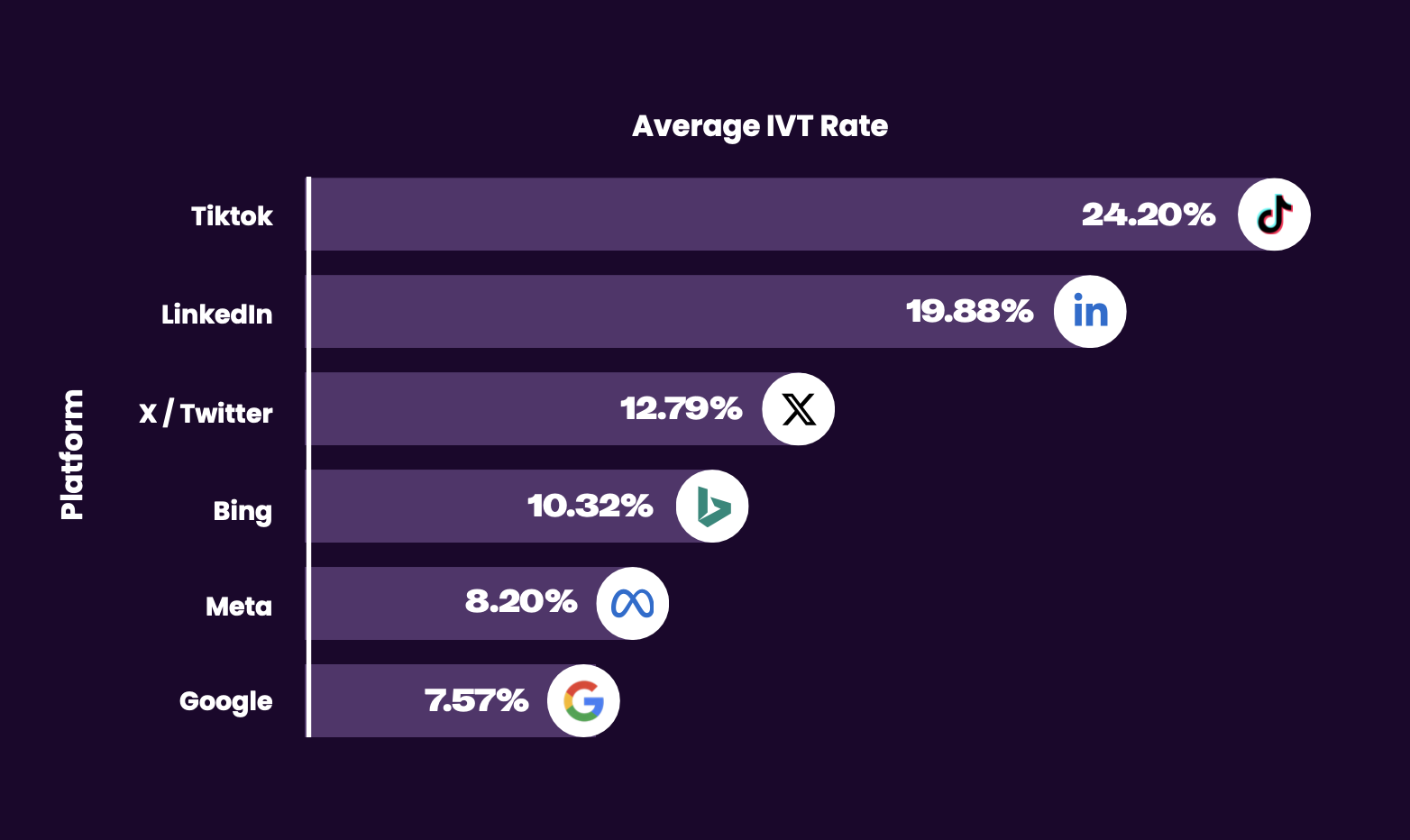
But the sheer volume of advertisers on Google means that even a relatively low IVT rate still wastes billions of dollars in absolute terms. So you shouldn’t overrely on built-in IVT protection from any ad platform. They don’t do enough to protect advertisers, which is why independent third-party click fraud detection tools are necessary for serious performance marketers.
Rules-based vs machine learning-based IVT detection: Which tool type fits your risk?
So can you get away with a simple rules-based system for detecting IVT, or do you need a more sophisticated level of protection?
Invalid traffic detection tools have varying levels of detection accuracy, false positives, traffic coverage, and operational costs. So it’s helpful to understand how rules-based, machine learning-based, and hybrid click fraud detection tools work in these respects.
The table below compares each type of bot traffic detection solution so you can decide which best fits your risk profile.
|
Risk |
Rules-based |
ML-based |
Hybrid |
|
Detection accuracy |
Static thresholds and scores which may need to be updated manually. Doesn’t account for nuances in behavior. |
Learns normal user patterns and flags behavioral anomalies missed by rules-based models. |
Both, leading to highest levels of accuracy. |
|
False positive risk |
Medium-high risk |
Low risk |
Low risk |
|
Coverage |
Sampled traffic checks. |
100% real-time traffic monitoring. |
100% real-time traffic monitoring (behavioral). |
|
Operational overhead |
Manual rule updates required. Human monitoring can help interpret nuanced data. |
Automatic updating based on learned information. Human monitoring can help interpret nuanced data. |
Automatic updating based on learned information. Manual rule updates required. Human monitoring can help interpret nuanced data. |
You should also consider how easily the solution can be integrated into your performance marketing setup. Click fraud detection tools that are built on cybersecurity frameworks often require a more complex setup involving IT or security teams, which may not be available to smaller enterprises. They can also introduce cookie dependencies and friction into the user journey, potentially impacting site performance, tracking reliability, and overall user experience.
Marketer-first platforms like Lunio integrate directly with ad platforms, creating a frictionless experience for you and your users. Lunio also monitors 100% of your traffic (rather than sampling), and uses customer conversion data to update its machine learning models on a daily basis. So we’re always using the most recent data to filter out IVT.
Protect your ad spend with Lunio's marketer-first IVT detection solution
Lunio is a click fraud detection platform built for performance marketers. It’s not a repurposed cybersecurity platform — we know the unique challenges advertisers face, from maximising ROAS to optimising user experience. That’s why our invalid traffic detection tools use a multi-layered approach to block basic and sophisticated bot traffic, without compromising usability for your real users.
Lunio is SOC2- and ISO27001-certified, GDPR-compliant, and cookie-independent, which is why we’re already trusted by hundreds of advertisers around the world. In addition, we’re planning tons of product updates this year and beyond, including prioritising brand safety on PMax, improving audience quality, and helping you optimize bids more effectively.
See how much IVT is affecting your performance marketing results with a free traffic audit from Lunio.
FAQ
Discover more about click fraud detection in these frequently asked questions:
What is the difference between click fraud and invalid traffic (IVT)?
Click fraud refers to the intentional and malicious generation of clicks with no real interest in the content or product, while invalid traffic is the broader industry term that includes click fraud but also covers non-malicious or unintentional activity that results in traffic without genuine engagement.
Examples of click fraud include competitor clicks, click farms, and botnets. Invalid traffic includes all these examples too, but may also include accidental clicks and web crawlers, among other unintentional clicks.
Does Google Ads automatically detect and refund all fraudulent clicks?
No. Google Ads identifies a proportion of invalid clicks, but it doesn’t detect all of them. Lunio research found that 7.57% of clicks on Google Ads are invalid.
Additionally, Google doesn’t generally refund advertisers for invalid clicks. You may receive ad credits, which can be put towards current or future campaigns.
Does Smart Bidding make click fraud detection irrelevant?
No. If anything, it’s more important to detect and filter out fraudulent clicks if you’re using Smart Bidding. Smart Bidding uses a mix of signals to seek out future users who are likely to convert, including data from previous clicks. If this data is corrupted thanks to fraudulent traffic, the platform may end up chasing similar (automated) users, creating a negative feedback loop of low-quality data.
Is click fraud illegal, and can I take action against a competitor?
Yes, click fraud is illegal. You can take legal action against a competitor if you can prove they have committed click fraud, though this is notoriously difficult to do.
If you believe a competitor has committed click fraud against you, it’s best to seek legal advice from a litigator who specializes in digital fraud.
How much of my ad budget is realistically being wasted on IVT right now?
According to our research, the IVT rate across all ad channels is 8.51%, which means just under a tenth of your ad budget could be being spent on invalid clicks.
If you spend $10,000 a month on PPC, you could be spending $851 a month on invalid clicks — a total of $10,212 wasted in a single year.
The IVT rate varies from platform to platform. The average IVT rate on TikTok is a whopping 24.2%. So if you’re spending $10,000 a month on TikTok ads alone, you could be wasting $2,420 on invalid clicks each month, or $29,040 per year.
Use our Click Fraud Calculator tool to discover how much of your budget is likely wasted on click fraud:


60 seconds, no signup. Built on Lunio's analysis of 2.7B+ ad clicks. Find out your industry's invalid traffic rate, your wasted spend, and the revenue you could recover.
from your business every year. That's $0 every month walking out the door — and another $0 every day you don't act.
Run a free 14-day audit on your live account and see your real numbers — broken down by campaign, keyword, geo and domain.
Calculations based on Lunio's Global Invalid Traffic Report 2026. Eight industries shown use Lunio-measured rates; additional industries use Lunio-methodology estimates calibrated against comparable verticals. Lost revenue applies Lunio's conservative 3:1 ROAS baseline — every $1 of wasted ad spend equals roughly $3 in missed revenue. Actual results vary by account.
Find out the exact rate of IVT for your ad spend when you get a free 14-day traffic audit from Lunio.

Table of Contents
On average, 8.51% of your ad budget is wasted.
But that number can be much higher. Find out how much you're spending on bot traffic.