

AI Max for Search has been one of the most talked-about Google Ads developments in recent years, and with good reason.
It represents the biggest shift to Search campaigns since Broad Match, and Google is pushing it hard.
But as with most things Google rolls out at speed, the gap between the promise and the reality can be significant (especially for advertisers who haven't had the time to dig into what's actually happening under the hood).
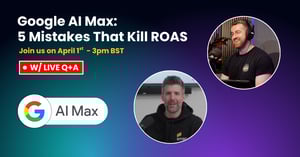
That's exactly why we brought in Google Ads expert Mike Ryan, Head of Ecommerce Insights at Smarter Ecommerce, for our latest webinar.
Mike has spent the past year stress-testing AI Max across more than 600 Google Ads accounts, and he's put together what is arguably the most comprehensive independent guide to the feature available right now.
The session was packed with data, balanced takes, and practical advice. So if you haven't watched it yet, you can find the full recording here.
Or keep reading for a written rundown, with a particular focus on the five AI Max mistakes Mike sees advertisers making most often.
Session timestamps:
0:00 - Intro
6:20 - [Icebreaker] AI Generated headline rewrites in Google Ads
8:32 - Agenda
11:15 - What is AI Max, really?
19:18 - Avoiding hype & focusing on fundamentals
25:45 - Mistake 1: Stacking technologies
31:15 - Mistake 2: AI Max & match types
36:28 - Mistake 3: Ignoring Branded exact match interference
41:25 - Mistake 4: Over-estimating volume opportunity
44:15 - Mistake 5: Improper AI Max maintenance
46:58 - Our data: IVT in AI Max
49:55 - How to approach AI Max in 2026
53:10 - Q&A from live attendees
What is AI Max, actually?
Before getting into the mistakes, it's worth making sure we're all on the same page about what AI Max actually is, because there's a fair amount of confusion out there.
The short version: AI Max brings Performance Max-style features into classic Search campaigns. Rather than forcing advertisers to migrate their Search campaigns into PMax (Google's previous approach), AI Max works in the other direction - bringing PMax capabilities to Search. It introduces three core features to your existing campaigns: search term matching, text customisation, and final URL expansion.
The key thing to understand is that AI Max is an expansion layer on top of your existing keyword targeting. It isn't a replacement for keywords, and it isn't a standalone campaign type.
It sits inside your Search campaigns and works alongside your existing build, in theory finding incremental traffic that your keywords alone wouldn't reach.
"AI Max is, in many ways, a repackaging of existing Google features. Broad match is in there. DSA is in there, and a lot of PMax features are in there."
- Mike Ryan
It's also worth noting that AI Max is more feature-complete than PMax was when it first launched. Somewhat surprisingly, the reporting and control options are genuinely useful.
But that doesn't mean you can simply switch it on and walk away. In fact, that assumption is one of the most costly mistakes advertisers are currently making - but more on that shortly.
The 5 AI Max mistakes
Mistake 1: Stacking overlapping technologies
One of the first things Mike flagged (backed by data from 600 accounts) - is just how many advertisers are running AI Max on top of an already crowded tech stack.
Around one in six AI Max users are also running DSA. One in four are running AI Max alongside PMax. And roughly half are running all three at the same time.
Add Broad Match into the mix, and you can end up with four different technologies all doing functionally similar things - competing for the same traffic, splitting your conversion data, and making your reporting almost impossible to interpret cleanly.
Google's answer to this is that ad rank sorts it out, and the best technology wins each auction. But Mike isn't buying it as a complete solution:
"If the conversion could land in bucket A today, bucket B tomorrow, and bucket C the day after — you would never purposely build a system like that. So I think you also shouldn't just passively lapse into it either."
- Mike Ryan
The takeaway here:
Before enabling AI Max, audit your current setup. Look at how much of your Search spend is flowing through DSA. Check what PMax is actually doing on the Search network specifically.
If you're running all three, something probably needs to go - and given that DSA is confirmed to be deprecated (more on that below), it's likely the first candidate.
That said, AI Max and PMax can coexist - the conflict is most pronounced on the DSA side. If PMax is doing relatively little on Search, there's less to worry about. The key is going in with your eyes open, rather than piling on every available technology and hoping for the best.
Mistake 2: Misunderstanding what AI Max does to match types
A common misconception is that AI Max adds an entirely new form of targeting. It doesn't.
What it actually does is apply broad match logic to your existing exact and phrase match keywords - effectively broad-matchifying them.
After analyzing a sample of one million AI Max impressions, Mike found a clean 80/20 split: roughly 80% of AI Max expansion is happening on exact match keywords, with the remaining 20% on phrase match. Broad match keywords are barely touched, because they're already broad.
There's also a second arm to AI Max - keywordless matching, similar to how DSA operates - which often contributes roughly half of all AI Max traffic in campaigns where it's active.
It's this combination of broad match expansion and keywordless matching that makes AI Max more than just a rebranded broad match setting, but also what makes it essential to understand before enabling it.
"Broad match has improved a lot over the years... the combination of broad match and smart bidding was the big unlock moment."
- Mike Ryan
If you're a heavy exact match user, Google's pitch for AI Max is aimed squarely at you. And the potential volume uplift is real.
But as Mike noted, if you're still running exact match-heavy campaigns in 2026, there's probably a reason.
A sensible middle ground before jumping straight to AI Max is to test broad match first. It's a more predictable technology, and in Mike's data it has actually shown slightly stronger performance than AI Max as a match type. It may not be the flashiest move, but it's often the most sensible entry point.
Mistake 3: Ignoring branded exact match interference
This one is specific, but the commercial implications can be enormous.
And many advertisers aren't aware it's happening.
AI Max is designed to find pockets of high-intent traffic that your current targeting isn't reaching. The problem is that competitor brand terms often fit that description perfectly. If you haven't proactively excluded competitor terms, AI Max has no way of knowing that's off-limits - and it will go after them.
In one account Mike analyzed, competitor terms had come to account for 69% of total Search impressions after AI Max was enabled.
The advertiser had a deliberate strategy of not bidding on competitor terms - partly for brand safety reasons, partly because they were the smaller player in a David-and-Goliath situation. AI Max simply didn't know any of that.
The good news is that this is highly manageable. Google's brand lists are the cleanest solution - a modern, UI-based alternative to piling on negative keywords, which catches typos and variants automatically. You can set brand inclusion and exclusion lists at the ad group level, which allows for quite granular control depending on how your account is structured. The important thing is to set them before you enable AI Max, not after you've already noticed the problem.
Mistake 4: Overestimating the incremental volume opportunity
Google has made some bold claims about what AI Max will deliver. Depending on which version of the pitch you've seen, that's either a 14% or a 27% uplift in conversions or conversion value - at a similar CPA or ROAS.
Mike's data from over 250 campaigns tells a more nuanced story. The volume uplift is real. A median of around 13% additional conversion value, which is actually remarkably close to Google's non-retail figure of 14%. So on that front, the claim holds up.
But the efficiency picture is different. Those incremental conversions come at a median 16% higher CPA than the business-as-usual campaign.
ROAS, meanwhile, is essentially a coin toss. The median difference is 0%, but the distribution is extremely wide, ranging from campaigns performing 42% above baseline to 35% below.
"Happiness is expectations minus reality - and I don't think Google is doing themselves a favor with this marketing claim."
- Mike Ryan
This isn't a flaw in AI Max; it's just the law of diminishing returns at work.
Well-optimized accounts have already captured most of the easy, efficient traffic. The incremental volume AI Max finds will, almost by definition, cost more.
That's not a reason to avoid it, but it is a reason to go in with clear expectations. If your current efficiency target has headroom to absorb a higher CPA on the expansion traffic, AI Max can absolutely be a net positive.
If your ROAS targets are already stretched thin, the maths may not work.
Mistake 5: Enabling AI Max and walking away
The fifth mistake is perhaps the most costly, and one of the most common:
Enabling AI Max, assuming the algorithm will figure things out, and not looking under the bonnet until CPA has already crept well above target.
AI Max introduces a lot of moving parts: search terms your keywords would never have matched, dynamically generated ad copy, landing pages selected by the algorithm.
When it works well, it's impressive. When it doesn't, the problems can compound quickly, and they're not always obvious from top-line campaign metrics.
Mike flagged three specific issues worth watching closely:
-
Competitor matching (covered above) can scale fast if brand exclusions aren't in place.
-
Search Partner Network (SPN) scaling is a less well-known but equally damaging issue. In one extreme case Mike documented, half of nearly 500,000 monthly impressions were going to Search Partners, with a conversion rate of just 0.07% compared to 3.04% on Google Search.
-
Bad search term and ad combinations, where AI Max pairs a search term with a mismatched landing page or headline, can quietly drain efficiency even when everything else looks fine.
To help manage the third of these, Mike and the Smarter Ecommerce team built the AI Max Triage Script, available for free here.
It filters and scores your most important ad and search term combinations from best to worst, cutting through what can otherwise be tens of thousands of rows of data to surface what actually matters. It's a genuinely useful tool - especially for anyone running AI Max at meaningful scale.
And regardless of anything else: always run AI Max with a CPA or ROAS target in place.
"It would be a little scary for me right now to let AI Max do its thing with no ROAS target or no CPA guidance."
- Mike Ryan
So, should you actually test AI Max?
The final verdict is (drumroll please)...
...Yeah, probably.
But how urgently, and how aggressively, depends on where you're starting from.
Mike identified three broad archetypes among the advertisers he works with, and the calculus is genuinely different for each.
1. Exact match loyalists — advertisers who have stayed heavy on exact and phrase match and haven't embraced broader automation — have the most to gain from AI Max, at least on paper. Google is dangling a claimed 27% revenue uplift specifically at this group. If that's you, Mike's advice is to treat it as worth testing, but to go in with clear efficiency guardrails and realistic expectations about the CPA trade-off.
2. Hybrid pragmatists — those who already use some automation but take things case by case - are the group Mike identifies with most. The approach here is straightforward: pick a campaign or two, set a fair test budget, define your success criteria upfront, and let the data tell you whether it's working. No dogma in either direction.
3. Automation maximalists — advertisers already running Broad Match, Smart Bidding, PMax, and DSA at scale, have the least incremental ground to gain, since they're already covering much of the traffic AI Max would find. But with DSA confirmed for deprecation, they arguably have the most strategic reason to start the transition now, on their own terms, rather than being forced into it later under time pressure.
Whatever camp you're in, one thing came through clearly across the whole session: the fundamentals still matter more than ever. Better data inputs, smarter bidding targets, and clean account structure will do more for your results than any feature toggle.
"Do try testing it. That doesn't mean you have to love it — it doesn't mean you have to switch 100% of your account — but give it a look and see what the data comes back with." — Mike Ryan
Final thoughts + additional resources
A huge thank you to Mike Ryan for joining us and sharing such a detailed, nuanced breakdown of where AI Max actually stands, warts and all.
The whole advertising community benefits from the kind of independent, data-led analysis Mike consistently puts out, and this session was no exception.
If you want to go deeper on any of the topics covered here, the resources below are well worth your time:
-
Article: Why Performance Max looks different for B2B in 2026
-
Article: Google confirms AI headline rewrites test in Search results
-
Mike’s post: Overlapping technologies / AI Max NOT ready for primetime
-
Ginny Marvin’s article: How to tell if AI Max is working for you
-
Mike’s post: AI Max "broad-matchifies" exact match and phrase match

Table of Contents
On average, 8.51% of your ad budget is wasted.
But that number can be much higher. Find out how much you're spending on bot traffic.