



It’s a scenario familiar to most Meta advertisers: your Ads Manager dashboard is showing strong click volumes, but when you switch to Analytics, the numbers don’t add up. So it’s hard to trust your data and no way of knowing your actual Meta ROAS.
Click fraud is the likely culprit. Meta has a pretty major problem with invalid traffic (IVT) — our 2026 Global IVT Report shows that more than 8% of traffic on the platform is invalid. And given Facebook alone has more than 3bn active monthly users (and earned around $195bn in advertising revenue in 2025), that’s an astronomical number of fake clicks.
Meta isn’t known for its commitment to tackling click fraud, so it’s possible your Meta PPC campaigns are being compromised by bots, resulting in wasted ad spend and poor campaign performance.
So is IVT a problem for your Meta ad campaigns? Here, take a look at genuine data from real campaigns to find out the true impact of click fraud on Meta performance advertising.
What is Meta click fraud and how big a problem is it?
Click fraud is a major cause of invalid traffic on Meta ad campaigns. Bots and fake profiles click on your campaigns without bringing any value to your business in terms of genuine traffic, leads, or purchases. As well as draining your ad budget, this reduces the quality of the data being fed back into your campaigns, creating a vicious cycle of IVT.
It’s hard to completely eradicate click fraud, especially if you’re relying on manual IVT detection methods. So how big of a problem is this for Meta advertisers?
According to Lunio’s 2026 Global IVT Report, Meta has an average IVT rate of 8.20% across all campaigns. This is actually among the lowest average IVT rate of the platforms we analyzed — only Google’s IVT rate was lower (7.57%) — and is just below the average across all channels (8.51%).
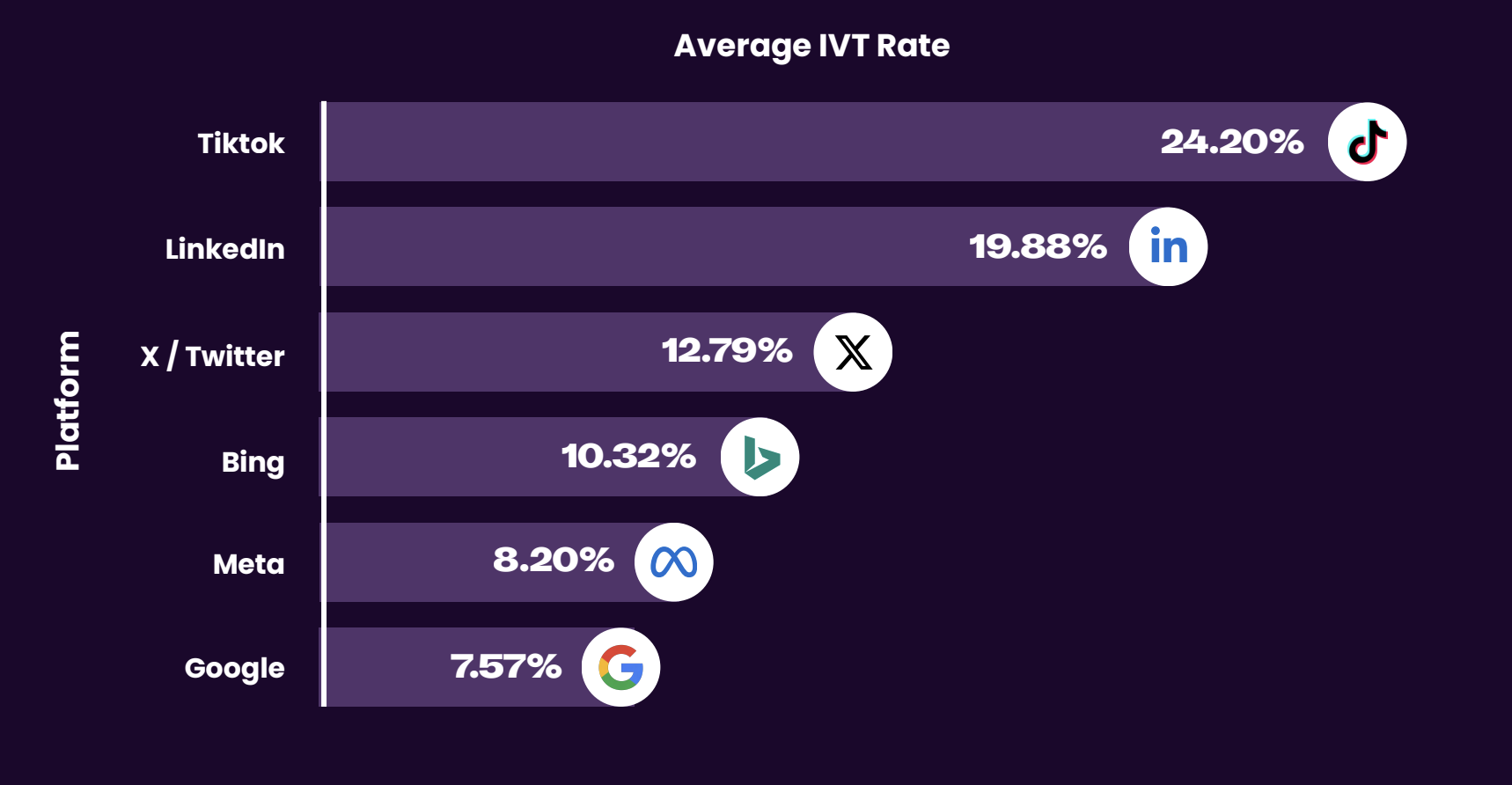
Click fraud on Meta is a significant issue due to the size and scale of the platform. While it has a relatively low rate of IVT, Meta still has a prolific problem thanks to the sheer volume of traffic it facilitates. High traffic volumes mean there’s a staggering amount of invalid traffic to contend with in absolute terms.
And let’s not forget that Meta is currently being investigated by the Supreme Court for allegedly inflating its potential reach metrics by up to 400%. Advertisers have accused Facebook and Instagram of significantly overstating the potential audience size advertisers could reach on the platforms. This in itself raises questions about the validity and quality of Meta’s traffic (and to what extent Meta is leveraging bots as part of its potential reach metric).
This isn’t the first time Meta’s been accused of defrauding advertisers. In 2016, they admitted to inflating average video ad view times by up to 80%, and paid out $40m to claimants.
So even if Meta’s IVT rate is relatively low, their track record for dealing with ad fraud isn’t great. And the data shows that advertisers are still hugely affected by IVT across Meta’s channels.
Watch this video for a more detailed comparison of IVT across all major ad platforms:
Why Meta ads are vulnerable to click fraud
Meta is an engagement machine, so it’s prime real estate for bots and fake users. Botnets, click farms, and even competitors can target your ads and generate endless fake clicks, draining your ad budget and feeding the algorithm with bad data (more on this later).
Aggravating advertisers isn’t great for business, even at a megacorporation like Meta. So what are they actually doing about it?
Meta has invested in some click fraud detection solutions. Here’s how Meta says they deal with the problem of “inauthentic behavior”:
“When we identify networks [of inauthentic assets], we remove the fake accounts, Pages, Groups or other Meta assets directly involved in the operation. In cases where these people also create, manage, co-opt, target or control Pages, Groups or communities that represent authentic entities not involved in the violating behaviour, we may take steps to remove the violating individuals, but allow the uninvolved people and communities to remain on our services.”
Post-click detection and profile blocking isn’t an ideal solution. For one thing, while the fake profile may eventually be removed, you’re still charged for the click. And as bots become more sophisticated, it’s much harder for Meta’s click fraud detectors to notice that they’re not real users.
This problem is further increasing thanks to the widespread adoption of AI. A 2026 cybercrime report claims agentic AI bot traffic rose by 450% in 2025, fuelling an 8% surge in global fraud attacks.
Additionally, Meta’s ad network extends far beyond Facebook and Instagram. It also places ads on third-party sites via its Audience Network, which vary massively in quality. This works in a similar way to Google’s Display Network, which is also rife with dodgy placements (that’s why it’s important to use a GDN placement exclusion list if you’re running display ads). Our research found some GDN domains had an average IVT rate exceeding 60%.
Meta’s third-party placements are likely to include similar made-for-advertising sites, where traffic quality is hard to verify. Anecdotal reports indicate lots of Meta advertisers excluding the Meta Audience Network from their campaigns, thanks to its low-quality clicks:
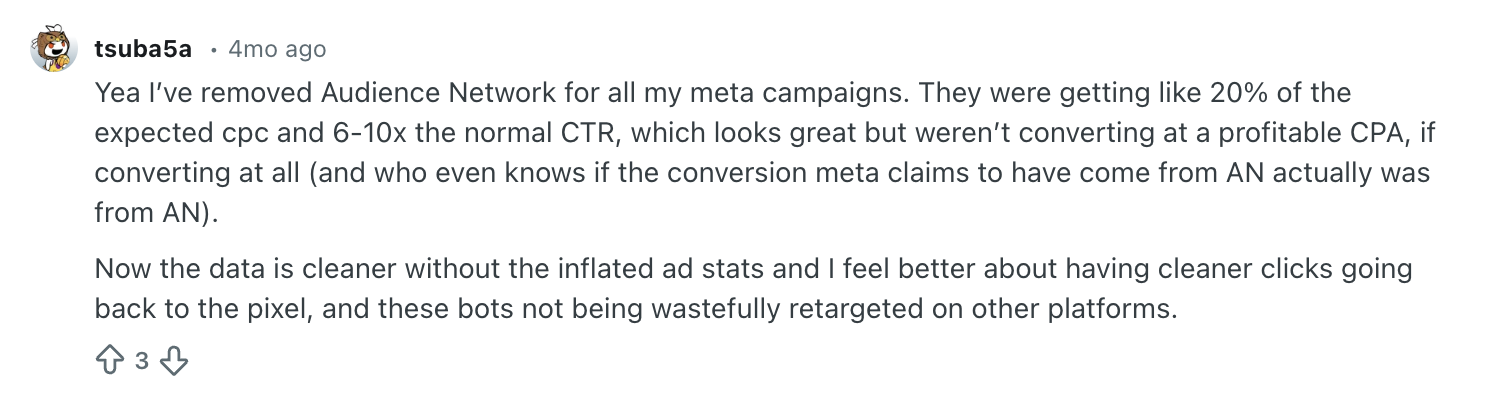

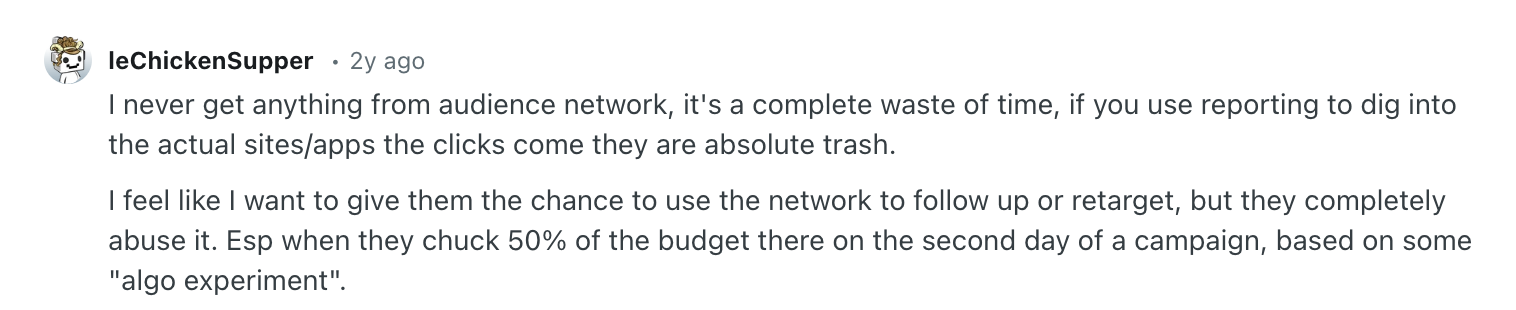
So Meta is vulnerable to click fraud for plenty of reasons: it’s a victim of its size and success, but it’s also not doing much to tackle the problem. And with reports indicating Meta actually profits from fraudulent ad activity, there’s not much incentive for them to do more, especially while it’s still one of the most-used ad platforms out there.
The real impact on campaign performance in 2026
Advertisers bear the brunt of Meta’s click fraud problem. With an average invalid traffic rate of 8.20% across Meta’s colossal user base, serious advertisers are likely to be losing thousands in wasted ad spend and lost revenue. As our CEO Nick Morley highlights:
“The return on ad spend for an invalid click is always 0:1. Even based on a conservative average ROAS of 3:1, this means every dollar lost to invalid traffic results in $3 of lost revenue opportunity. Added up over the course of a quarter or year, this often becomes incredibly costly.”
Let’s crunch the numbers. Advertisers who spend $10,000 a month on Meta ads are spending $820 on invalid clicks. Assuming a ROAS of 3:1, that means you’re actually missing out on $2,460 in revenue every month (in addition to the wasted ad spend). Over the year, that adds up to almost $40,000.
Our data estimates that invalid traffic cost advertisers $63 bn in 2025. And if you’re using Meta ads for lead gen, the issues mount up even further. Lead gen businesses face 32.07% higher IVT rates than transactional advertisers, so it’s not just ad spend that’s being wasted — it’s time and energy your sales team could spend following up on genuine leads.
Financial losses are just one of the ways IVT hits campaign performance. A more insidious effect of fraudulent clicks is the impact on Meta’s algorithm.
Like other ad platforms, Meta uses machine learning to understand your audience, then show your ads to other similar users. In theory, this broadens your reach without compromising on audience relevance.
But when invalid clicks build up, the algorithm gets distorted. It starts to see bots and fake users as desirable users and tries to target more of them, creating a negative feedback loop that amplifies your problem. The more invalid clicks you have, the more revenue you lose.
6 warning signs your Meta campaigns have an IVT problem
Invalid traffic is widespread on Meta, but not all industries or businesses are affected equally. So how can you tell if your Meta ads have an IVT problem?
Your data dashboards hold the information you need. These six warning signs can indicate IVT activity on your Meta campaigns:
- High click-through rate but low conversions — A spike in real users should see a corresponding increase in conversions. If conversion rates don’t increase alongside clicks, this could indicate click fraud (assuming everything in your campaign is unchanged).
- High click volume on Ads Manager but low session volume on Google Analytics — Bots don’t tend to hang around after the click, so while Meta registers the interaction, Google doesn’t pick up on it. Cross-reference data in each platform regularly so you know what’s normal for your account.
- Very short sessions and high bounce rates — Sessions that are just 1-2 seconds long can indicate bot activity, as can unexpectedly high bounce rates from your landing page (again assuming you haven’t made any major changes to it).
- Spam form submissions — Advertisers running lead gen campaigns may see an uptick in spam form fills.
- Traffic from unusual locations — You may see a significant increase in traffic from locations outside your expected audience base or geographical targeting.
- Sudden unexplained spikes in click volume — Some attacks can result in a massive spike in clicks that isn’t related to optimized assets or audiences.
Seeing one of these indicators doesn’t always mean you have a widespread IVT problem on your Meta ads. But at the very least, you’ll need to spend time investigating the data, and may need to take further action if you suspect click fraud.
Is Meta tackling the problem?
Meta has taken some action to tackle click fraud, though progress has been slow. And some users speculate that Meta’s bot detection measures are actually getting less effective over time.
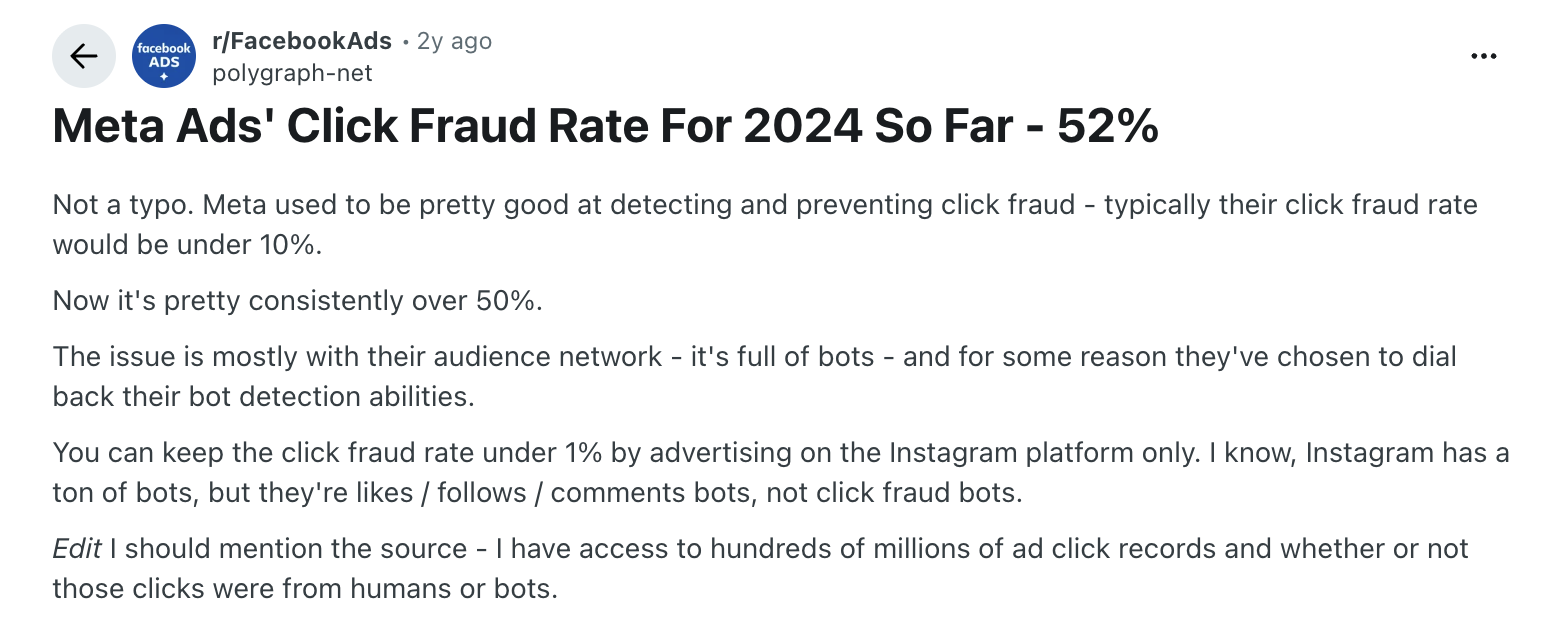
Like most ad platforms, Meta has some rudimentary filters that prevent some invalid activity. For example, it can filter out activity from bots with known IPs, as well as accidental duplicate clicks and obvious automation patterns.
But more sophisticated bots (known as “soft invalids”) slip through the net. Their behavior is convincing enough to evade detection by Meta’s built-in filters, so they can corrupt audience signals and compromise conversions. What’s more, Meta won’t always refund you for soft invalid clicks they’ve failed to detect.
Ultimately, there’s no real incentive for Meta to do more to tackle click fraud. They benefit financially from high click volumes, and IVT contributes to this. Rumours in some tech circles suggest big ad platforms (like Meta and Google) are pretty much enabling IVT for this reason. But as we’ve seen in our research, no other platform is tackling it any better — so advertisers have no real choice but to continue buying these ads.
5 ways to protect your ad spend on Meta
So if Meta isn’t going to protect your ad spend, what can you do to stop IVT from undermining your ROAS? Let’s take a look at five ways to tackle IVT and protect your ad spend on Meta.
1. Audit your traffic quality independently
Most ad platforms inflate their own success, so it’s pretty standard to see higher click volumes on your Ads Manager dashboard versus, say, Google Analytics. So it’s important not to overrely on the data Meta is giving you.
Cross-reference your Meta data with sessions reported on GA4. If there’s a substantial difference, it’s possible your Meta clicks are being inflated by IVT. So you’ll know you need to take action.
2. Exclude Meta’s Audience Network from campaigns
Meta’s Audience Network is notorious for poor-quality third-party placements that expose your ads to much higher volumes of IVT. Many advertisers choose to exclude the Audience Network from their campaigns for this reason.
Excluding the Audience Network can slightly increase your cost-per-mille. You’re now paying for higher quality placements, so impressions cost a bit more. But this is a trade-off most advertisers will accept for higher conversion rates among real users.
3. Optimize for conversions over clicks
Optimizing for conversions (such as purchases or qualified leads) rather than clicks can help the algorithm better understand what real value looks like to your brand. So instead of chasing lookalike clicks that may be invalid, Meta’s algorithms are forced to look further afield for signals that indicate more downstream potential.
4. Leverage first-party data (and check for spam leads)
Clean data is essential for maintaining the health of your targeting algorithms. Feeding first-party data into Meta can help it learn more about who you want to see your ads.
Additionally, if you’re using Meta ads for lead gen, check new form submissions against your CRM data to flag any junk or spam leads. This will save your sales team time chasing up on fake users.
5. Use a dedicated IVT protection platform
While Meta’s built-in filters remove most of the obvious fraud, third-party invalid traffic detection tools like Lunio identify and block the sophisticated invalid activity that has a real impact on your campaigns.
Lunio uses machine learning to detect IVT and stop invalid users from interacting with your ads in real-time, so it’s caught before the click. We then build audience exclusion lists and apply them to your campaigns, so IVT is blocked before it interferes with your campaign performance.
You don’t need to spend time requesting refunds and trawling through your data — everything happens behind the scenes.
Elevate your Meta campaign performance with Lunio
With such massive reach, Meta is one of the world’s most powerful ad channels. But siphoning off more than 8% of your ad spend with no return is damaging for campaign performance, so it’s essential for advertisers to tackle the problem of IVT.
Advertisers who win big on Meta aren’t just those with the best creative. They’re those who are diligent about their data hygiene, which enables Meta’s powerful algorithms to actually work.
Lunio makes it easy to keep your data clean and reduce wasted ad spend. By eliminating invalid clicks, Lunio helps maintain a positive feedback loop within your Meta campaigns, and prevents fake users from draining your budget on worthless clicks, boosting performance and increasing ROI.
To find out how much IVT is affecting your Meta campaigns (and any other PPC campaigns you run), book your free 14-day traffic audit.

Table of Contents
On average, 8.51% of your ad budget is wasted.
But that number can be much higher. Find out how much you're spending on bot traffic.